We built RawMktg because we kept finding the same thing across every audit: brands absent from AI answers with no way to see why. This is the research it came from, 47 teardowns and playbooks, 51 free tools and a versioned methodology. See the product →
B2B marketing intelligence for the AI era.
Buyers are asking ChatGPT, Perplexity and Gemini which vendor to use. We dig into who shows up in the answer, who doesn't, and why, using real data across real B2B verticals.
Search has quietly moved. Most companies aren't in the room.
The buyer who used to type a query into Google and scan ten blue links now asks an AI assistant a direct question, such as "what's the best container-tracking software for a mid-market freight forwarder?", and acts on the three names it returns. The vendors in that answer win. The ones who aren't get no second look.
rawmktg. is where we publish what we find when we measure that gap. We pull citation data across ChatGPT, Gemini, Perplexity, Google AI Overviews, Copilot and Grok, line it up against the SEO fundamentals underneath, and write up what actually separates the brands AI recommends from the ones it ignores.
The recurring finding, vertical after vertical, is the same: most companies aren't in the room. In the AEC software space, four of six vendors had fewer than two AI citations combined. In senior living, one brand was being misclassified by AI at the exact moment of highest buyer intent. The pattern holds across CX SaaS, autonomous retail and container tracking. A visibility moat sitting wide open because almost nobody is building it yet.
No theory for its own sake. Every piece here is either built on data we ran, or on the published research that holds up when you check it. If a tactic doesn't move citations, it doesn't make the page.
The industry teardowns
We pick a B2B vertical, pull the AI-citation and SEO data across the main players, and show you exactly where the visibility gaps are. Same method every time. These are the clearest illustration of what this site is about.
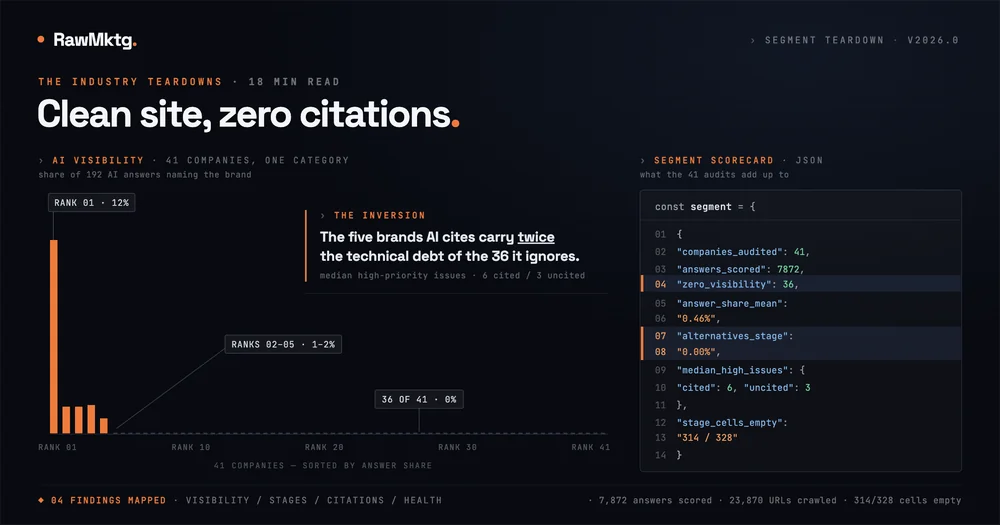
41 investing and wealth companies scored on four AI tools: 36 of 41 got zero AI citations, and the five that appeared ran the messiest sites. Why retrieval is a gate, not a ranking factor.
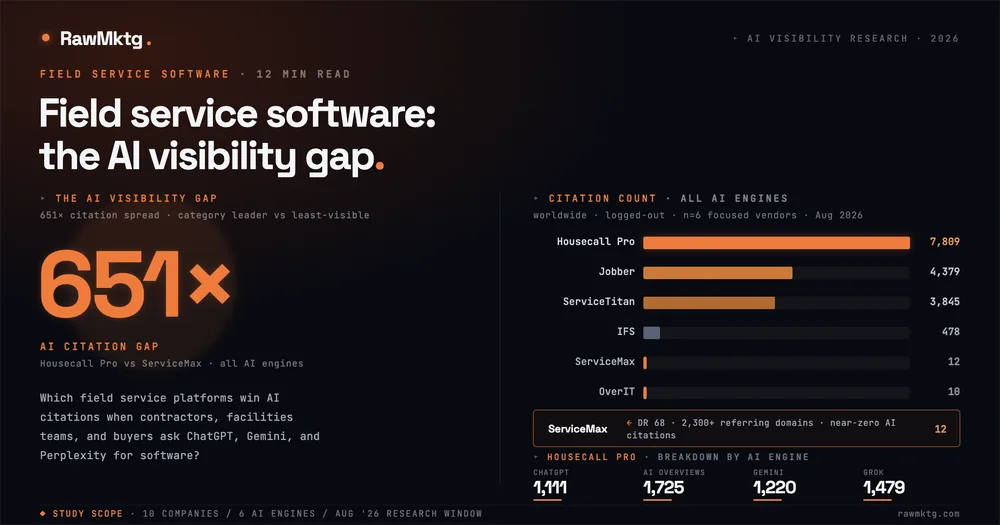
A teardown of 10 field service management platforms: why authority isn't traffic, the branded-demand trap, AI citations across 6 engines, and a 90-day playbook.
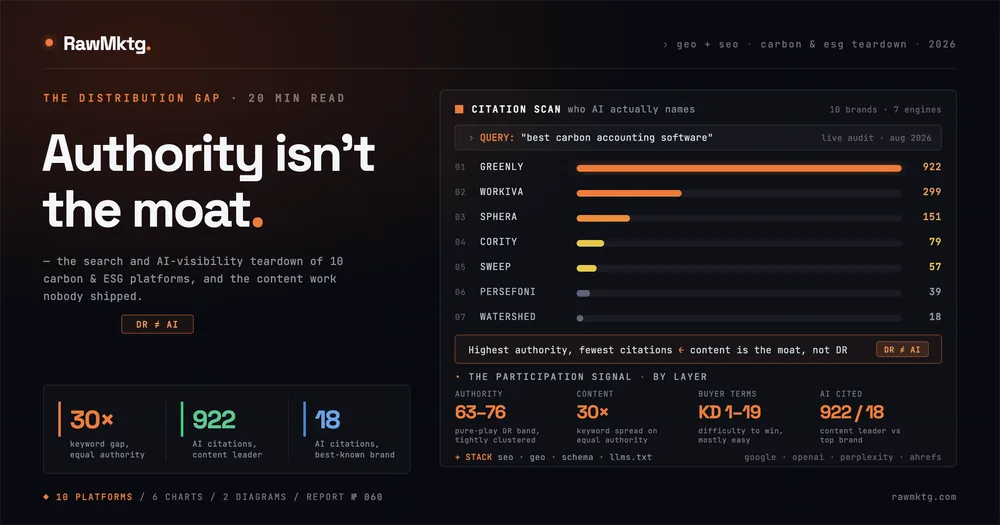
A search and AI-visibility teardown of 10 carbon and ESG platforms: why authority isn't the moat, content is, and the GEO playbook to win.
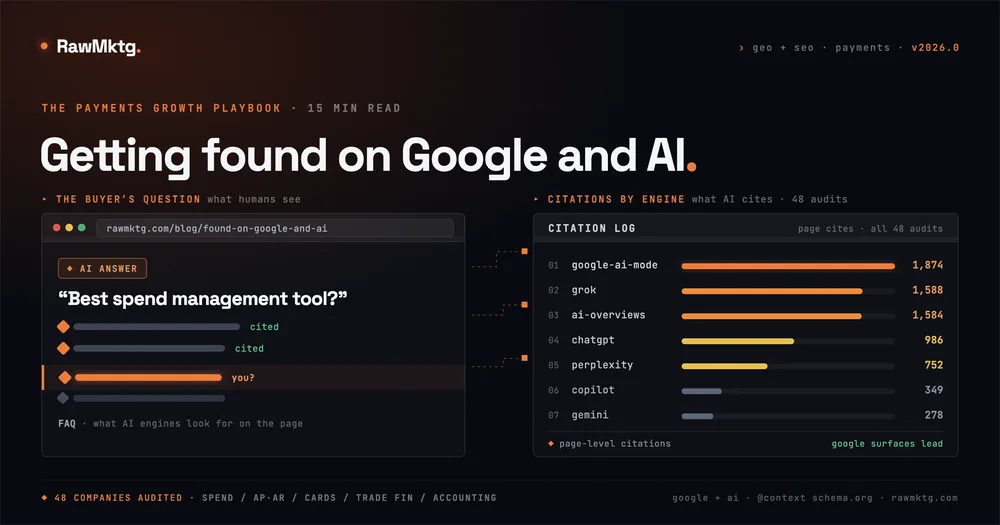
A payments marketer's playbook from 48 fintech audits: why discovery doubled, how brands win their name but lose the category, and the 90-day plan to get found on Google and AI.
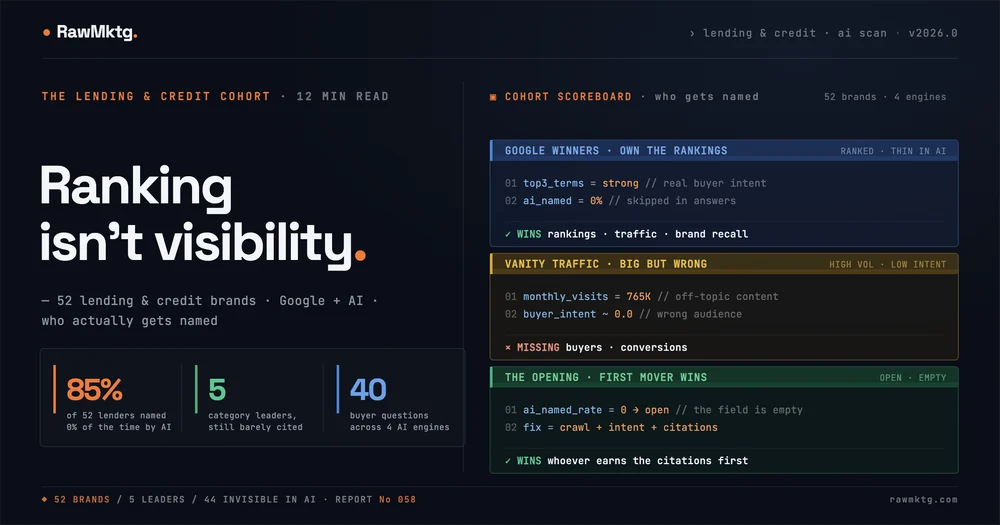
An audit of 52 lending & credit brands: 44 named 0% of the time by AI. Why ranking isn't visibility, where AI answers come from, and the full-funnel fixes.
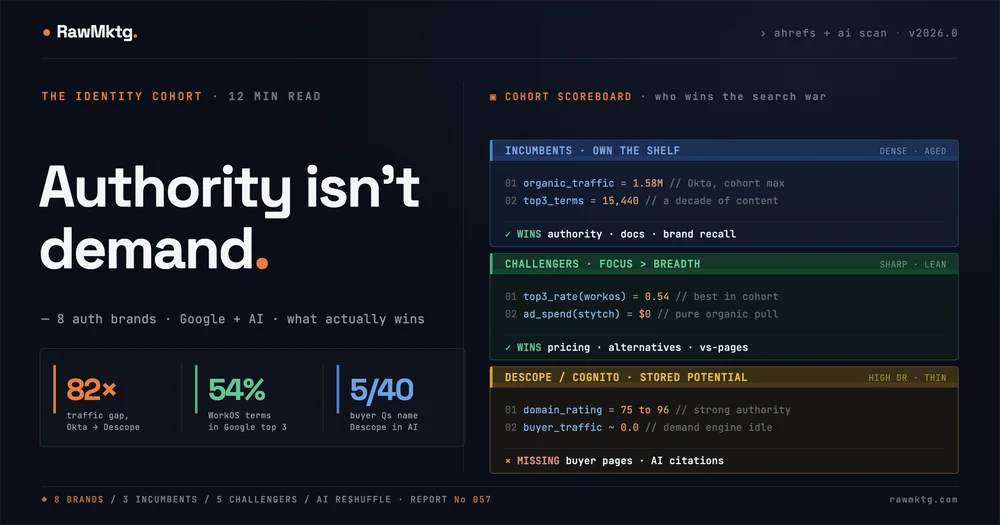
An 8-brand teardown of the identity cohort (Okta to Cognito): why DR-75 Descope wins almost no buyer demand, why AI names MojoAuth over Okta, and the demand engine that converts authority.
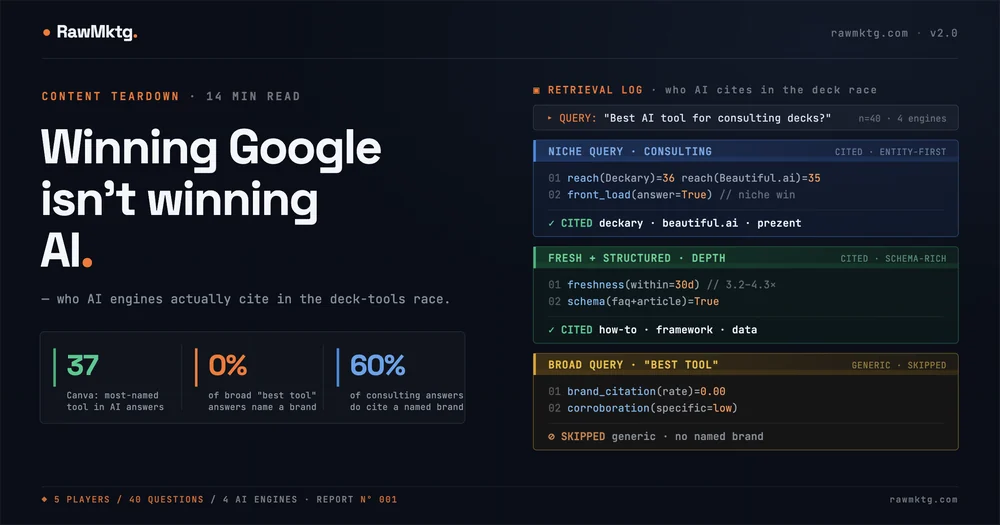
A teardown of the AI deck-tools market: Gamma owns Google, but Canva, Deckary and Beautiful.ai win AI answers, and why niche questions are where brands get named.
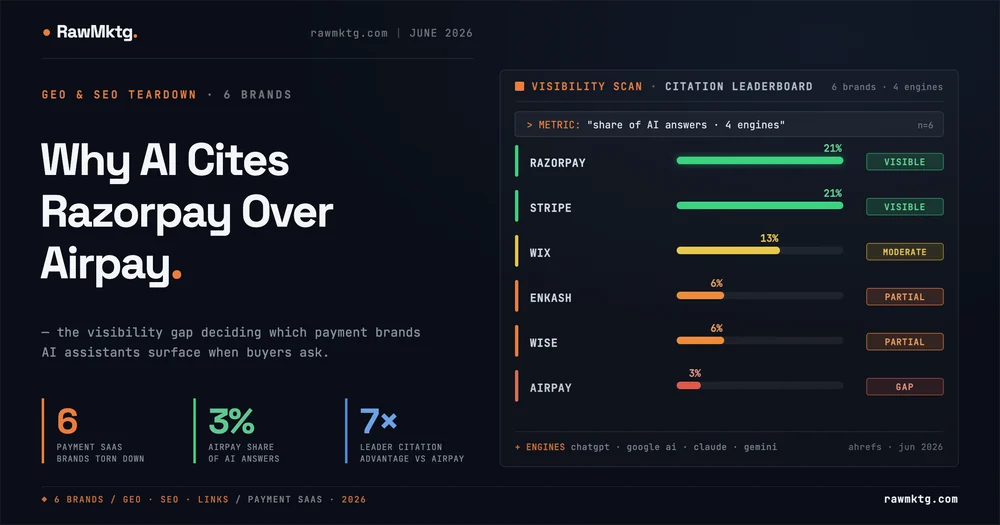
A six-brand teardown of India's payment gateways: why Razorpay and Stripe each win ~21% of AI answers while Airpay sits at 3%, and the content, trust and crawl gaps behind it.
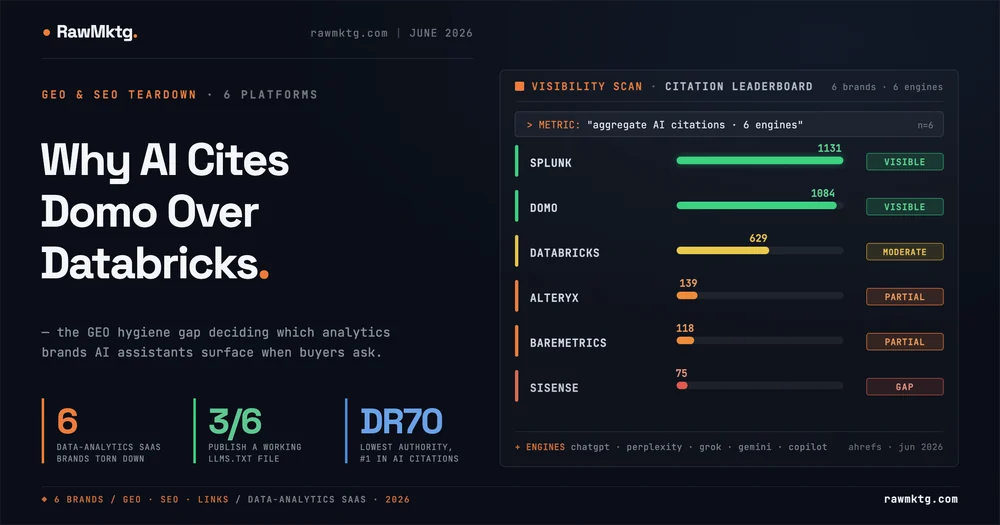
A six-platform teardown of data-analytics SaaS: why a DR-70 brand out-cites a DR-88 one, and the GEO hygiene gap behind it.
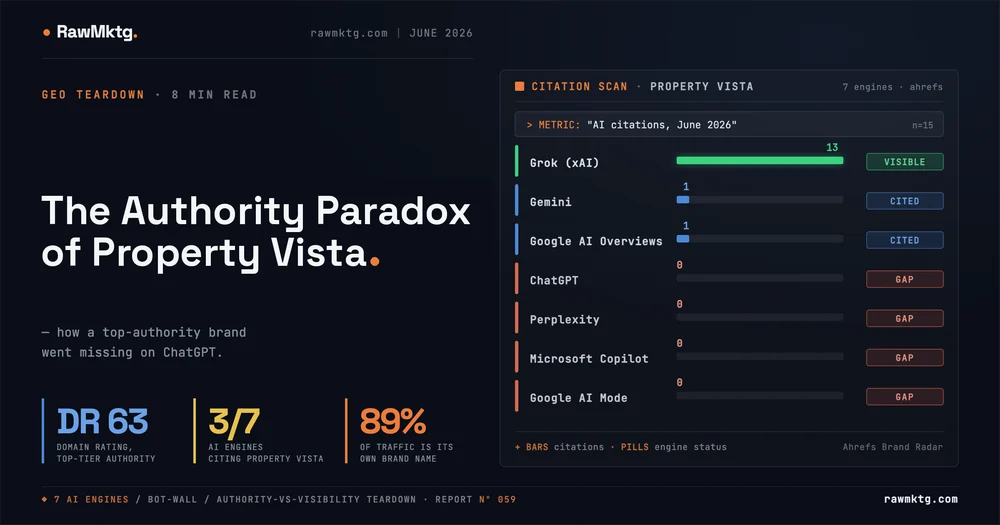
A DR-63 brand with G2, Gartner and Crunchbase backlinks that is nearly invisible on ChatGPT and Perplexity, and the one infrastructure fix behind it.
How AI search actually works
Before the tactics, the mechanism. How retrieval-augmented generation decides what gets pulled into an answer, why each engine recommends different vendors, and how visibility compounds once you have it.
An AI agent shopping for your customer never sees your storefront, it reads a feed and a few fields, then decides whether to surface, compare or buy your product. How to be in the set it chooses from.
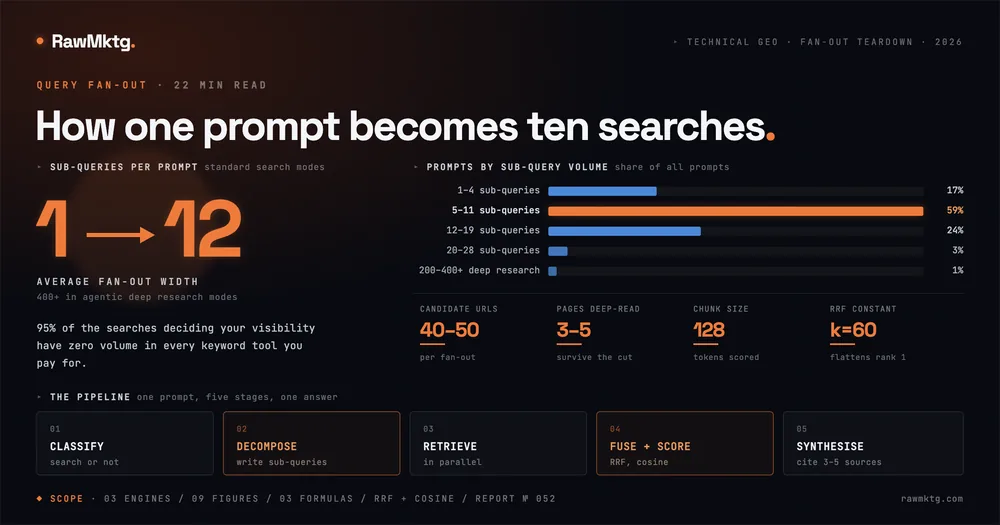
How AI search turns one prompt into 8-16 hidden sub-queries, the RRF and cosine math that decides citations, and why 95% of the searches that matter have zero keyword volume.
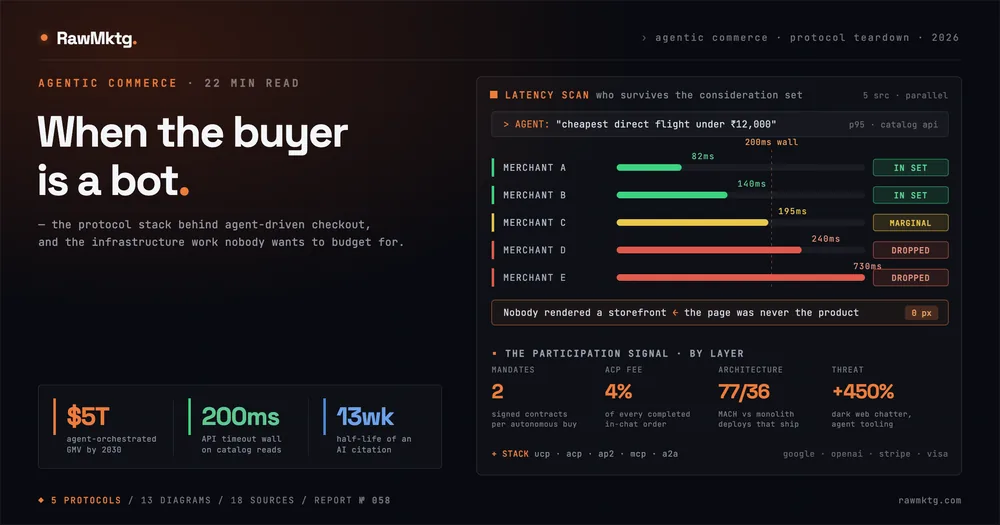
When the buyer is an AI agent, your catalog API is the product, not your homepage. The agentic-commerce protocol stack (UCP, ACP, AP2, MCP, A2A) and the infrastructure to win.
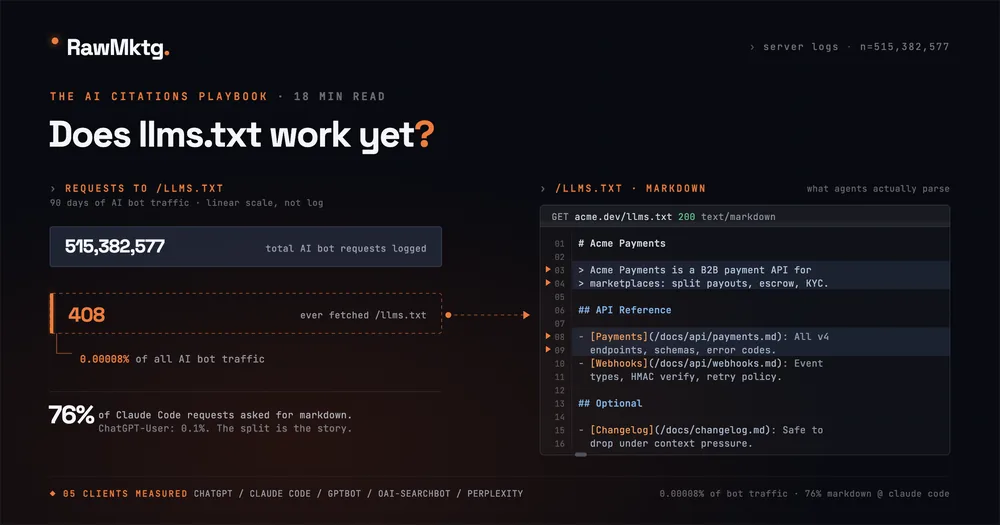
515 million AI bot events, only 408 touched llms.txt. Search crawlers ignore the file; coding agents devour it. What the server logs prove, and what to actually ship.
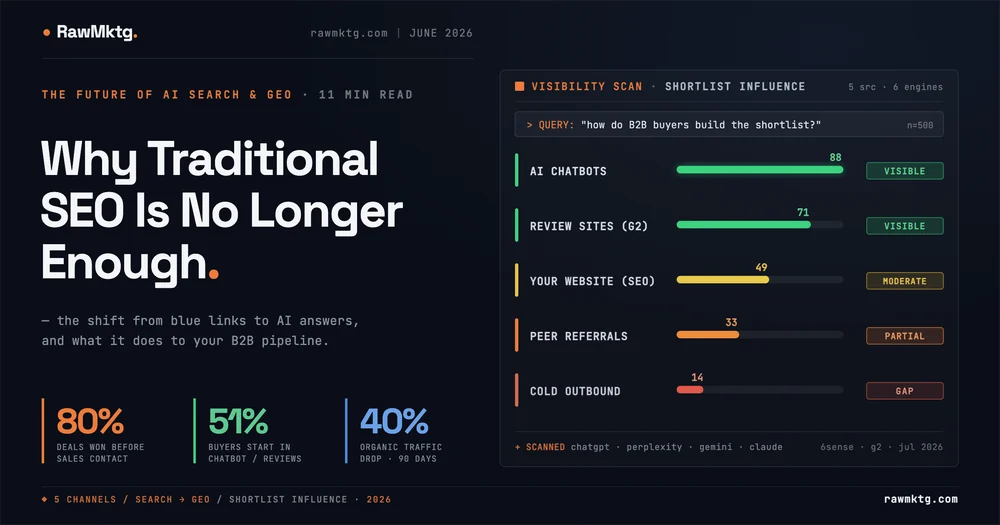
80% of B2B deals go to the vendor favored before sales contact, and chatbots now shape the shortlist. The shift from blue links to AI answers, what RAG rewards, and a 90-day GEO roadmap.
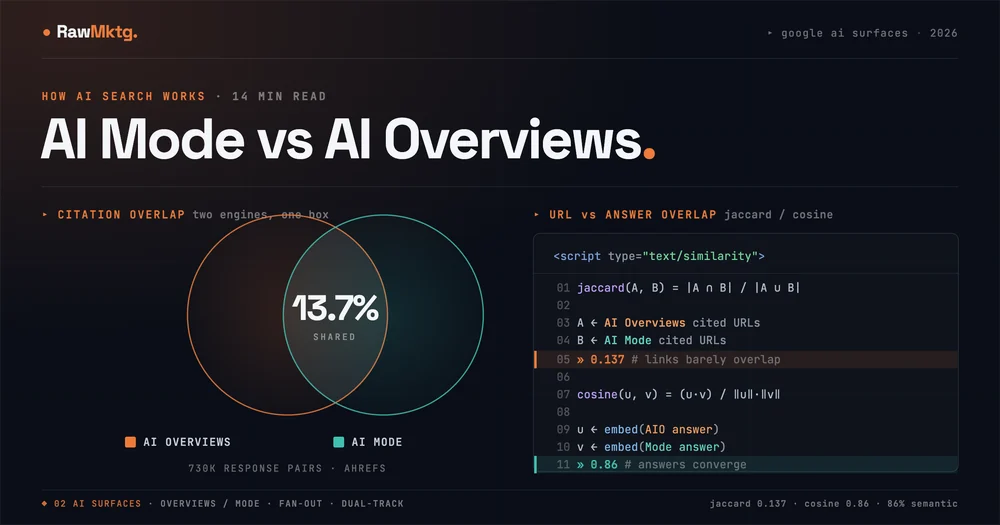
Google split search into two AI surfaces that share a query box but agree on sources just 13.7% of the time. The architecture, query fan-out, and the dual-track playbook.
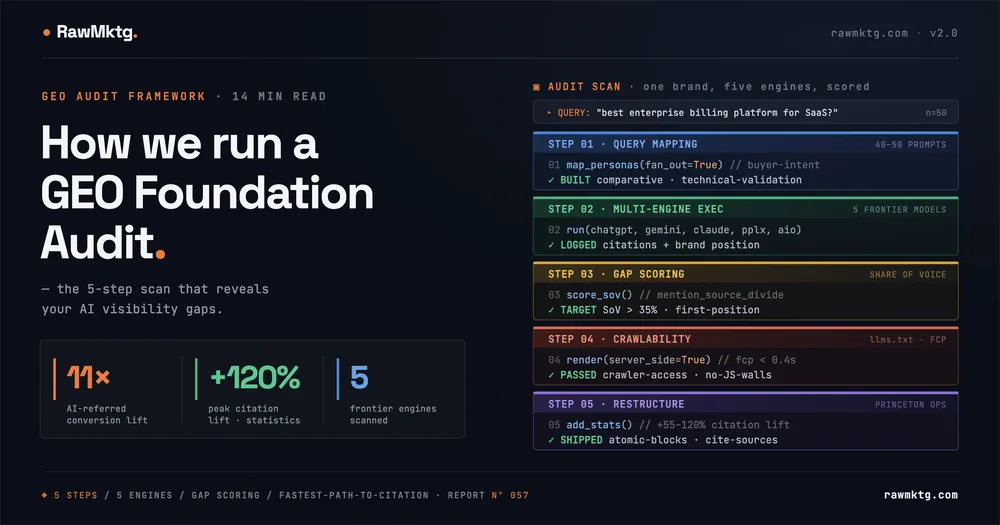
AI converts at 11x organic, but your analytics can't see it. The five-step diagnostic: query mapping, multi-model execution, citation gap scoring, crawlability, and content restructuring.
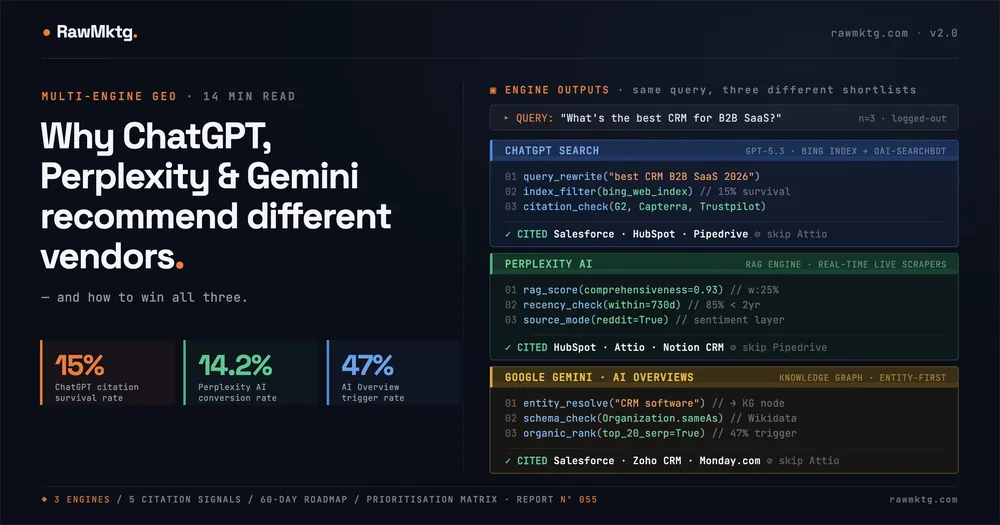
69% of B2B buyers use 3 or more AI engines. ChatGPT leans on Bing's top 15%, Perplexity scores 5 real-time RAG factors, Gemini resolves entities first. Tactics and a 60-day roadmap.
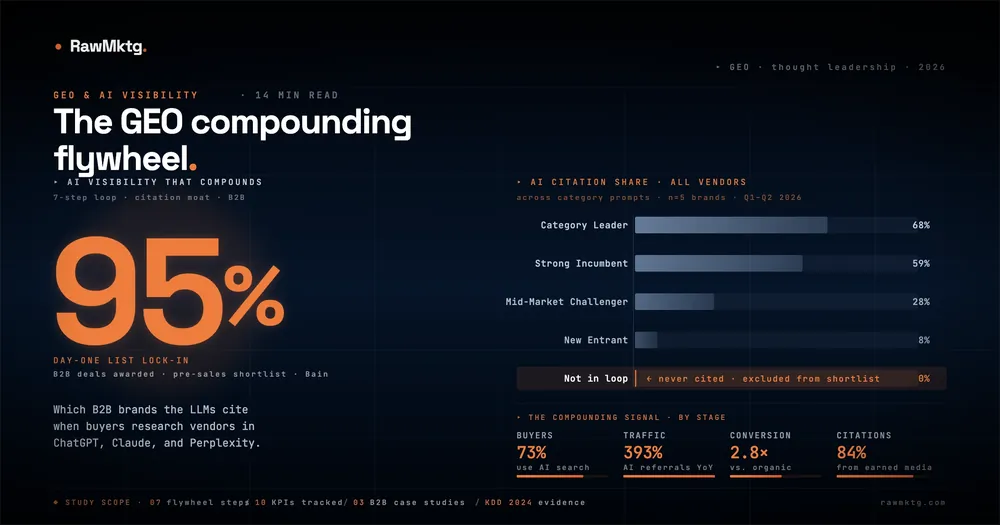
73% of B2B procurement managers use AI for vendor discovery. The seven-step loop that decides who gets cited, and why first-mover advantage compounds in AI search.
The five-stage AI search pipeline, what the Princeton and Georgia Tech GEO research actually shows, and a three-phase action plan for B2B marketers.
The technical layer
What the crawlers can and can't do, and the structured data that makes your pages legible to them. The unglamorous plumbing that decides whether you are even eligible to be cited.
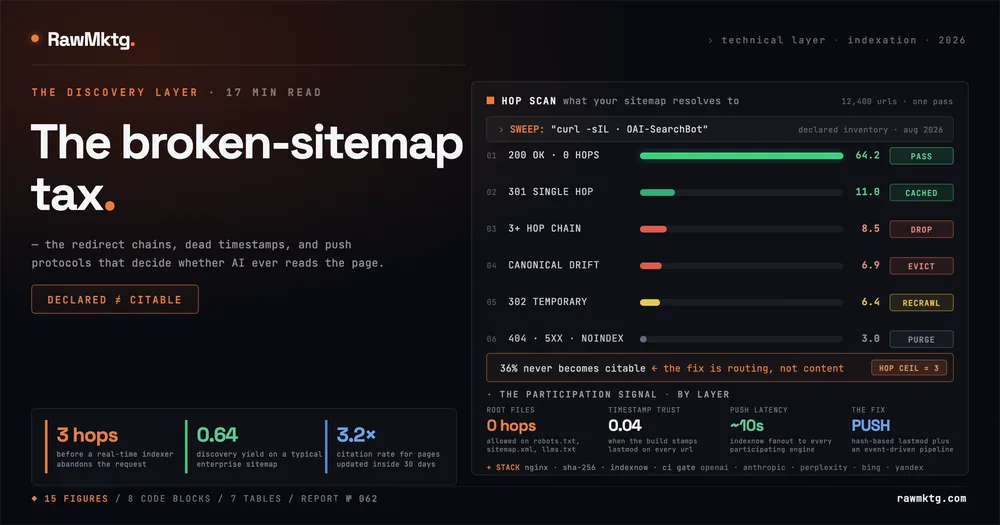
Real-time AI indexers quit after 3 redirect hops and read lastmod as a schedule. The hop ceiling, cache-instruction status codes, honest timestamps, and IndexNow push.
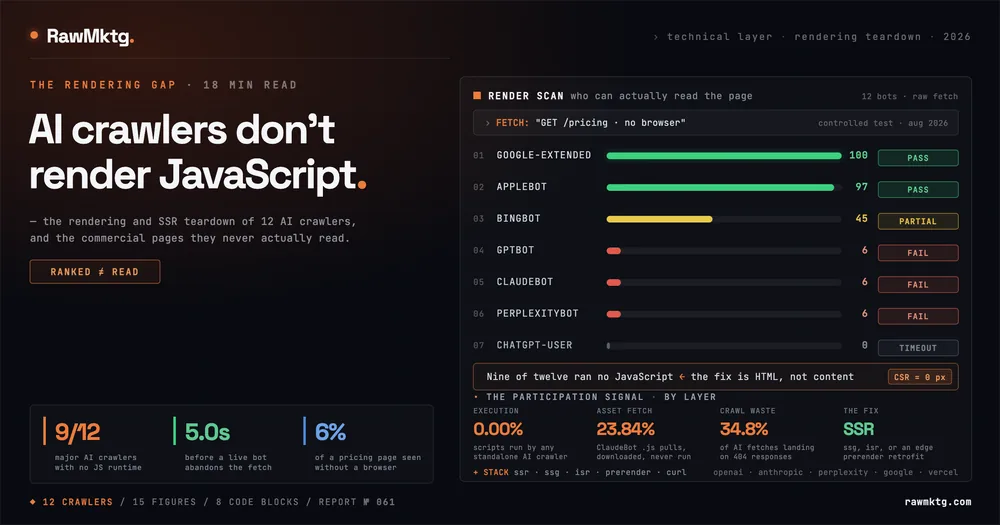
9 of 12 major AI crawlers run no JavaScript runtime. The per-crawler pass/fail data, the Content Visibility Ratio test, and four SSR fixes.
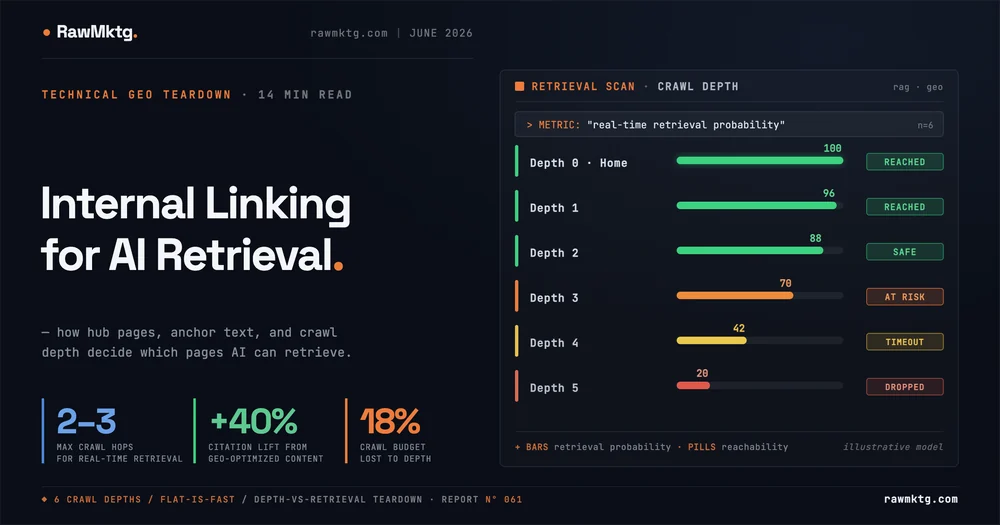
How hub pages, anchor-text density, and a flat 2-3 hop crawl depth decide whether your pages are retrieved in a RAG query chain.
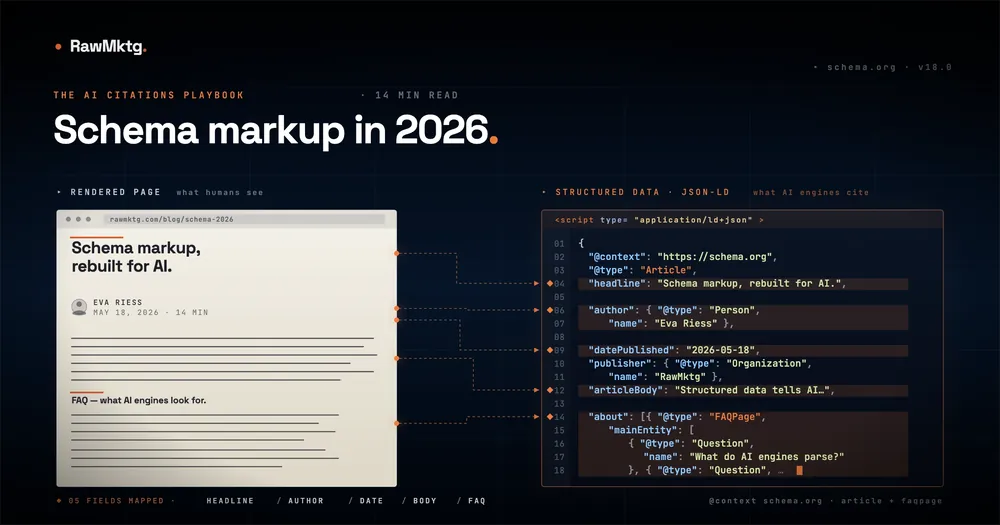
53% of AI-cited pages carry valid schema. The @graph architecture, four core B2B schema types, and a six-week implementation roadmap.
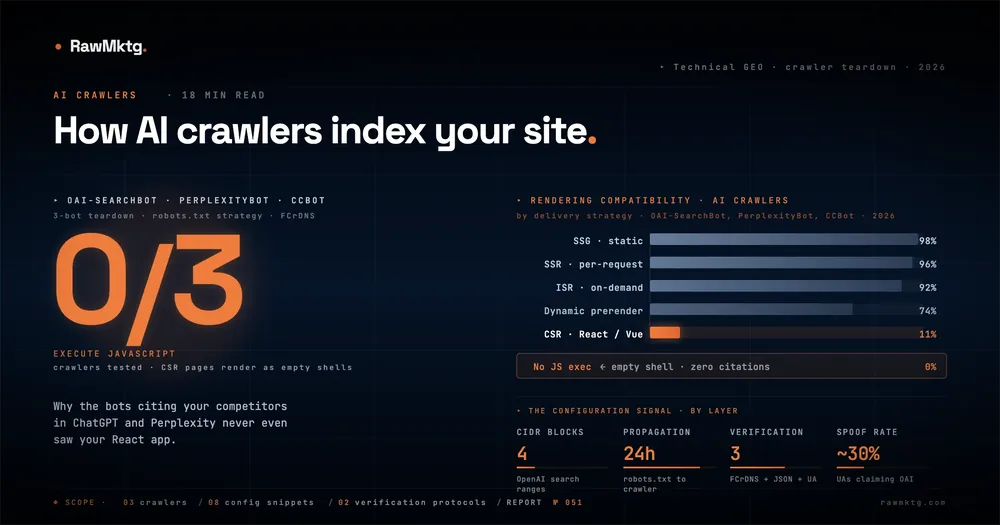
0 of 3 AI crawlers execute JavaScript. The breakdown of crawl logic, IP verification, and the robots.txt config that separates citation indexers from training harvesters.
Content & authority architecture
How to structure pages and off-site signals so AI trusts and retrieves them: the cluster models, the page anatomy, and the trust signals that correlate with citations.
YouTube is the 4th most-cited domain in AI answers and overtook Reddit as the top social source. Since models read the transcript, not the pixels, here's how to make your video the one AI quotes.
Buyers ask AI what things cost. If your price is trapped in an image, a widget, or a 'contact us', the model quotes a competitor or invents a number. How to write the page it lifts instead.
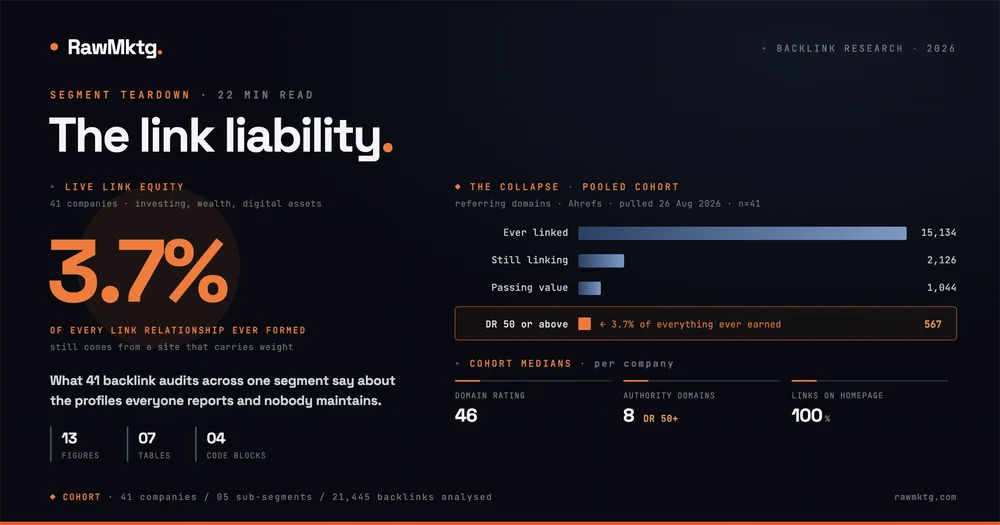
The Investing & Wealth cohort: 41 backlink audits across investing, wealth and digital assets, read as one dataset. Only 3.7% of every link relationship ever formed still carries authority.
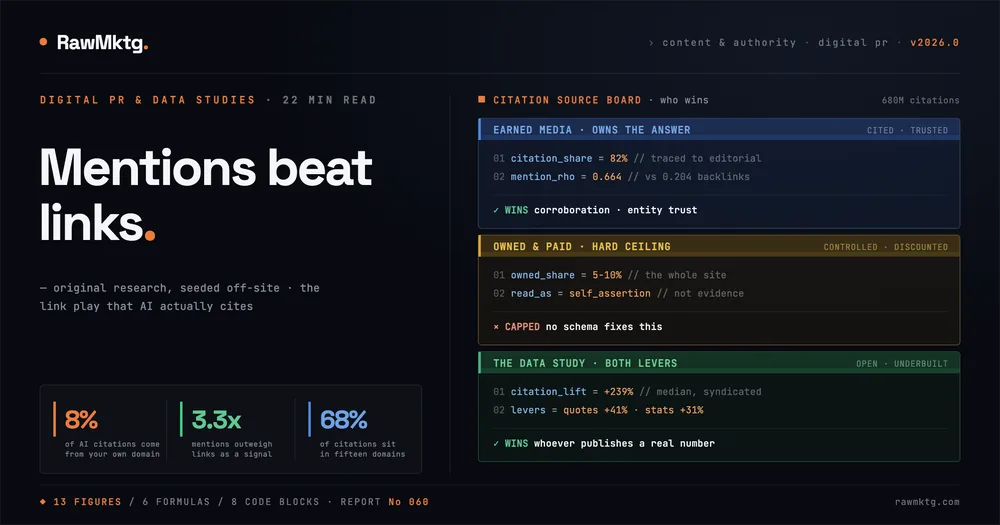
Your domain is under 10% of AI citation sources. Original research seeded off-site is what generative engines actually cite, plus the study spec and a 90-day play.
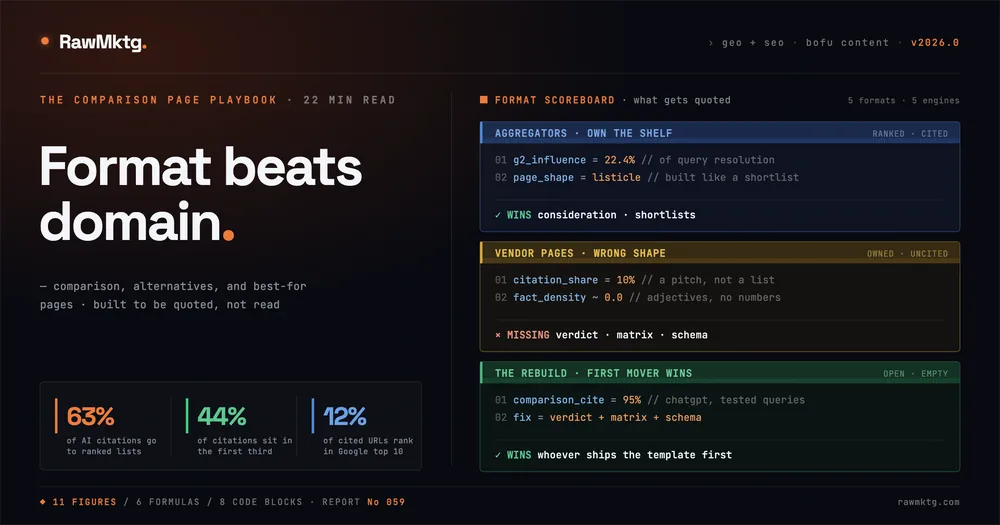
63% of AI citations go to ranked lists; only 12% of cited URLs sit in Google's top 10. The comparison-page playbook: verdict box, fact density, schema, and a 90-day sequence.
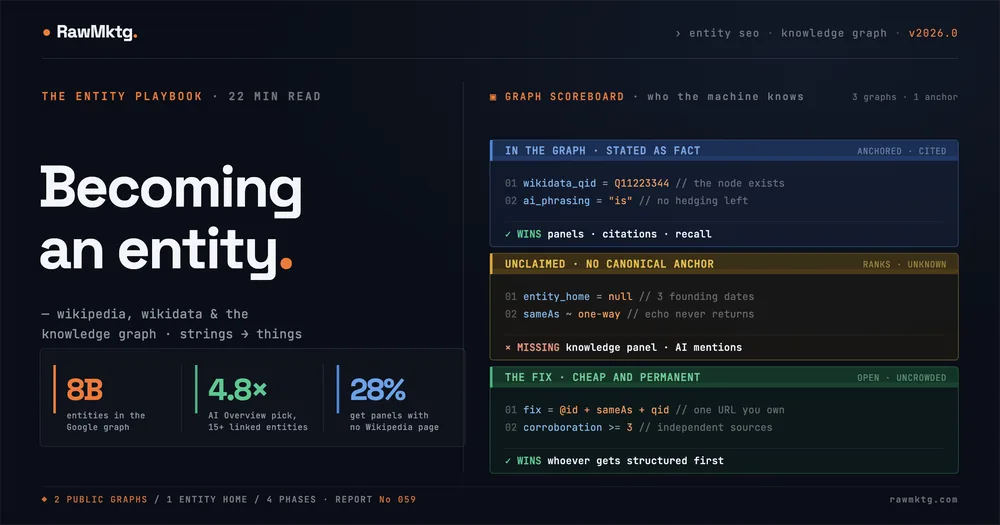
Search moved from strings to things. The build guide for becoming a recognized entity: the Entity Home, Wikidata, sameAs corroboration, and a 12-month sequence.
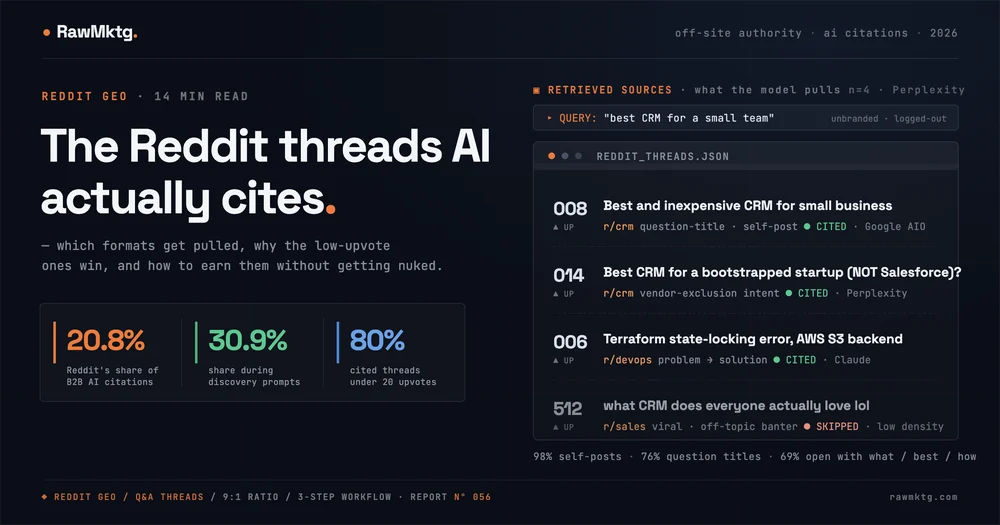
Reddit drives 20.8% of B2B AI citations. Which threads AI cites (80% have under 20 upvotes), how each engine reads Reddit, and the 9:1 workflow to earn citations without getting banned.
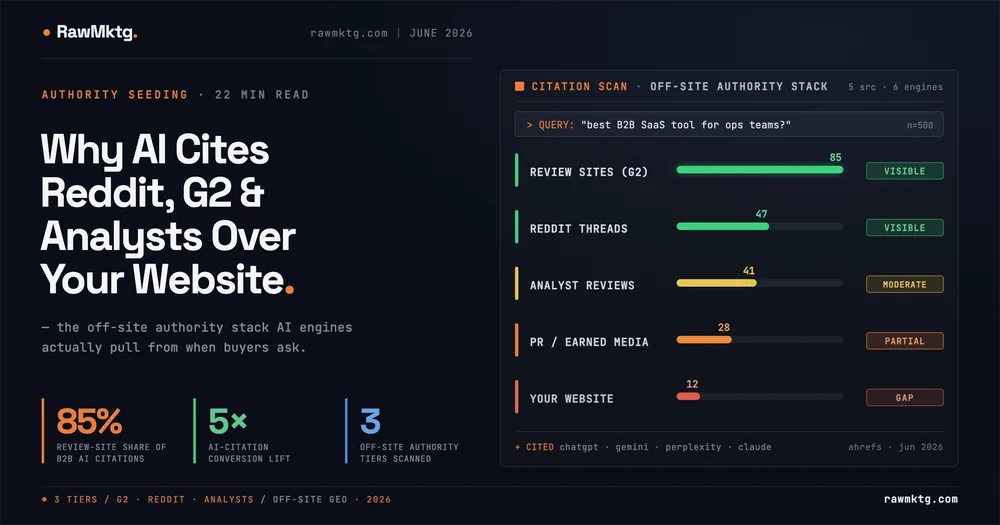
The off-site authority stack AI engines actually pull from, and how to seed G2, Reddit and analyst reviews so they feed AI answers.
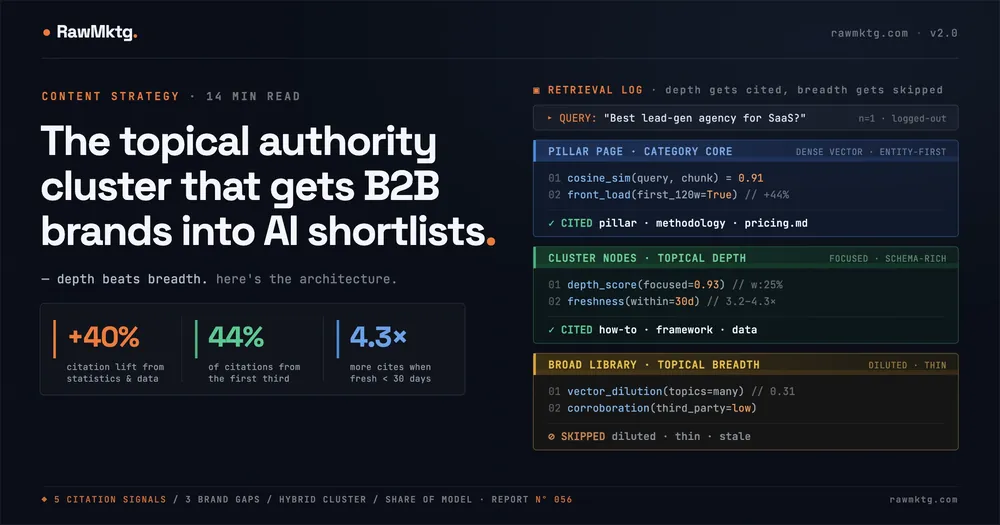
+41% citation lift from statistics, 86% of citations from brand-managed sources. The hybrid cluster architecture and Share of Model measurement framework.
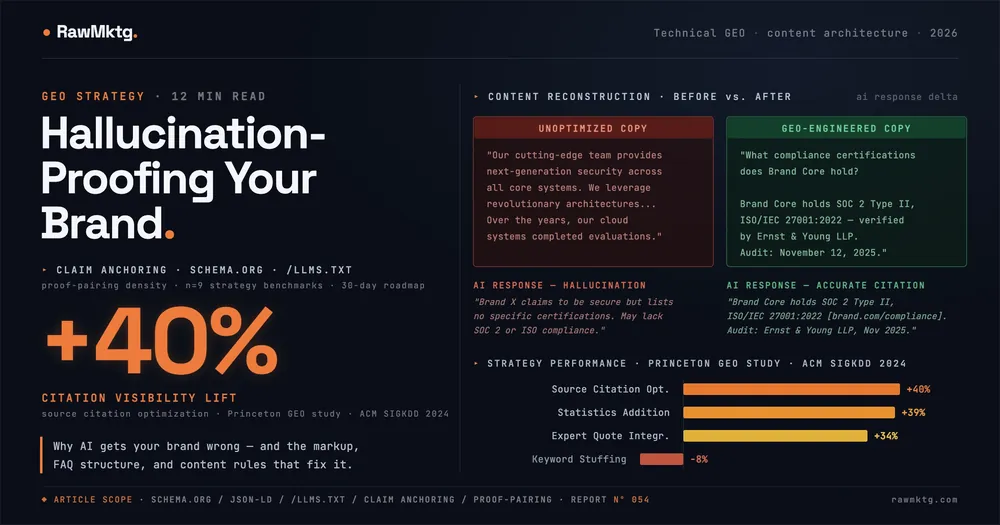
+41% citation lift from statistics; 54% fewer hallucinations with knowledge graphs. Schema @graph, /llms.txt, Answer Capsules, and Proof-Pairing Density.
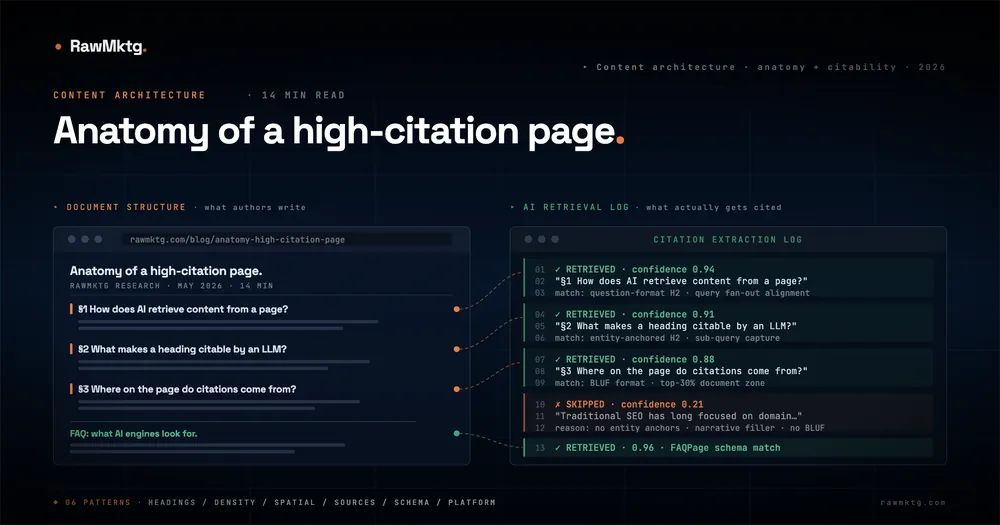
38% top-10 overlap; 55% of citations come from the first 30% of the page. What heading structure, paragraph density, and answer-lead formatting look like on cited pages.
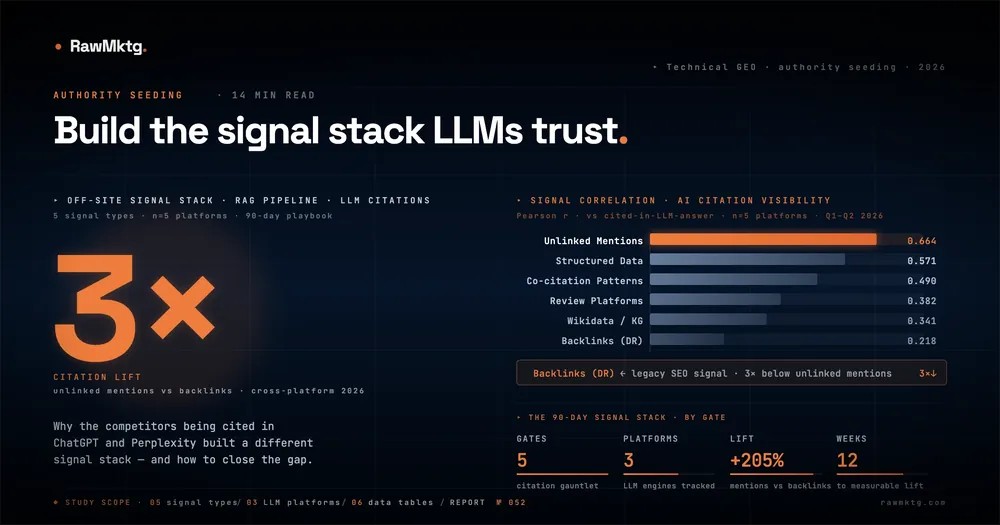
Unlinked mentions correlate at r=0.664 vs r=0.218 for backlinks. The five-gate citation gauntlet, platform profiles, and a five-phase execution blueprint.
Ranking signals & measurement
The signals that decide whether you hold a citation or lose it, and how to actually measure any of this when your analytics can't see most AI traffic.
An honest 2026 comparison of the platforms that track whether AI answers cite your brand, Profound, Peec, Otterly, AthenaHQ and the rest, with published pricing and which to buy by profile.
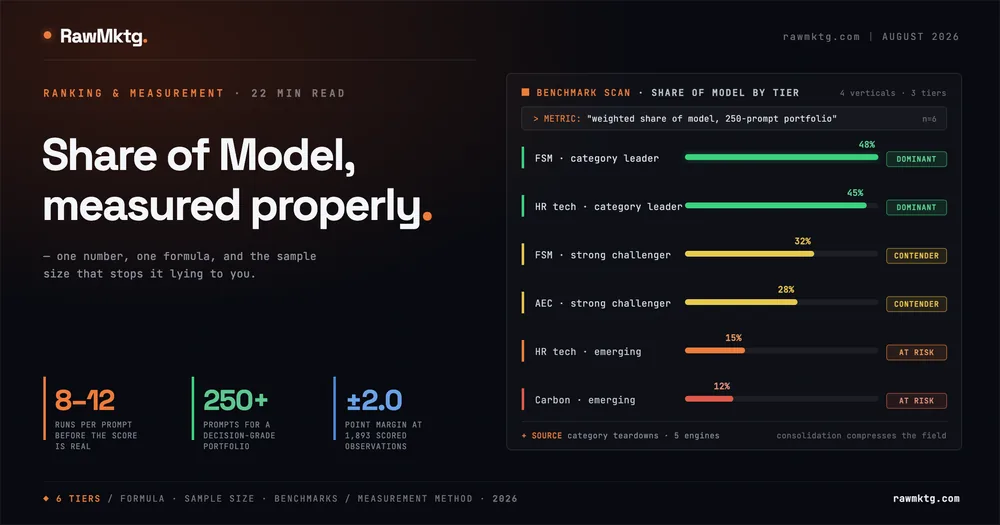
The formula, the sample size that makes it stable (8-12 runs, 250-500 prompts), and benchmark bands by vertical. The metric that replaces the screenshot.
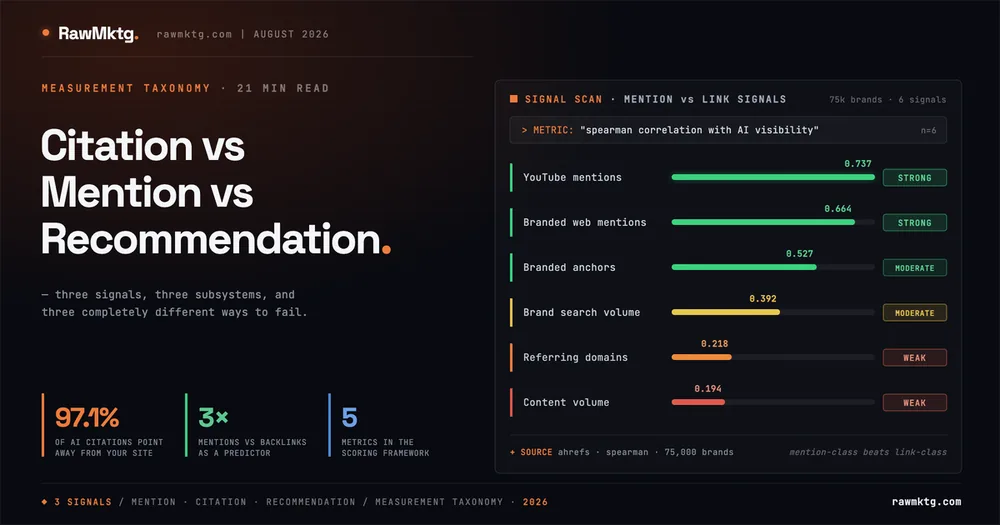
Mentions, citations and recommendations are three different AI-search signals with three different fixes. The taxonomy, the math, and what the data shows.
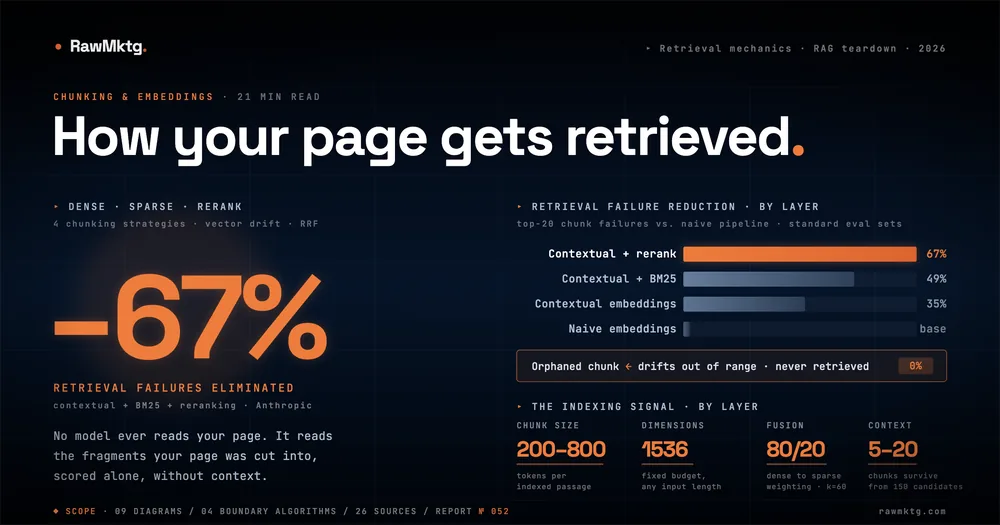
AI engines never read your page, they read chunks of it, scored alone. How chunking, embeddings, vector drift and reranking decide what gets cited, and how to write for it.
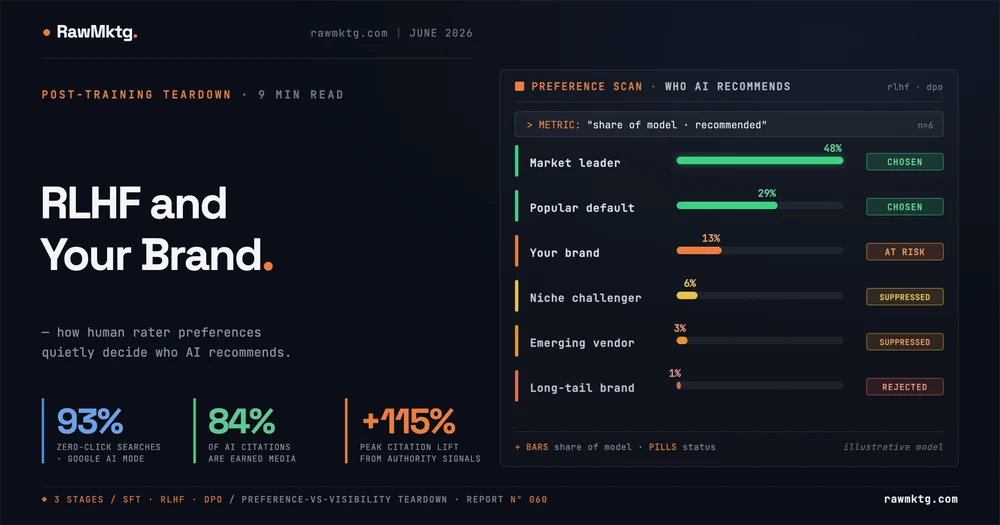
How human rater preferences in RLHF and DPO quietly decide which brands AI recommends, and the GEO playbook to win Share of Model.
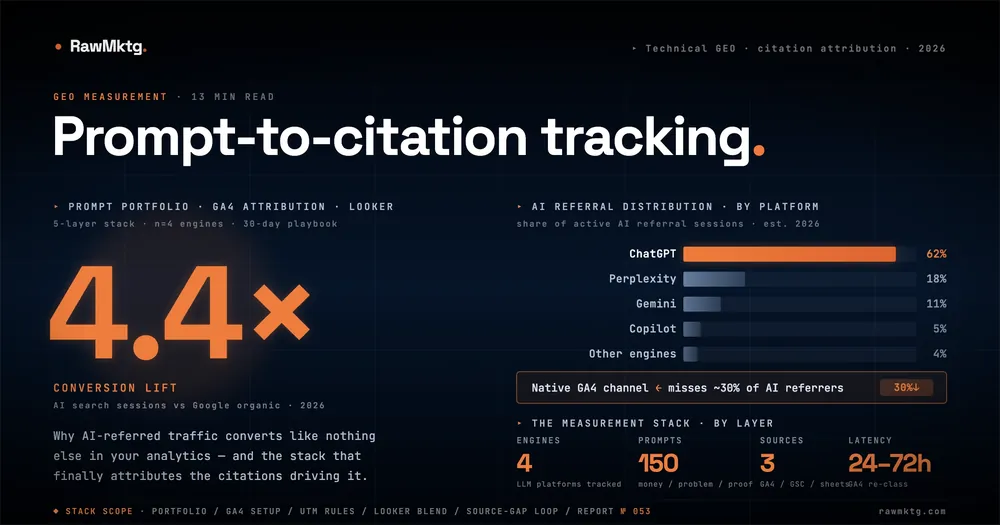
AI sessions convert at 4.4x organic; GA4 misses about 30% of AI referrers. The prompt portfolio, GA4 dual-setup, and Looker Studio dashboard that prove GEO ROI.
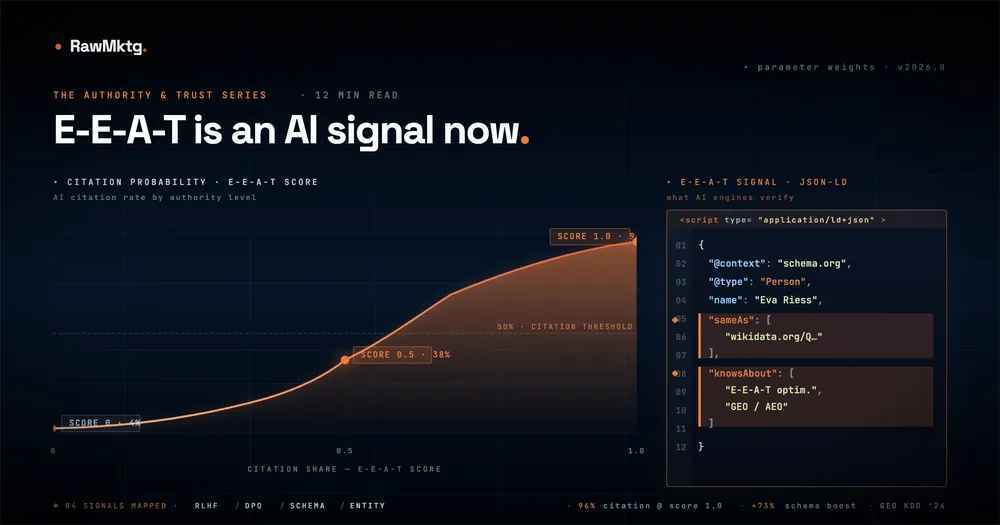
96% of AI Overview citations go to E-E-A-T-trusted sources. How RLHF wired quality into LLMs, and the 90-day framework to close the gap.
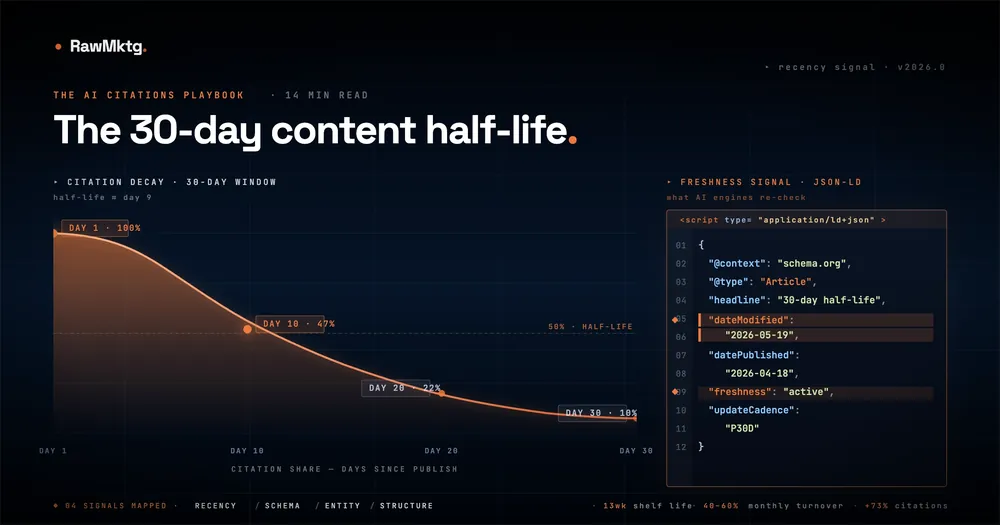
Pages are 3.2x more likely to lose AI citations after 90 days. The technical reason why, platform-by-platform heuristics, and the refresh system to fix it.
Written by Vinayak Ravi
rawmktg. is written by Vinayak Ravi. The analyses here come out of original research: citation data pulled across the major AI engines, lined up against the SEO fundamentals underneath, and checked against the published studies that hold up.
Nothing on this site is theory for its own sake. If a finding is here, it is because the data behind it showed something worth writing down. If something is useful to you, the method behind it is available.
Get in touch →