Find out why AI assistants don't recommend you
Twenty tools will tell you that ChatGPT didn't mention your brand. Almost none will tell you why not, or what to change. RawMktg diagnoses the cause and generates the fix.
No card required. Audits 25 pages and takes about two minutes.
Illustrative dashboard · sample data
Your buyers stopped clicking ten blue links
Ask AI "who's the best?" and you get a shortlist — three or four vendors, named and recommended. If you're not in that answer, you're not losing a ranking. You're not considered at all.
Ten blue links
Buyers compared pages and judged you on your own site.
One AI answer
The assistant returns a shortlist. If you're not on it, you're not considered.
Four problems that look identical from the outside
"We're not being mentioned" has at least four distinct causes, and they need opposite fixes. RawMktg tests each one separately.
How often are you named?
Across a repeatable set of buying questions, with a confidence interval, so you can tell a real change from sampling noise.
Does the model know you exist?
Some brands are missing from the model's memory of the category. An off-site, entity and corroboration problem, not an on-page one.
Can a bot actually read your pages?
AI crawlers fetch differently from browsers. Pages that render fine for a human can return almost nothing to a bot. We measure how much survives.
Can your content be quoted?
Retrievable isn't quotable. An assistant needs a self-contained, factual passage it can lift. Most marketing pages don't have one.
You can't fix a mention problem with better on-page content, and you can't fix a citation problem with more press coverage. Knowing which one you have is the entire point.
From crawl to measured result
Point it at your site
We crawl the way an AI crawler does, respecting robots.txt, at a modest rate, identifying ourselves honestly.
Get findings, not a score
Seven rubrics and around fifty checks produce specific, located faults: this page, this problem, this fix, worth this many points.
Apply generated fixes
Findings ship with artefacts — JSON-LD, rewritten answer blocks, llms.txt files, content briefs — not just advice.
Measure whether it worked
On paid plans we ask AI assistants your buying questions on a schedule and report your share of their answers over time.
See it, track it, fix it, in one place
Sample dashboard shown for illustration.
Built to be honest about uncertainty
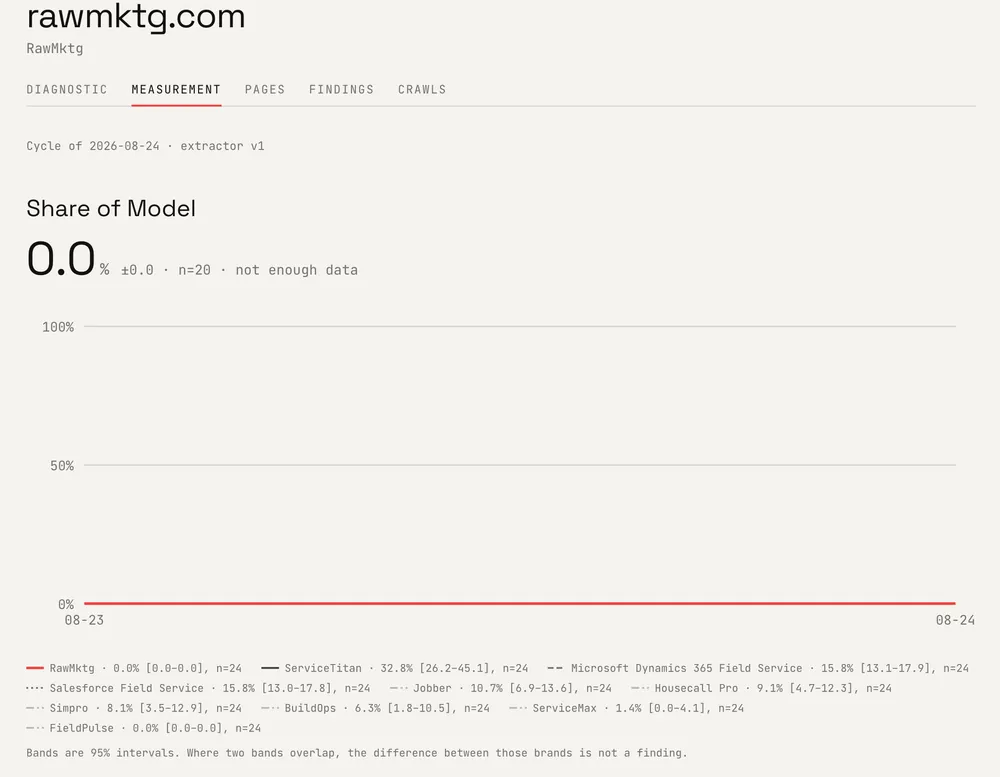
Every number carries an interval
AI answers vary run to run. A tool that samples once and reports a percentage is reporting noise. We sample repeatedly and publish the range.
No arrow without significance
When a change is not statistically distinguishable from noise, we say "no significant change" and draw nothing. Most dashboards will happily show you a trend that isn't there.
Measured and asserted are kept apart
Some inputs can't be measured, whether you publish original research, for instance. Those are labelled "asserted, not measured" and never quietly blended into a score.
Competitors cost nothing extra
Your competitors are scored from the same answers we already collected. We don't charge per tracked brand, because there is no marginal cost to us.
Who it's for
B2B SaaS marketing teams
You own the pipeline number and AI search is quietly changing it.
See the B2B SaaS use case →Technical SEO leads
You need to know which pages a bot can't retrieve, and why.
See the technical SEO use case →Start free. Scale when it's working.
Every plan includes the crawl diagnostic and generated fixes. Paid plans add scheduled measurement across more engines and competitors.
Diagnostic
- Up to 500 pages crawled weekly
- 25 prompts, measured monthly
- ChatGPT & Google AI Overviews
- Up to 3 tracked competitors
Visibility
- Up to 2,000 pages crawled weekly
- 100 prompts, measured weekly
- ChatGPT, AI Overviews, AI Mode, Copilot
- Up to 5 competitors · API access
Program
- 3 projects · up to 10,000 pages weekly
- 350 prompts across projects
- All seven engines, incl. Claude & Grok
- Up to 10 competitors · API access
Questions we get a lot
How is this different from SEO?
SEO gets you ranked on a page of links. RawMktg gets you into the AI answer itself, a different surface with different signals, and that answer is what buyers now see first.
Which AI engines do you measure?
It depends on your plan. Diagnostic covers ChatGPT and Google AI Overviews; Visibility adds Google AI Mode and Copilot; Program covers all seven engines, including Claude and Grok.
Do I need a credit card for the free audit?
No. The free audit crawls up to 25 pages and returns real findings with no card and no call.
How do you handle uncertainty in the numbers?
AI answers vary run to run, so we sample repeatedly and publish a confidence interval. When a change is not statistically significant, we say so and draw no trend arrow.
Can my team just do this in-house?
You can measure in-house. The hard part is the fix, the content and third-party citations that actually move the answer, which is the work RawMktg generates and does for you.
Don't let AI tell the wrong story about your brand
Run a free audit and see exactly where AI leaves you out, and the fixes worth doing first.
No card required. Audits 25 pages and takes about two minutes.