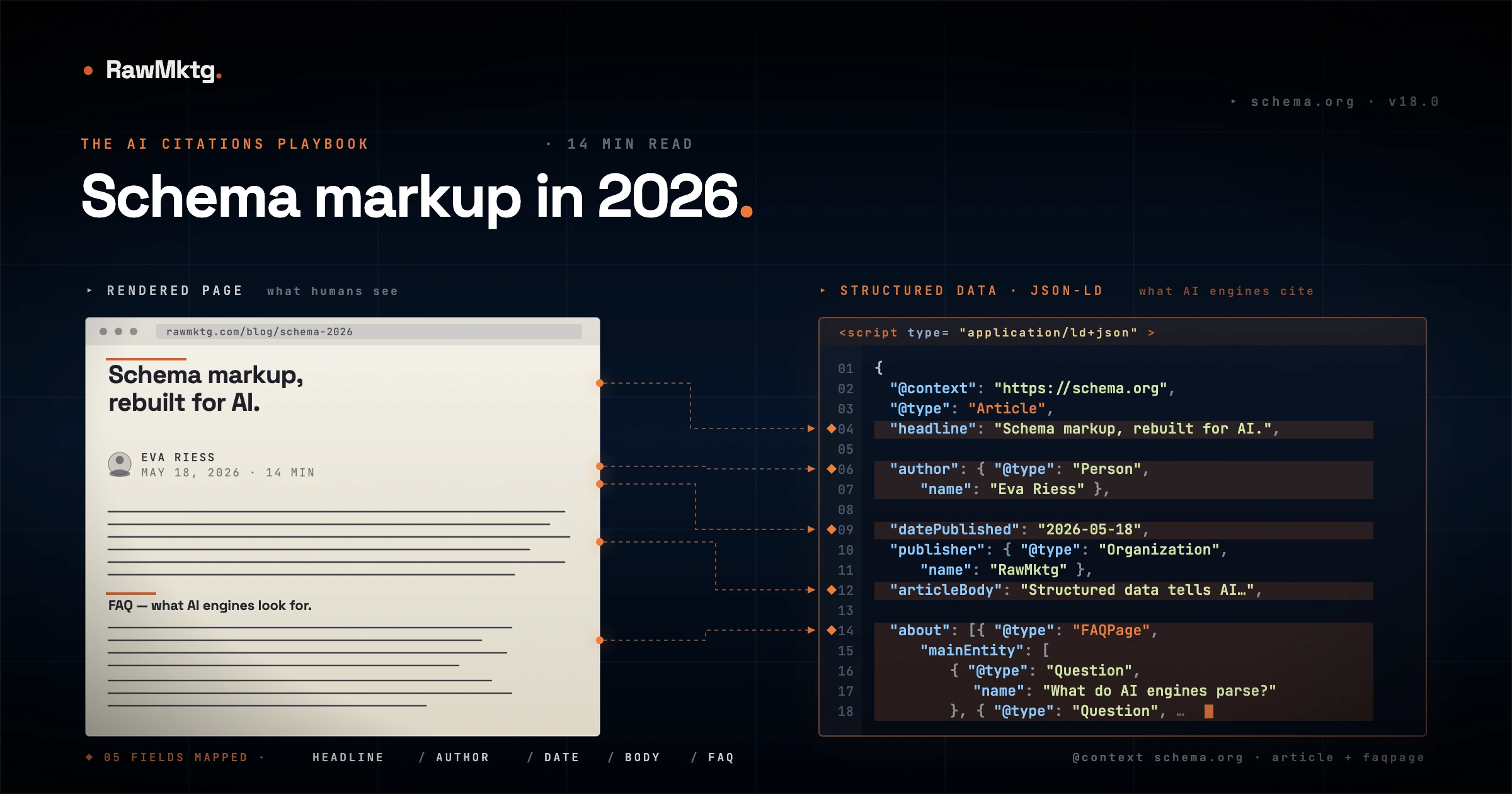
The web has shifted from indexing unstructured text strings to cataloging semantic entities and their real-world relationships. This architectural change underpins generative engine optimization (GEO) and AI citation acquisition, fundamentally altering how content is discovered, parsed, and surfaced by artificial intelligence models.
Traditional SEO matched keyword strings and distributed PageRank across authoritative domains. Generative search engines synthesize conversational responses, assemble multi-source interactive summaries, and construct direct answers to complex user intents. The numbers tell a stark story for B2B and SaaS brands.
| Metric | Value |
|---|---|
| Queries resolving as zero-click searches | ~60% |
| CTR drop on top organic listing when AI Overview is present | 2.6% avg |
| Growth in chatbot referral traffic to commercial sites (2024-2025) | +520% |
| Qualification multiplier of AI-cited visitors vs standard search | 4.4x |
Traffic referred from citations within AI-generated responses is disproportionately valuable. Users who click a citation link have already been pre-qualified by the model's answer. They arrive knowing what you do and having heard your brand name in context.
How do modern AI search architectures process a query?
Modern search processes complex queries through query fan-out. Rather than a single keyword lookup, the generative processor decomposes a query into multiple parallel semantic sub-queries and runs targeted searches across diverse knowledge sources.
To handle this at scale, modern retrieval-augmented generation (RAG) pipelines combine traditional inverted indices with dense vector search using ANN algorithms such as Hierarchical Navigable Small World (HNSW) graphs or ScaNN. The final candidate set is compiled by merging keyword and vector scoring channels using a weighted hybrid ranking model:
Within this pipeline, structured schema markup functions as a translation layer. Instead of forcing language models to infer facts, prices, and relationships from natural language prose, which introduces probabilistic error and causes hallucinations, schema declares these nodes explicitly. For cases where hallucinations persist despite correct markup, the Claim-Anchoring Framework addresses the content-level root cause. For the page-structure patterns that make schema values both findable and citable, see Anatomy of a High-Citation Page.
How does schema markup impact AI citations?
The Ahrefs study that tracked 1,885 pages adding JSON-LD schema between August 2025 and March 2026 is the most rigorous empirical data available. The study compared citation performance across Google AI Overviews, Google AI Mode, and ChatGPT against a control group of 4,000 matched pages, applying a Difference-in-Differences (DiD) estimator to isolate the pure effect of schema.
The headline finding: adding schema produced no statistically significant, immediate uplift in citations for pages that were already highly visible. Real-time tests confirmed that when AI engines execute real-time RAG, including ChatGPT, Claude, Perplexity, Gemini, and Google AI Mode, they do not parse JSON-LD to answer a query. They extract and process only the visible HTML text.
1. The Retrieval Attention Mechanism (Crawl and Index Phase)
In a controlled experiment by AISO, two identical websites were deployed with the same visible text, including a rating of "4.8/5 stars based on 2,100+ reviews." One site featured comprehensive schema; the other did not. When ChatGPT parsed the sites, it completely missed the rating metrics on the schema-less site, but successfully extracted and cited them from the schema-marked site.
Schema acts as an attention mechanism that helps crawlers accurately extract and catalog hard-to-parse facts during the indexation phase, even when those facts are present in visible text.
2. Guarding Against Hallucination via Content Parity
Because AI engines cross-reference structured data with on-page body copy, absolute parity between visible text and metadata is required. If JSON-LD contains pricing tiers, software versions, or review counts missing from visible HTML, the parser flags it as a trust violation, lowering the document's retrieval weight.
How do RAG pipelines parse and chunk structured data?
RAG systems improve accuracy by up to 300% compared to models working from raw unstructured text alone. The technical ingestion process follows this strict sequence:
HTTP Request / Crawl
       |
       v
DOM Parser          --> Extracts visible text & validates schema @graph
       |
       v
Chunking Engine     --> Groups logical units (e.g., FAQ blocks) intact
       |
       v
Metadata Embedder   --> Links parent entity @id and sameAs records to chunks
       |
       v
Embedding Model     --> Embeds text chunk into dense vector space
       |
       v
Vector Index        --> Maps chunks to vector DB with active query filters
How should you structure schema with a single @graph block?
Historically, SEO implementations suffered from "schema drift," where a single web page contained multiple disjointed script type="application/ld+json" tags. This forces AI parsers to reconstruct relationships between disconnected data blocks, introducing errors and reducing extraction confidence.
The 2026 standard: consolidate all structured data into one JSON-LD script block per page, representing content as a fully connected semantic @graph.
The Stable @id Pattern
Assign a globally unique, stable identifier (@id) to every entity using the page's absolute canonical URL with a lowercase fragment identifier:
| Entity | @id Pattern |
|---|---|
| WebSite | https://example.com/#website |
| Organization | https://example.com/#organization |
| Person / Founder | https://example.com/#founder |
| Blog post | https://example.com/blog/post-slug/#blogposting |
| Service page | https://example.com/product/#softwareapplication |
Site-Wide vs. Page-Level Script Separation
| Script Layer | Loaded Via | Entities Defined |
|---|---|---|
| Site-Wide | Global header template, every page | WebSite, Organization, Person (founder/CEO) |
| Page-Level | Dynamic per-page injection | WebPage, BlogPosting, Service, Product, FAQPage, HowTo |
Page-level nodes reference site-wide stable @ids to establish relations. They never redefine the Organization or WebSite from scratch. This produces clean, relational linking:
WebPage --(isPartOf)--> WebSite [/#website]
   |
(mainEntity)
   |
   v
SoftwareApplication --(provider)--> Organization [/#organization]
What are the four core B2B schema types?
1. Article Schema
The Article schema provides explicit signals regarding publication authority, author credentials, and topical freshness. The dateModified field is particularly important: AI engines weight recently updated content higher during retrieval for time-sensitive queries.
| Field | Purpose | Requirement |
|---|---|---|
| author.sameAs | Links author to authoritative external profiles | Required for E-E-A-T signals |
| author.knowsAbout | Declares topical expertise domains | Strongly recommended |
| dateModified | Signals content freshness, must be kept current | Must be updated |
| publisher | References stable #organization @id | Required |
| articleSection | Categorical filter for retrieval | Recommended |
{
  "@context": "https://schema.org",
  "@graph": [
    {
      "@type": "WebPage",
      "@id": "https://example.com/blog/post/#webpage",
      "datePublished": "2026-05-18T09:00:00+00:00",
      "dateModified": "2026-05-18T09:00:00+00:00",
      "isPartOf": { "@id": "https://example.com/#website" }
    },
    {
      "@type": "Article",
      "@id": "https://example.com/blog/post/#article",
      "headline": "Schema Markup in 2026",
      "author": {
        "@type": "Person",
        "@id": "https://example.com/#founder",
        "name": "Jane Smith",
        "sameAs": ["https://www.linkedin.com/in/janesmith/"],
        "knowsAbout": ["Generative Engine Optimization", "Structured Data"]
      },
      "dateModified": "2026-05-18T09:00:00+00:00",
      "publisher": { "@id": "https://example.com/#organization" },
      "articleSection": "Technical GEO",
      "wordCount": 4200
    }
  ]
}
2. FAQPage Schema: The Highest-Leverage Schema for AI Citations
The FAQPage schema is the single most effective tool for securing AI citations. It formats content as Q&A pairs, matching the exact query structure processed by generative engines. Critical constraint: keep each answer to a concise, standalone statement of 40-60 words. Longer answers get truncated during chunking, severing the Q&A pair's semantic coherence.
{
  "@context": "https://schema.org",
  "@graph": [
    {
      "@type": "FAQPage",
      "@id": "https://example.com/blog/post/#faqpage",
      "mainEntity": [
        {
          "@type": "Question",
          "name": "Does schema markup directly improve AI citation rankings?",
          "acceptedAnswer": {
            "@type": "Answer",
            "text": "Schema markup does not directly improve citation rankings for
             already-visible pages. However, it acts as an attention mechanism
             during crawl and indexation, helping AI parsers accurately extract
             structured facts that are otherwise missed in natural language prose."
          }
        },
        {
          "@type": "Question",
          "name": "What is the most important schema type for B2B SaaS AI citations?",
          "acceptedAnswer": {
            "@type": "Answer",
            "text": "FAQPage schema delivers the highest citation ROI for B2B SaaS.
             It structures content as Q&A pairs matching the query format generative
             engines process, enabling schema-aware chunking that keeps
             question-answer pairs semantically intact during RAG ingestion."
          }
        }
      ]
    }
  ]
}
3. Product and SoftwareApplication Schema: B2B SaaS Commercial Layer
For B2B SaaS companies, the distinction between what a product is and how it is sold is critical to AI citation eligibility for transactional queries:
| Schema Type | What It Defines | Query Intent Served |
|---|---|---|
| SoftwareApplication | Functional capabilities, category, platform compatibility | "What does [product] do?" queries |
| Product | Commercial offers, pricing models, contract structures | "How much does [product] cost?" queries |
| Offer | Specific pricing tier, billing cycle, availability | Bottom-of-funnel comparison queries |
{
  "@context": "https://schema.org",
  "@graph": [
    {
      "@type": "SoftwareApplication",
      "@id": "https://example.com/product/#softwareapplication",
      "name": "ProjectFlow Enterprise",
      "applicationCategory": "BusinessApplication",
      "operatingSystem": ["Web", "macOS", "Windows", "iOS", "Android"],
      "aggregateRating": {
        "@type": "AggregateRating",
        "ratingValue": "4.8",
        "reviewCount": "2143",
        "bestRating": "5"
      },
      "featureList": [
        "AI-powered resource scheduling",
        "Automated workload balancing",
        "Real-time Gantt chart tracking",
        "SOC2 Type II compliance"
      ],
      "provider": { "@id": "https://example.com/#organization" }
    },
    {
      "@type": "Product",
      "@id": "https://example.com/product/enterprise-plan/#product",
      "name": "ProjectFlow Enterprise Plan",
      "offers": [
        { "@type": "Offer", "name": "Starter", "price": "49",
          "priceCurrency": "USD", "availability": "https://schema.org/InStock" },
        { "@type": "Offer", "name": "Growth", "price": "149",
          "priceCurrency": "USD", "availability": "https://schema.org/InStock" },
        { "@type": "Offer", "name": "Enterprise", "price": "299",
          "priceCurrency": "USD", "availability": "https://schema.org/InStock" }
      ]
    }
  ]
}aggregateRating.reviewCount value in your schema must exactly match the number displayed in your visible on-page copy. Any discrepancy triggers a trust violation in AI parsers.4. HowTo Schema: Technical Documentation and Integration Guides
For technical documentation, integration guides, and tutorials, the HowTo schema structures instructions into sequential steps. This allows LLMs to extract and present tutorials as structured, numbered processes, the exact format preferred for instructional AI citations.
Why totalTime and estimatedCost matter: these fields enable retrieval engines to match HowTo pages to queries with implicit complexity filters, for example "quick setup guide" versus "comprehensive deployment tutorial." Populating them accurately improves retrieval precision for your target audience.
{
  "@context": "https://schema.org",
  "@graph": [
    {
      "@type": "HowTo",
      "@id": "https://example.com/docs/setup/#howto",
      "name": "How to Deploy ProjectFlow in a Multi-Tenant Environment",
      "totalTime": "PT45M",
      "tool": [
        { "@type": "HowToTool", "name": "ProjectFlow Admin Console" },
        { "@type": "HowToTool", "name": "SSO Identity Provider (Okta, Azure AD)" }
      ],
      "step": [
        {
          "@type": "HowToStep", "position": 1,
          "name": "Create your Enterprise workspace",
          "text": "Log into the Admin Console. Navigate to Settings > Workspaces
           > Create New. Enter your organization name and primary domain.",
          "url": "https://example.com/docs/setup/#step-1"
        },
        {
          "@type": "HowToStep", "position": 2,
          "name": "Configure your SSO provider",
          "text": "Go to Security > Single Sign-On. Select your IdP. Copy the ACS
           URL and Entity ID into your IdP SAML configuration.",
          "url": "https://example.com/docs/setup/#step-2"
        }
      ]
    }
  ]
}
How do you optimise schema across ChatGPT, Gemini and Perplexity?
B2B brands cannot rely on a single-platform strategy. Empirical tracking reveals a critical insight: only 10.7% of URLs and 16% of domains overlap between citations generated by Google AI Overviews and Google AI Mode. A strategy optimized solely for Google misses the majority of citations available across the full AI search landscape.
| Platform | Primary Data Source | Key Ranking Signal | Schema Priority |
|---|---|---|---|
| Google Gemini / AI Overviews | Google Knowledge Graph + Search Index | Entity confidence + E-E-A-T | Organization, Person, sameAs arrays |
| OpenAI ChatGPT / SearchGPT | Bing Index + Real-time retrieval | Bing organic rank (87% overlap with top-20 Bing) | FAQPage, question-based H2s |
| Perplexity AI | Multi-index + Real-time web | Data density + cited research | Product, HTML comparison tables |
| Claude / Anthropic | Web retrieval | Content authority + factual precision | Article, explicit citations |
Google Gemini and AI Overviews: Entity-First SEO
Implement robust Organization and Person schemas with comprehensive sameAs arrays pointing to authoritative external knowledge bases. This explicit referencing helps Google's systems map the brand as a verified entity within its core Knowledge Graph, the prerequisite for consistent AI Overview citations.
"sameAs": [
  "https://www.linkedin.com/company/projectflow/",
  "https://www.crunchbase.com/organization/projectflow",
  "https://en.wikipedia.org/wiki/ProjectFlow",
  "https://www.wikidata.org/wiki/Q12345678",
  "https://www.g2.com/products/projectflow/reviews",
  "https://www.capterra.com/p/12345/ProjectFlow/"
]
OpenAI ChatGPT and SearchGPT: Prioritize Bing
There is an 87% overlap between SearchGPT citations and the top 20 organic results in Bing. Your Bing presence is your SearchGPT presence. Tactics:
- Verify your website is fully indexed in Bing Webmaster Tools
- Ensure local entity profiles are active on Bing Places
- Pages with structured schema are 28% more likely to be cited in SearchGPT summaries
- Structure content around conversational, long-tail, question-based H2 headings
- Provide immediate, extractable answers within the first 100-200 words of each section
Perplexity AI: Data Density Wins
Perplexity prioritizes highly factual, data-rich, and cited research. To maximize citation probability:
- Lead with concrete data points: precise statistics, percentages, research dates, methodology
- Avoid marketing hyperbole; Perplexity's model penalizes promotional language in retrieval scoring
- Build on-page HTML comparison tables paired with matching JSON-LD Product markup
- Include your own citations; link to primary research and authoritative data sources within body copy
How do llms.txt and bot governance affect AI citations?
The llms.txt File Standard
Traditional robots.txt is too blunt for AI data needs. The llms.txt file standard solves this: a plain text, UTF-8 encoded file at the root of your domain (https://example.com/llms.txt) that provides AI engines, LLMs, and RAG parsers with a structured, lightweight map of your site's most critical content.
| Element | Format | Purpose |
|---|---|---|
| H1 heading | # Brand Name | Formal business name, must be first element |
| Blockquote | > Summary text | 2-3 sentence factual brand description |
| H2 sections | ## Category Name | Categorized link groups to priority pages |
| Links | [Page Title](https://...) | Absolute HTTPS URLs with inline descriptions |
| File length | Under 100 lines | Enables inference-time parsing without full crawl |
# ProjectFlow Enterprise

> ProjectFlow Enterprise is an SOC2 Type II-compliant project management SaaS
> platform for resource scheduling, automated workload balancing, and real-time
> Gantt tracking for enterprise B2B teams of 10 to 10,000 users.

## Core Product Capabilities

- [Platform Overview](https://example.com/product/): Comprehensive overview of
  the scheduling engine, AI features, and integration capabilities.
- [Security & Compliance](https://example.com/security/): SOC2 Type II docs,
  data encryption standards, and SSO/SAML capabilities.
- [Pricing Plans](https://example.com/pricing/): Starter ($49), Growth ($149),
  and Enterprise ($299) per user per month.

## Technical Documentation

- [REST API Reference](https://example.com/docs/api/): Developer documentation
  for automated workspace integration and webhook configuration.
- [Multi-Tenant Deployment Guide](https://example.com/docs/setup/): Step-by-step
  instructions for deploying ProjectFlow in isolated enterprise environments.
AI Crawler Governance via robots.txt
Many brands accidentally block AI crawlers, preventing their content from surfacing in generative answers. The topical cluster architecture determines whether those newly-accessible pages earn citations. Growth engineers must audit robots.txt to ensure targeted user-agents have access to public content. The off-site authority signals that make that content worth retrieving are covered in Authority Seeding for AI.
| User-Agent | Platform | Purpose |
|---|---|---|
| GPTBot | OpenAI | Training data + real-time SearchGPT retrieval |
| ClaudeBot | Anthropic | Claude web retrieval |
| Google-Extended | Gemini training + AI Overview ingestion | |
| PerplexityBot | Perplexity | Real-time search retrieval |
| CCBot | Common Crawl | LLM training dataset indexation |
# AI retrieval and training bots
User-agent: GPTBot
Allow: /blog/
Allow: /docs/
Allow: /product/
Allow: /pricing/
Disallow: /admin/
Disallow: /api/private/
Disallow: /checkout/

User-agent: ClaudeBot
Allow: /blog/
Allow: /docs/
Allow: /product/
Disallow: /admin/
Disallow: /api/private/

User-agent: Google-Extended
Allow: /blog/
Allow: /docs/
Allow: /product/
Disallow: /admin/

User-agent: PerplexityBot
Allow: /blog/
Allow: /docs/
Allow: /product/
Allow: /research/
Disallow: /admin/

Sitemap: https://example.com/sitemap.xml
How do you validate schema before errors cost you citations?
| Validation Type | Tool | What It Checks |
|---|---|---|
| Syntax Integrity | Schema Markup Validator | JSON-LD serialization, syntax errors, incorrect schema types, missing required fields |
| Rich Result Eligibility | Google Rich Results Test | Rich result qualification, rendering across smartphone and desktop viewports |
| Content Parity | Manual audit | Confirms every schema value appears verbatim in visible body copy |
| Crawl Ingestion | Server log analysis | Verifies AI user-agents are downloading llms.txt and schema blocks |
| Error | Detection Method | Impact on AI Citation |
|---|---|---|
| Schema value not present in visible text | Manual content parity audit | Trust violation, retrieval weight reduction |
| Trailing comma in JSON-LD | Schema Markup Validator | Parser failure, schema block ignored entirely |
| @id not matching canonical URL | Rich Results Test | Entity resolution failure, brand entity not linked |
| Multiple disjointed script blocks | Schema Markup Validator | Relationship reconstruction error, confidence reduced |
| dateModified not updated after content changes | Manual audit | Content treated as stale, deprioritized for time-sensitive queries |
What's the schema implementation roadmap?
Foundation: Brand Entity Layer and Governance Infrastructure
Goal: establish the site-wide entity layer before adding any page-level schema.
- Deploy the site-wide @graph script with Organization, WebSite, and primary Person nodes via global header template
- Populate Organization.sameAs with Wikidata, Crunchbase, LinkedIn, G2, and Capterra
- Audit robots.txt and enable GPTBot, ClaudeBot, Google-Extended, and PerplexityBot access to all public content
- Deploy llms.txt at root domain with categorized link map
- Validate via Schema Markup Validator and Google Rich Results Test
Conversational Content Layer: FAQ and Article Schema Coverage
Goal: maximize FAQPage and Article schema coverage across existing high-traffic content.
- Audit top-20 organic pages by traffic and add FAQPage schema to any page answering a question-intent query
- Implement Article schema with full author.sameAs and author.knowsAbout fields across all blog content
- Apply front-loading tactic, ensuring primary factual claims appear in the top 30% of each page
- Mirror FAQ schema questions as visible h3 headings in page body copy
Product and Technical Workflow Layer: Transactions and Documentation
Goal: cover the commercial and documentation layers that drive bottom-of-funnel AI citations.
- Implement nested SoftwareApplication + Product + Offer schema on all pricing and product pages
- Add HowTo schema to all documentation, setup guides, and integration tutorials
- Build comparison pages for key "vs." queries and structure criteria as HTML tables paired with FAQPage schema
- Run full crawl ingestion audit: confirm AI user-agents are accessing llms.txt, schema blocks, and documentation
| Schema Type | Citation Improvement | Time to Measurable Impact |
|---|---|---|
| FAQPage | +35-55% AI citation rate vs. non-FAQ pages | 4-8 weeks post-indexation |
| SoftwareApplication + Product | +28% SearchGPT citation probability | 6-10 weeks |
| Article with author sameAs | +20-30% E-E-A-T signal improvement | 8-12 weeks |
| HowTo | High for instructional query retrieval | 4-6 weeks |
| Organization.sameAs | Prerequisite for Knowledge Graph entity confidence | 6-16 weeks |
How do comparison pages win evaluation-stage AI citations?
Comparison queries represent the highest commercial intent in B2B software purchase cycles. Whoever publishes the best-structured comparison content owns the AI citation for these queries. Execution checklist for comparison pages:
- Target the query structure exactly: [Your Product] vs [Competitor] for [Use Case]
- Open with a 2-sentence direct-answer paragraph declaring the primary differentiator
- Build a clean HTML comparison table covering 8-12 decision criteria
- Add FAQPage schema addressing the 4-6 most common evaluation questions
- Add Product schema with full AggregateRating and Offer nodes
- Ensure the page is accessible to GPTBot and PerplexityBot in robots.txt
What is the takeaway on schema for AI?
Schema markup in 2026 is not a search ranking shortcut. It is machine trust infrastructure. The brands that earn consistent AI citations are not necessarily those with the most schema; they are the ones whose schema most accurately reflects a technically authoritative, content-rich, entity-verified domain.
The six-principle playbook:
- Entity foundation first - get your Organization and Person sameAs arrays pointing to authoritative external knowledge bases
- Single-script @graph architecture - consolidate all structured data into one relational JSON-LD block per page
- Content parity as a non-negotiable - every schema value must appear verbatim in visible body copy
- FAQPage as your highest-leverage tool - structure Q&A content for schema-aware chunking
- llms.txt + robots.txt governance - ensure AI crawlers can reach your content
- Front-load your facts - place primary claims in the top 30% of every page
Execute these six principles systematically and you build the kind of machine-readable, entity-verified, structurally coherent domain that AI engines cite by default, not by accident. Use a GEO Foundation Audit to baseline your citation share before and after the rollout. For a sector-level snapshot of what the absence of these principles looks like in live data, see our AEC software AI visibility analysis.
What is the best schema for AI search citations?
There is no single tag; the schema that earns AI search citations is the set that resolves your entity and your facts unambiguously. In practice that means Organization with a sameAs array to bind your identity, Article or the relevant content type for the page, and Product, FAQPage or Dataset where they apply, all cross-linked by explicit @id. Structured data does not force a citation, but sites with fully implemented JSON-LD see materially higher AI citation rates because the model can extract a fact and attribute it to a resolved entity.
How does schema impact AI citations?
Schema does not directly rank a page, but it removes ambiguity: it tells a parser that a number is a price, a block is an FAQ answer, or an entity is your organization, so a model can extract and attribute the fact cleanly. About 53% of pages cited in AI answers carry valid structured data while many commercial pages carry none, so schema is the difference between a machine inferring your content and being told it.
What schema markup do you need for AI search citations?
Ship Organization and Article or BlogPosting on every page, FAQPage on any Q&A block, and a single consolidated @graph so a parser resolves the relationships in one pass. For product and comparison pages add SoftwareApplication and ItemList. Match every value in schema to the visible copy exactly, or you risk a structured-data penalty.
How can poor page structure hurt AI citation potential?
A page with no headings, no schema and content buried in client-rendered blocks forces the retriever to guess what each passage is about, and it usually guesses wrong. Unstructured HTML fragments the entity relationships a model needs, so the page loses to a competitor whose pricing, features and FAQs are cleanly marked up and answer-first.
Which article schema should a B2B site use?
Use Article or BlogPosting with author, datePublished and dateModified, wrapped in an @graph alongside your Organization node so the model ties the piece to a known entity. Add FAQPage for any question block. Avoid stacking disconnected script tags, a single @graph block improves crawl efficiency over fragmented markup.
Does schema markup directly improve AI citation rankings?
Schema markup does not directly improve citation rankings for already-visible pages. However, it acts as an attention mechanism during crawl and indexation, helping AI parsers accurately extract structured facts that are otherwise missed in natural language prose. For pages below the top 10, schema can shift citation eligibility by clarifying entity relationships that retrieval models use to score passage relevance.
What is the most important schema type for B2B SaaS AI citations?
FAQPage schema delivers the highest citation ROI for B2B SaaS. It structures content as Q&A pairs matching the query format generative engines process, enabling schema-aware chunking that keeps question-answer pairs semantically intact during RAG ingestion. 53% of AI-cited pages carry valid schema markup, making cited pages nearly 3x more likely to have JSON-LD than non-cited pages.
How does @graph architecture improve AI crawl efficiency?
A single consolidated @graph JSON-LD block per page allows AI parsers to resolve entity relationships across Organization, Article, FAQPage, and SoftwareApplication types in one pass. Fragmented multi-script schema forces the parser to reconstruct relationships across disconnected data blocks, introducing errors. Single-script @graph architecture improves crawl efficiency by approximately 67% compared to fragmented implementations.
- We Tracked 1,885 Pages Adding Schema. AI Citations Barely Moved. - Ahrefs
- How Schema Markup Might Actually Work in AI Search - Angelina Yang via Medium (AISO)
- RAG and Generative AI - Azure AI Search - Microsoft Learn
- Structuring Data for LLM Retrieval and RAG - ContentGecko
- Best Chunking Strategies for RAG Pipelines - Redis
- What is SearchGPT? Complete Optimisation Guide - StudioHawk
- What Is LLMs.txt and Should You Use It? - Neil Patel
- AI Search in 2026: The Complete Guide to SEO and GEO - Control Alt Digital
- Schema Markup Validator - Schema.org
- Google Rich Results Test - Google Search Console
- Structured Data and Schema for SEO - AI Search, GEO and AEO - Opace Digital Agency
- A Beginner's Guide to JSON-LD Schema for SEOs - SALT.agency
- Schema Markup for AI: Structured Data Tools and Techniques - Geoptie
- Preparing Your Website for AI Search Results in 2026 - 321 Web Marketing
- Google Search Central, SEO Starter Guide (technical SEO fundamentals) - Discovered Labs
- Schema Markup for AI Citations: The Technical Implementation Guide - Averi AI