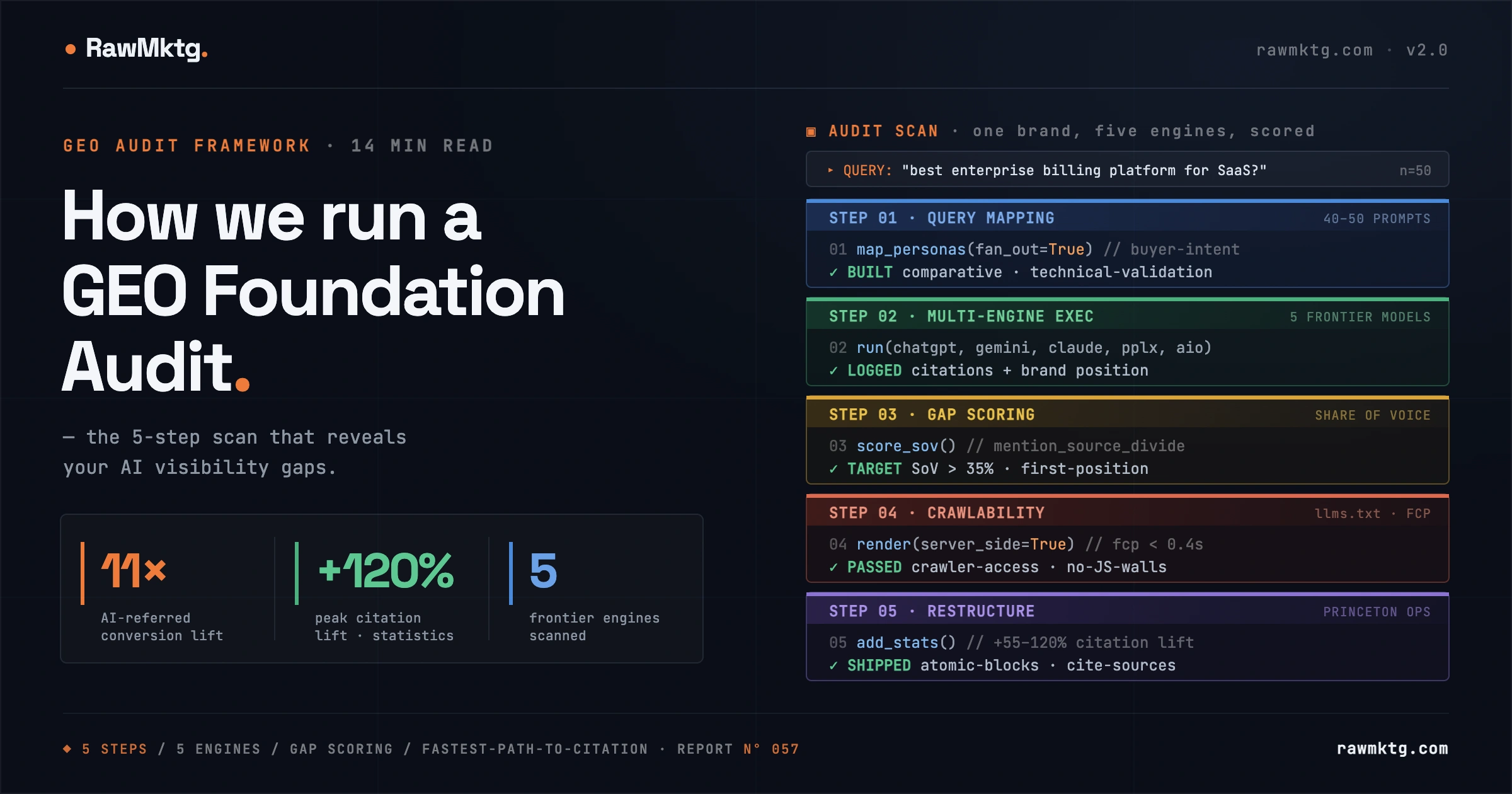
01How is B2B search shifting to conversational discovery?
Enterprise marketing teams are navigating the rise of conversational AI assistants that don't return a list of ten blue links. They return one answer, sometimes with citations, sometimes without. Gartner forecasts traditional organic search volume will fall roughly 25% by 2026 as buyer intent migrates toward conversational AI interfaces. The brands synthesized into that single answer win the shortlist. Everyone else is invisible.
In the AI-mediated model, you are not optimizing to rank on a results page and drive clicks. You are optimizing to be the source the model trusts enough to cite when a buyer asks a qualifying question. That shift requires a fundamentally different diagnostic than a keyword audit or a backlink review.
The economics are compelling. AI-referred traffic converts at approximately 11 times the rate of standard organic search: a 1.66% sign-up rate versus a 0.15% organic baseline. A buyer who arrives via an AI recommendation has been pre-qualified by the model's reasoning, not served an ad.
The catch: AI visibility is invisible by default. Standard analytics platforms don't track impressions inside LLM environments, so organizations routinely stay unaware of severe citation gaps until a competitor has quietly captured the conversational pipeline. The remedy is a repeatable diagnostic: the RawMktg. GEO Foundation Audit.
02What is the algorithmic core of GEO?
Optimizing for machine synthesis requires understanding RAG architectures. Unlike classic ranking that leans on keyword density and backlinks, generative engines retrieve semantically similar passages, rerank them by authority signals, and synthesize an answer from the top candidates. The model never sees your page as a whole: it sees the passages most relevant to the query.
The academic foundation was established in late 2023 by researchers from Princeton and Georgia Tech. Their paper framed GEO as a black-box optimization problem: original content c is transformed by a function into optimized content c'. Inclusion alone is too crude a metric, so they score a Position-Adjusted Word Count impression that gives more weight to citations that appear earlier in the synthesized answer.
# Position-Adjusted Word Count impression for source s in response r
#   S_c(s) = sentences in r that cite source s
#   wc(si) = word count of sentence si
#   pos(si) = sentence index (0 = first)  ->  earlier = higher weight

Imp(s, r) = Σ  [ wc(si) · e^(−pos(si)) ]   for si in S_c(s)
            ─────────────────────────────
                Σ wc(sj)  for sj in r

# Relative visibility lift after an edit:
Lift = ( Imp(s, r') − Imp(s, r) ) / Imp(s, r)
Which optimization vectors actually work
The Princeton research evaluated nine content transformations across multiple domains. The headline finding: keyword stuffing performs poorly in generative contexts. Three levers consistently produced the largest gains, estimated at 30–40% citation lift across domains:
- Statistics Addition: replace qualitative claims with precise figures (e.g. "improves ROI by 36%"), giving the model an extractable, verifiable trust signal. The single most effective on-page move: "improves server speed" becomes "reduces server response times by 42%," lifting citation rates by an estimated 55–120%.
- Quotation Addition: embed direct, high-authority expert quotes that add verifiable consensus. Models paraphrase or extract these as anchor text in synthesized answers.
- Source Citation: reference recognized industry studies and databases (Gartner, McKinsey) to raise the semantic credibility of the page. Models read cross-source consensus as a trust signal.
RawMktg. operationalizes these via the RAID G-SEO pipeline: Content Summarization (strip markup to clean semantic entities), Intent Inference via multi-role reflection (model how each buyer persona phrases queries), Stepwise Planning (define edits from competitive-gap data), and Targeted Rewriting (apply the Princeton operators to high-value pages).
03Why do AI engines cite such different sources?
Citation overlap between engines is strikingly low: only 11% of domains are cited by both ChatGPT and Perplexity for the same query, and 71% of cited sources appear on a single platform. Concentration differs sharply too, measured by the Gini coefficient of citation distribution: a Gini of 0 means every source gets equal citations; a Gini of 1 means one source takes everything.
How the four frontier engines behave
- ChatGPT (Gini 0.164): the most democratic distribution; leans on encyclopedic knowledge with Wikipedia making up approximately 47.9% of its top-ten citations, and roughly 28.3% of its most-cited pages have zero organic visibility in classic search.
- Perplexity (Gini 0.244): citation-first by design, retrieving across 200B+ URLs and averaging approximately 21.9 sources per answer; Reddit accounts for roughly 46.7% of its top ten, and it reflects on-page updates in hours.
- Google AI Overviews / Gemini (Gini 0.351): grounded in Google's index, so it is winner-takes-all. AI Overviews match a top-ten organic result approximately 99.5% of the time. Classic search authority is a prerequisite here.
- Claude (Gini 0.288): a conservative engine that rewards depth and structure; approximately 30% more likely to cite pages with clear definitions and bulleted lists, with blogs its largest cited category at 43.8%.
Top cited sources by platform
The fragmentation is easiest to see in the raw distribution of citations across the three highest-volume engines (Aug 2024–Jun 2025). The leading cited domains differ almost entirely: community and reference sites dominate where brand content is largely absent.
| ChatGPT, Top Sources | Google AI Overviews | Perplexity |
|---|---|---|
| Wikipedia, 7.8% | Reddit, 2.2% | Reddit, 6.6% |
| Reddit, 1.8% | YouTube, 1.9% | YouTube, 2.0% |
| Forbes, 1.1% | Quora, 1.5% | Gartner, 1.0% |
| G2, 1.1% | LinkedIn, 1.3% | Yelp, 0.8% |
| TechRadar, 0.9% | Gartner, 0.7% | LinkedIn, 0.8% |
| NerdWallet, 0.8% | NerdWallet, 0.6% | Forbes, 0.7% |
The implication for B2B brands: appearing only on your own domain is not enough. You need presence on the community, review, and reference platforms each engine trusts most. The audit maps exactly which platforms are missing.
04How do you run a GEO foundation audit, step by step?
Sample buyer-intent prompt (Step 1)
Which enterprise billing platform is best for a mid-market
healthcare company that requires HIPAA compliance, natively
integrates with Salesforce, and supports usage-based pricing?
Step 3 in detail: the citation gap scoring matrix
After computing SoV across all engines, we score each gap along three dimensions. The matrix drives the downstream remediation plan.
| Metric | Target | Sourcing Mechanic | RawMktg. Remediation |
|---|---|---|---|
| Share of Voice | > 35% across platforms | High vector similarity to query embeddings | Run the RAID pipeline; restructure pages into semantic entity definitions |
| Mention-Source Overlap | > 25% of top brands | AI retrieves from official brand domains for validation queries | Publish original benchmark reports and proprietary datasets |
| Citation Position | First-position | Top index ranking and high factual recency | Optimize Core Web Vitals; cut server-render delay |
Step 4 in detail: page speed and llms.txt
A modern technical layer adds an llms.txt file at the site root: a lightweight Markdown map of the highest-value pages, built specifically for RAG ingestion. RawMktg. deploys a dual hierarchy: a lightweight llms.txt summarizing high-value posts, and a comprehensive llms-full.txt containing the complete content database in clean Markdown with link controls to protect server performance.
# https://example.com/llms.txt

# Acme Billing, enterprise usage-based billing for healthcare & SaaS
> HIPAA-compliant billing with native Salesforce integration.

## Core pages
- [Platform overview](https://example.com/platform): what Acme is, in one line
- [Pricing](https://example.com/pricing): usage-based tiers, server-rendered
- [HIPAA & security](https://example.com/security): compliance posture

## Proof & data
- [2026 Benchmark report](https://example.com/benchmark): original dataset
- [Customer results](https://example.com/results): quantified outcomes
Step 5 in detail: the atomic knowledge block
The content restructuring step replaces narrative prose with atomic knowledge blocks: self-contained passages that can be retrieved and synthesized in isolation. The block structure is answer-first: a direct declarative sentence, followed by the supporting proof (statistic or case data), followed by the authority signal (source citation or expert quote).
05How does AI citation visibility differ by industry?
Yext's analysis of 17.2 million AI citations across six B2B-relevant verticals reveals that the highest-performing brands in each category have adapted their content and distribution strategy to match their engine's retrieval pattern: not a universal GEO playbook, but a vertical-specific one.
| Vertical | Brand Diversity | Conversion & Traffic | Distinct Characteristics |
|---|---|---|---|
| Financial Services | Moderate | AI traffic converts ~3x organic; +18% conversion | Dominated by legacy institutions (Fidelity 33.7% SoV); highest mention-source overlap |
| Travel Services | High | Sessions 41% longer; +80% revenue/visit | Rapid AI adoption; high revenue-optimization upside for early movers |
| Consumer Electronics | Low | Highest conversion of all categories | Global giants lead (Samsung 58.1% SoV); niche openings via forums (Garmin 31.2%) |
| Business Services | Extremely high (4.72) | Elevated engagement across channels | Most competitive; won by broad multi-platform presence (Google 23.2% SoV) |
| Fashion & Apparel | High | Lowest AI-referred conversion | Driven by ethics/sustainability narratives; lowest overlap (3 brands in ChatGPT) |
| Digital Technology | Moderate | Highly variable by segment | Incumbents dominate (Microsoft 52.9% SoV); niche category openings remain |
The pattern beneath the numbers: in regulated sectors like financial services, high mention-source overlap means discovery and validation align, so brand authority maps almost directly to AI recommendations. In fashion, low overlap means the model discovers through community sentiment but validates through separate sources, so off-site seeding and review platform presence matter more than on-page optimization.
06How do you capture the AI-synthesised pipeline?
The implication for marketing leaders is direct: as search behavior shifts, content must be structured not merely to rank on a page, but to serve as the definitive, citable answer the AI engines hand to your buyers. The audit quantifies exactly where the gap is, which engine it's worst on, and which fix (technical, structural, or off-site) will close it fastest. For a sector-level illustration of how those gaps concentrate within a real industry, see our AEC software AI visibility analysis. The results compound when the work is done sequentially and the GEO flywheel is spinning.
Two illustrative outcomes from organizations that completed all five steps: a B2B healthcare SaaS reached 45% AI search visibility in 2.5 months; a global manufacturer grew inbound lead volume 10x within two months of launching an optimization program. Neither result required new content from scratch; both came from restructuring existing assets and fixing technical crawl access first.
A mid-market healthcare billing SaaS had strong organic rankings but was absent from AI answers for its highest-intent queries. The GEO Foundation Audit revealed three issues: GPTBot was being blocked by an inherited CDN rule, key product pages were client-side rendered, and no original benchmark data existed to satisfy the Mention-Source Divide. The remediation ran the RAID pipeline on six core pages, deployed llms.txt, fixed the CDN rule, and seeded one proprietary benchmark report across targeted publications. Full details on the prompt-to-citation tracking methodology used are in our companion article.
A global manufacturer competing against Fortune 100 incumbents ran all five audit steps. Technical fixes came first: render blocking on product specification pages, missing AI crawler access, and zero structured schema on the highest-traffic product category pages. Content restructuring followed: product descriptions were rewritten into atomic knowledge blocks with verified compliance statistics and expert quotes. Authority seeding across niche industrial directories sealed the off-site gap.
The full diagnostic toolkit for measuring progress is in our article on prompt-to-citation tracking. For the schema and structured-data layer that underpins Step 5, see our guide to schema markup and AI citations. For the hallucination-proofing work that protects brand accuracy once citations are established, the Claim-Anchoring Framework applies from day one.
What is a GEO Foundation Audit?
A GEO Foundation Audit is a five-step diagnostic that maps a brand's citation visibility across AI engines: query mapping with buyer-intent prompts, multi-model execution across ChatGPT, Gemini, Claude, and Perplexity, citation gap scoring, technical crawlability analysis, and content restructuring using Princeton-validated optimization operators.
How does AI-referred traffic compare to organic search traffic in conversion rate?
AI-referred traffic converts at approximately 11x the rate of standard organic search: a 1.66% sign-up rate versus a 0.15% organic baseline. Buyers arriving via AI recommendations have been pre-qualified by the model's reasoning, which accounts for the significantly higher intent.
Why do different AI engines cite different sources?
Only 11% of domains are cited by both ChatGPT and Perplexity for the same query, and 71% of cited sources appear on a single platform. Each engine has a distinct retrieval architecture and Gini concentration coefficient: ChatGPT (0.164, most democratic), Perplexity (0.244), Claude (0.288), and Gemini (0.351, most concentrated). A GEO strategy must be engine-specific.
Citation overlap figures (11% ChatGPT/Perplexity overlap, 71% single-platform sources) and Gini coefficients are drawn from Yext's analysis of 17.2 million AI citations in Q4 2025. Page speed vs. citation correlation data is from Dr. Robert Li's citation attention research. Princeton formula and operator lift estimates (30–40%, 55–120% for Statistics Addition) are from Aggarwal et al., arXiv 2311.09735. Engine-specific behavior figures are compiled from Discovered Labs, Trakkr, and Whitehat SEO cross-platform analyses. All statistics link to primary sources in the citations section.
- 1. Simaia, Generative Engine Optimization Explained: 8 Things Every B2B Founder Needs to Know. simaia.co/resources/generative-engine-optimization-explained
- 2. Groundfog, Generative Engine Optimization (GEO): Stay Visible in AI Answers. groundfog.cloud/en/generative-engine-optimization
- 3. arXiv, GEO: Generative Engine Optimization (Aggarwal et al.). arxiv.org/pdf/2311.09735
- 4. Emarketed, Gartner Predicts 25% Search Volume Drop by 2026. emarketed.com/ai/gartner-predicts-25-percent-search-volume-drop-2026
- 5. Walker Sands, 7 GEO Metrics That Show B2B Marketing Impact. walkersands.com/about/blog/generative-engine-optimization-metrics
- 6. Clipatize, Generative Engine Optimization (GEO) for B2B Marketing. clipatize.com/b2b-marketing-blog/generative-engine-optimization-geo-b2b
- 7. LLMrefs, Generative Engine Optimization (GEO): The 2026 Guide to AI. llmrefs.com/generative-engine-optimization
- 8. Geoptie, Generative Engine Optimization (GEO): The Definitive Guide [2026]. geoptie.com/blog/generative-engine-optimization
- 9. ZipTie, How Different AI Platforms Cite the Same Source Differently. ziptie.dev/blog/how-different-ai-platforms-cite-the-same-source-differently
- 10. Emergent Mind, Generative Engine Optimization (GEO). emergentmind.com/topics/generative-engine-optimization-geo
- 11. Medium (Sourin), GEO Lessons From the Original Research Paper. heysourin.medium.com, GEO Lessons From the Original Research Paper
- 12. Trakkr, Gemini Citation Analysis: How Google Gemini Chooses Sources (2026). trakkr.ai/article/deep-citation-analysis-for-gemini
- 13. GrackerAI, GEO: Generative Engine Optimization (ACM SIGKDD 2024). gracker.ai/data-and-research-reports/geo-generative-engine-optimization-acm-sigkdd-2024
- 14. Yext, AI Citation Behavior Across Models: Evidence from 17.2 Million Citations. yext.com/research/ai-citation-behavior-across-models
- 15. Whitehat SEO, Perplexity vs ChatGPT vs Gemini: AI Citations. whitehat-seo.co.uk/blog/ai-engines-comparison-citations
- 16. BrightEdge, How Google AI Overviews and ChatGPT Cite Sources Differently. brightedge.com/resources/weekly-ai-search-insights
- 17. Profound, AI Platform Citation Patterns. tryprofound.com/blog/ai-platform-citation-patterns
- 18. Dr. Robert Li, AI Citation Attention Patterns and User Discovery. drli.blog/posts/citation-attention
- 19. Oltre AI, How to Get Cited by Gemini: Complete Guide 2026. oltre.ai/blog/how-to-get-cited-by-gemini
- 20. HubSpot, Generative Engine Optimization KPIs That Actually Matter. blog.hubspot.com/marketing/geo-kpis
- 21. AIOSEO, What Is LLMs.txt? Plus, Why You Need It On Your Site. aioseo.com/what-is-llms-txt