Digital marketing is in the middle of an architectural transition. For nearly three decades, search engine optimization operated on a stable paradigm: crawl, index, and rank pages by keyword density, HTML markup, and backlink authority. The arrival of large language models and retrieval-augmented generation (RAG) has rewired user behavior from keyword queries into conversational, natural-language dialogue, establishing Generative Engine Optimization (GEO) as the discipline that ensures a brand is recognized, retrieved, and cited inside AI-generated answers.1 Tracking only works once you know which signal you are measuring, the difference between a mention, a citation, and a recommendation.
Traditional metrics (keyword rankings, raw backlink volume) are increasingly insufficient in an environment dominated by ChatGPT, Gemini, Perplexity, and Google AI Overviews. These systems synthesize multiple sources into a single answer that can either displace organic clicks entirely or route highly qualified traffic through inline citation links.2 Visibility is no longer a linear function of SERP placement; it is a multi-dimensional function of entity authority, semantic clarity, and retrieval compatibility.
To operationalize this, mature teams structure work around a 5-Layer GEO Stack that moves a brand from basic indexation to machine-identifiable authority:1 entity engineering, LLM training and entity injection, semantic site infrastructure, retrieval and chunk governance, and citation engineering across trusted third parties. Measurement (the focus of this guide) is what tells you whether any of those layers are working.
01: How is GEO measurement different from SEO measurement?
| Dimension | Traditional SEO tools | LLM citation-tracking platform |
|---|---|---|
| Primary metric | Backlinks, keyword ranking, organic session volume2 | Citation frequency, mention rate, source attribution, AI trust2 |
| Data source | SERP snapshots, crawler data2 | LLM inference outputs, real-time prompt analysis2 |
| Core objective | Drive direct clicks to the site2 | Build visibility and retrieval likelihood inside AI answers1 |
| Actionable output | Optimize meta tags, build links, fix crawl errors2 | Refine content structure, optimize for RAG, engineer trust nodes1 |
The stakes are concrete. If a brand's data is ingested but cited under a competitor's name, or an engine synthesizes the brand's data without a backlink, a severe "Invisibility Gap" opens up.4 A dedicated prompt-to-citation tracking framework is the only viable way to diagnose and close those attribution blind spots.2
02: How does citation behaviour differ across AI engines?
There is a fundamental split between citation-first systems (Perplexity, Google AI Overviews) that synthesize real-time web results via active crawlers, and conversation-first systems (standard ChatGPT, Claude) that lean on pre-trained parametric memory and search the live web only when prompted.3 Those architectures produce very distinct source biases:
- ChatGPT: powered largely by Bing's index, it favors encyclopedic, structured content; Wikipedia accounts for roughly 47.9% of its top-ten citations, with 87% alignment to Bing's top results.6
- Perplexity: a real-time answer engine that leans heavily on user discussion, with Reddit making up about 46.7% of its top-cited sources, and is exceptionally receptive to fresh content.6
- Claude: prioritizes technical precision and formal documentation; blogs and whitepapers make up ~43.8% of cited sources, and it frequently strips URL referrers, naming brands while omitting active links.7
- Google AI Overviews: skewed toward multimodal content, with YouTube capturing ~23.3% of top citations, and only ~12% overlap with standard organic top-10 links.7
| Platform | Core retrieval source | Citation display | Referrer retention |
|---|---|---|---|
| ChatGPT | Bing index + parametric memory6 | Numbered footnotes | High (passes utm_source=chatgpt.com natively)8 |
| Perplexity | Continuous web scrape + RAG6 | Transparent inline numbered links | High (passes perplexity.ai referrer)10 |
| Claude | Parametric cutoff + select scrapes6 | Contextual brackets / inline links | Extremely low (strips referrers)10 |
| Google AIO | Search index + Knowledge Graph5 | Grouped cards + expandable grids | Masked as google.com/search10 |
03: How do you design a prompt portfolio to track citations?
Start with a 30-day playbook: assemble a representative set of 50-150 prompts sorted into three functional buckets. This is the baseline tier of the rawmktg measurement methodology; decision-grade work runs 250 to 500.5
| Bucket | Intent | Example prompt |
|---|---|---|
| Money (commercial) | High-intent evaluation | "What is the best [category] software for enterprise teams?"5 |
| Problem (pain + solution) | Top-of-funnel discovery | "How to build a custom channel grouping in Google Analytics 4?" |
| Proof (trust + validation) | Bottom-of-funnel verification | "Is [brand] SOC 2 compliant?" / "What's the pricing model for [brand]?"5 |
Once selected, tag every prompt by funnel stage, product category, ICP alignment, and target geography. For statistical validity, track 3-5 key competitors against the exact same prompt set.5 You then quantify the outputs with six core off-site metrics:
| Metric | Calculation | Why it matters |
|---|---|---|
| Citation Rate | Prompts with a clickable link to your domain / total prompts tracked5 | Overall inclusion frequency |
| Citation Share | Your citations / all citations granted across the set5 | Footprint vs. competitors |
| Citation Prominence | A/B/C tiers: first third, middle third, or footer5 | Placement and trust impact |
| Source Gap | Map high-frequency third-party domains cited instead of you5 | Surfaces the content and PR backlog |
| Source Diversity | Concentration of citations across landing pages2 | Flags over-reliance on hero pages |
| Volatility | Week- or month-over-month variance in citation rate5 | Tracks model drift and stability |
Small query sets can be run by hand monthly in a spreadsheet.3 At scale, use monitoring APIs (Gauge, Profound, Peec AI, or Otterly) to fire prompts in cookieless browsers, capture the raw LLM JSON, parse out inline links, and emit normalized destination URLs for analysis.5
04: How do you make your site legible to AI crawlers?
- User-agent allow-listing: confirm
robots.txtexplicitly permits GPTBot, CCBot, ClaudeBot, PerplexityBot. See the full breakdown in How AI Crawlers Index Your Site. - Render stability: priority pages return 200 OK, render under JavaScript, and avoid crawl waste via clean canonicals and faceted controls.
- Schema validation: deploy and verify Product, Organization, FAQPage, and Article schema with Google's Rich Results Test.
- Content accessibility: keep facts, specs, and brand claims in raw HTML, not locked inside images, PDFs, or script-only widgets.
Then optimize layout with a Chunk Governance Model. RAG systems split pages into localized segments before embedding them, so pages must preserve context at the modular level.1
Pages built to these four rules cut the odds of a model attributing your claims to a competitor.1
05: How do you attribute AI-search sessions in GA4?
The native channel (and why it isn't enough)
Across late 2025 and mid-2026, Google added a native "AI Assistant" default channel group. When GA4 detects a recognized AI referrer, it assigns session medium ai-assistant, channel group AI Assistant, and campaign (ai-assistant).11 Useful, but relying on it alone leaves three gaps:
- No retroactivity: historical traffic stays stuck in Direct/Referral forever.
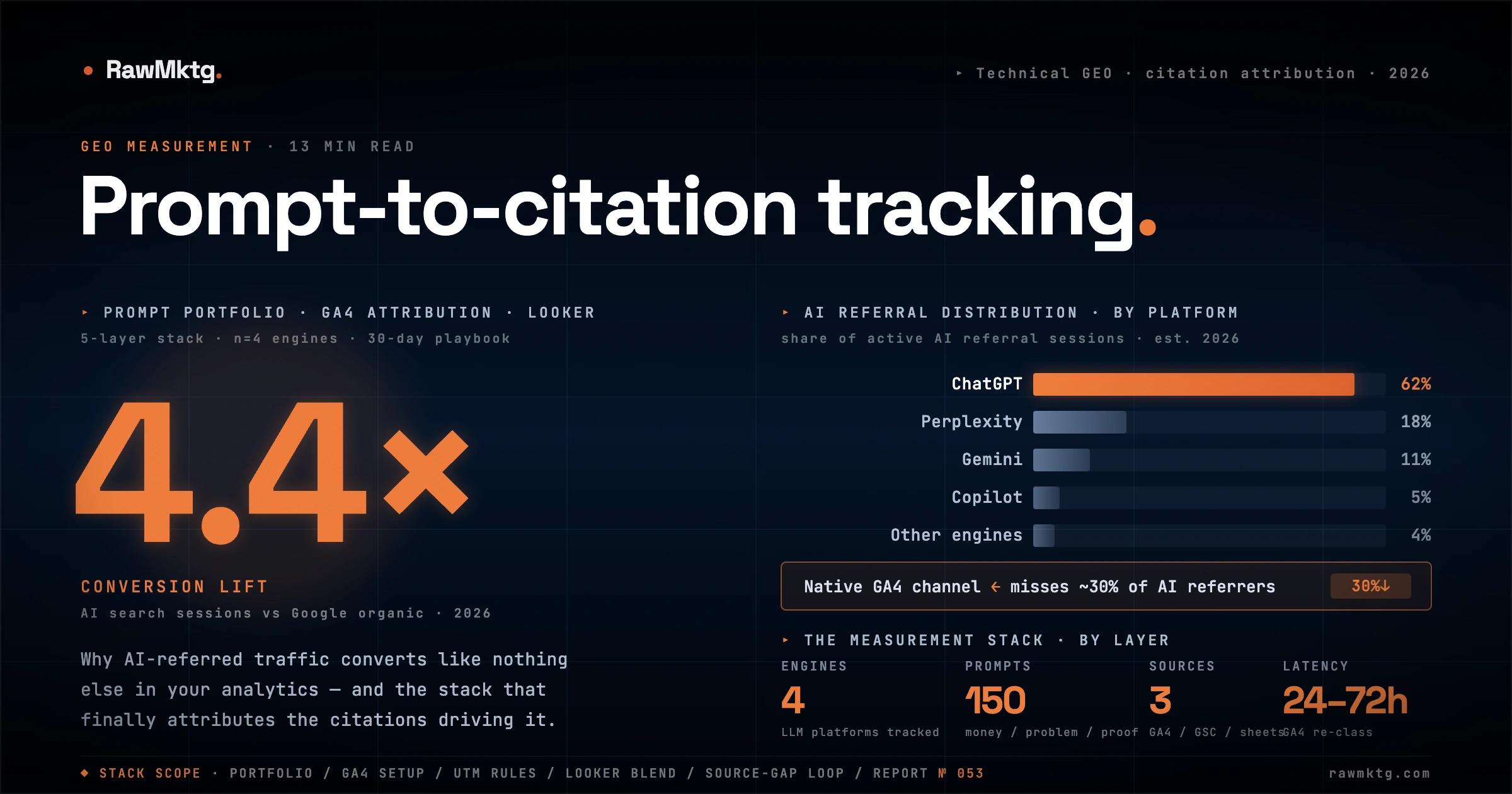
- Incomplete coverage: Google's closed list misses emerging and regional engines, under-counting AI referrers by an estimated ~30%.12
- Referrer fragility: if a link is opened from an app, in-app browser, or copy-paste, the referrer is stripped and the session lands in Direct.
AI traffic is worth fighting for. Early-adopter data shows AI-sourced sessions convert at up to 4.4x the rate of traditional Google organic, with deeper sessions and more first-session conversions: users finished their research inside the chatbot before clicking.12
The 2026 dual-setup solution
The fix is a dual setup: keep Google's native channel and add a custom, regex-driven AI Search channel grouping you control. This gives complete coverage, retroactive classification, and rule ownership.10 Configure it in Admin → Data Display → Channel Groups, create a group named AI-Aware Channel Grouping, add a channel called AI Search, and apply this rule:
# Case-insensitive; captures primary AI referrer hostnames
^(chatgpt|perplexity|gemini|copilot|claude|you|phind|grok|deepseek|chat\.mistral)\.
Prefer explicit strings? Use Source matches one of: chatgpt.com, chat.openai.com, perplexity.ai, gemini.google.com, copilot.microsoft.com, claude.ai, you.com, phind.com, chat.mistral.ai.10
GA4 evaluates channel rules top to bottom. If Referral or Organic Search sit above your AI Search channel, they intercept and misclassify AI sessions before your regex ever runs. Drag AI Search to the absolute top of the priority list.10 Validate live: run a query in ChatGPT, click a cited link, and watch the session land in the new channel in the Realtime report.
Five operational gotchas in 2026
| Anomaly | What happens | Workaround |
|---|---|---|
| Claude referrer stripping | Applies rel="noreferrer", no UTMs: lands as Direct10 |
Model Claude traffic proportionally to ChatGPT/Perplexity trends10 |
| AI Overview masking | Passes google.com/search: looks organic10 |
Treat as Organic; watch for CTR spikes at stable positions in Search Console10 |
| ChatGPT UTM appendage | Adds utm_source=chatgpt.com but no device split8 |
Parse user-agent server-side for device-level separation10 |
| ChatGPT prefetching | Background fetches fire tags with 0 duration / 0 engagement10 | Filter out zero-engagement single-pageview hits10 |
| Mobile app gap | OS browser isolation drops the referrer on app-to-browser hops10 | Read Direct spikes on cited pages alongside known citation wins13 |
06: How do you report GEO results in Looker Studio?
The data-blend architecture
Join all three sources with a left-outer join to avoid omission.14 GSC contributes Date / Page / Query / Search Appearance and Impressions, Clicks, CTR; GA4 contributes Date / Landing Page + Query String and Sessions, Conversions, Revenue; the Sheet contributes Date / Target URL / Platform / Appearance Type and citation counts.15 Use two join keys: Date across all three, and Page (GSC) matched to Landing Page (GA4) matched to Target URL (Sheet).
GA4 reports full paths with query strings (/blog/page?utm_source=chatgpt.com) while GSC reports canonical URLs (/blog/page). Strip the parameters with a calculated field in the GA4 source before blending, or the page join silently fails.10
REGEXP_REPLACE(Landing Page + Query String, '\?.*', '')
Calculated fields that prove ROI
The headline metric is Revenue per Citation (RPC): it quantifies the financial return of each citation won and lets you defend content investment to the C-suite.15 To isolate AI Overview performance, filter GSC charts on its native search-appearance flag:
// Revenue per Citation
RPC = SUM(Revenue) / SUM(Citation Count)

// Isolate Google AI Overview rows in GSC
Include  Search Appearance = AI_OVERVIEW

// Entity heatmap: extract brand/product terms from query
REGEXP_EXTRACT(Query, '(?i)(brand name|product name|competitor name)')
The five-panel ESP dashboard
- Executive scorecard: Total Citations, Blended AI Session Volume, AI Overview CTR, and RPC on a rolling daily basis.15
- Dual-axis trend: Citations (left axis) vs. Direct Revenue (right axis) over 12 weeks, exposing causal links between citation spikes and revenue.15
- Top performing pages: landing pages ranked by citation volume against sessions and conversions, identifying "AI-friendly" hero pages to clone.10
- Entity heatmap: query entities plotted against citation impressions to surface authority gaps.15
- Conversion funnel: off-site discovery to transaction, diagnosing leaks like "answer cannibalization."15
A page with high citations but low click-through is the classic "answer cannibalization" signal: the LLM answered so completely the user never clicked. The fix is to add click triggers: downloadable templates, interactive tools, or proprietary data that require a visit.15
07: How does GEO measurement actually drive action?
| Domain class | Examples | Optimization action | Target metric |
|---|---|---|---|
| Type 1: Outrankable | Weak blogs, thin comparison lists, outdated articles5 | Content upgrade: publish a structured RAG-optimized replacement1 | Citation Rate |
| Type 2: Partner targets | Niche directories, forums, review aggregators5 | Off-site PR: secure mentions, updated listings, expert quotes1 | Mention Rate |
| Type 3: Authority anchors | Standards bodies, journals, gov portals, Wikipedia5 | Entity co-citation: align definitions, build thematic links1 | Entity Resolution Score |
Wire these diagnostics into a cadenced workflow so tracking data continuously feeds the content calendar:3
Weekly evaluation → monthly audit → quarterly sprint keeps the stack tied to the marketing calendar.3
What are the strategic takeaways?
Building a GEO measurement stack is not a tweak to an SEO program: it is a fundamental reconfiguration of how organizations attribute and value digital visibility.2 With AI-sourced sessions converting at up to 4.4x organic, failing to attribute that traffic is a high-stakes risk that leads to misallocated budget and under-investment in the highest-yield channel you have.12 Four moves to make now:
- Deploy the dual GA4 setup: custom AI Search regex, pinned to the top of the evaluation order.10
- Establish a baseline prompt portfolio: 50-150 money/problem/proof prompts, tracked monthly across the major engines.3
- Build the blended Looker Studio dashboard: GSC + GA4 + prompt sheet, surfacing Revenue per Citation.14
- Operationalize the Source Gap loop: feed citation data straight into the content calendar and cluster architecture.2
Do this, and you demystify the generative search ecosystem, prove the tangible ROI of AI-ready content, and run an agile, data-driven strategy built for the next generation of discovery. The citation baseline that populates your prompt portfolio starts with a GEO Foundation Audit.
How do you track AI citations from ChatGPT and Perplexity in GA4?
Create a custom AI Search channel group in GA4 under Admin > Data Display > Channel Groups. Add a regex rule matching AI referrer hostnames: ^(chatgpt|perplexity|gemini|copilot|claude|you|phind|grok|deepseek|chat\.mistral)\.. Critically, drag this channel to the top of the evaluation order above Referral and Organic Search. Use a dual setup that keeps Google's native AI Assistant channel alongside your custom grouping for maximum coverage and retroactive classification.
What is a prompt portfolio in GEO measurement?
A prompt portfolio is a controlled set of 50-150 queries run across AI engines on a recurring schedule to measure citation visibility. Prompts are sorted into three buckets: Money prompts (high-intent commercial evaluation queries), Problem prompts (top-of-funnel pain and solution discovery), and Proof prompts (bottom-of-funnel trust and validation). The portfolio is run against your brand and 3-5 competitors simultaneously, tracking six metrics: Citation Rate, Citation Share, Citation Prominence, Source Gap, Source Diversity, and Volatility.
What is Revenue per Citation and how is it calculated?
Revenue per Citation (RPC) is a Looker Studio calculated field that quantifies the financial return of each AI citation won. It is calculated as SUM(Revenue) divided by SUM(Citation Count), using blended data from GA4 (on-site revenue) joined to a prompt-portfolio Google Sheet (citation counts) on the date and page dimensions. RPC is the headline metric that proves GEO ROI to the C-suite.
How do you measure AI traffic in GA4, and what is Dark AI?
To measure AI traffic in GA4, build a custom channel or segment for known AI referrers, chatgpt.com, perplexity.ai, gemini.google.com and copilot, and report their sessions and conversions over time. The complication is Dark AI: a large share of AI referrals arrive in GA4 as Direct with the referrer stripped, so they are undercounted. Segment Direct traffic against your AI-visibility trend to estimate the dark portion, tag links you control with UTMs, and report the AI-referral and Dark-AI estimate together in Looker Studio alongside your citation tracking.
- 1. ThatWare, GEO Stack: 5-Layer AI Visibility & Citation Framework. thatware.co/5-layer-geo-stack-ai-visibility-framework
- 2. Topify, LLM Citation Tracking Analytics, Explained. topify.ai/blog/llm-citation-tracking-analytics-explained
- 3. Reboot Online, Tracking AI Visibility and Citations (GEO Playbook). rebootonline.com/geo/geo-playbook/tracking-ai-visibility
- 4. Gauge, Best AI Citation Tracking Tools in 2026. withgauge.com/resources/best-ai-citation-tracking-tools-2026
- 5. The Rank Masters, Best AI Citation Tracking Tools for AI Visibility (2026). therankmasters.com/insights/ai-visibility/best-ai-visibility-tools-citation-tracking
- 6. Profound, AI Platform Citation Patterns. tryprofound.com/blog/ai-platform-citation-patterns
- 7. ZipTie, How Different AI Platforms Cite the Same Source Differently. ziptie.dev/blog/how-different-ai-platforms-cite-the-same-source-differently
- 8. Pixelmojo, How to Get Cited by ChatGPT, Perplexity, Claude & Gemini (2026). pixelmojo.io/blogs/geo-playbook-get-cited-chatgpt-perplexity-claude
- 9. AuthorityTech, How to Check Traffic from ChatGPT, Perplexity & Gemini in GA4 (2026 Setup Guide). authoritytech.io/blog/ai-traffic-attribution
- 10. SolvSpot, GA4 AI Search Attribution: Tracking ChatGPT and Perplexity. solvspot.com/blog/ai-search-attribution-ga4-2026
- 11. Delante, Google Analytics 4 Adds a Native AI Assistant Channel. delante.co/ga4-adds-a-ai-assistant-channel-what-it-changes
- 12. OrganiKPI, Track AI Search Referrals in GA4: ChatGPT & Gemini. organikpi.com/blog/technical-seo/ga4-ai-search-referral-attribution
- 13. Affiverse, Track AI Traffic in GA4: A Guide for Affiliates. affiversemedia.com/track-ai-traffic-ga4-affiliate-guide
- 14. eSEOspace, GEO Dashboards and Reporting Templates. eseospace.com/blog/geo-dashboards-and-reporting-templates
- 15. BlogSEO, Looker Studio Dashboard Template: Track AI Overview Citations and Organic Revenue. blogseo.io/blog/looker-studio-ai-overview-citations-revenue
All sources accessed 30 May 2026.