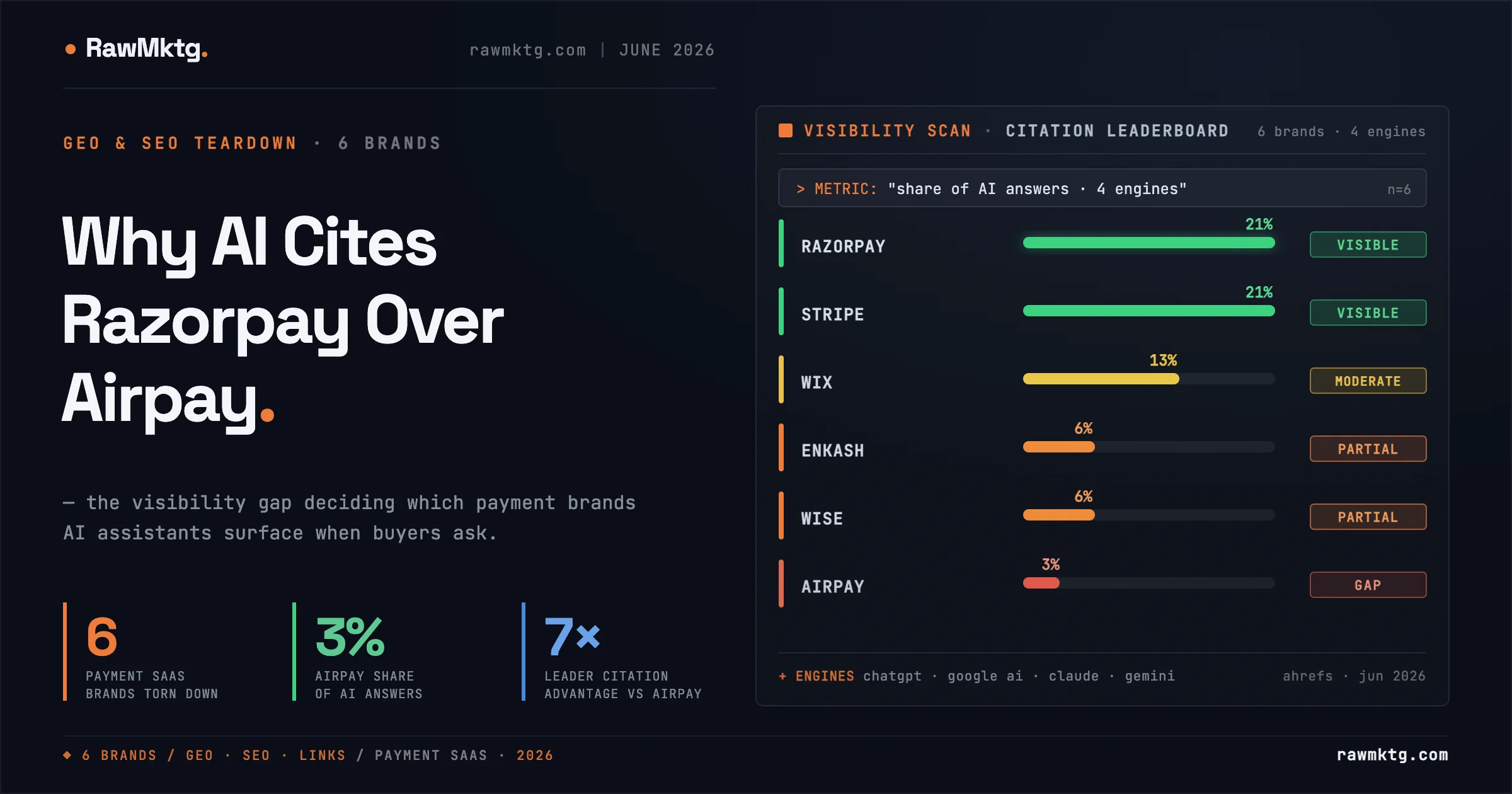
For most of the internet's history, getting found meant ranking on Google. That game still matters. But a second game has begun, and it is reshaping how buyers in India choose a payment gateway: many no longer scroll ten blue links, they ask an assistant. ChatGPT, a Google AI Overview, Gemini or Claude replies with a short answer that names a few brands. If a brand sits inside that answer it makes the shortlist; if not, it is invisible, no matter how good the product is.
To see how this plays out in payments, we used one mid-market Indian gateway, Airpay, as a lens, and compared it against the market leaders across 40 common buyer questions on four AI engines, alongside search, content and link data from June 2026. The patterns are not unique to one company; they describe the whole market, the same gaps we mapped across 48 payments companies.
01Why is getting found changing?
02How do buyers discover a payment gateway now?
On the search path, a brand on page two still has a chance to be seen. On the AI path, the answer usually names only a handful of brands. Being left out of that handful is far more costly than ranking a little lower on Google.
03Who wins AI answers in payments today?
Wix follows at 13%, helped by its website-builder audience asking about payments; EnKash and Wise sit at 6%. The picture also changes by engine: Airpay shows up a little on ChatGPT and Google AI Overviews, and not at all on Claude and Gemini, so visibility has to be earned engine by engine. Grouped into eight buyer topics, Airpay appears only for Wix and website-integration questions and is silent across the core payment topics, gateway basics, EMI, comparisons, compliance, the very topics where new buyers start.
| Buyer question | Brands the AI named instead |
|---|---|
| Best payment gateway for small businesses in India? | Payoneer, Razorpay, Wise |
| How much do payment gateways charge per transaction? | GoCardless, Razorpay |
| How can I offer EMI payment options? | Razorpay, Innoviti, Paytm |
| Which Indian gateway supports buy-now-pay-later? | Cashfree, Stripe |
| Top payment gateway providers in India? | Enterslice, Razorpay |
04What's the content engine behind the leaders?
The leaders did not just write about their own product. They built large libraries of simple guides on topics their buyers care about, what UPI is, how to check a GST number, what a cancelled cheque looks like, how to register a business. Those pages pull in enormous monthly search volume. Comparing Airpay against six leading gateways (Razorpay, Cashfree, PayU, CCAvenue, Instamojo and Easebuzz), we found 8,940 keywords where at least one of them ranks and Airpay does not appear at all.
| Buyer topic | Monthly searches | A competitor that ranks |
|---|---|---|
| gst | 2,190,000 | Razorpay, Cashfree |
| udyam registration | 1,490,000 | Razorpay, Cashfree |
| gst search | 871,000 | Razorpay, Cashfree |
| meesho seller | 757,000 | Razorpay, Easebuzz |
| msme registration | 285,000 | Razorpay, Cashfree |
| cancelled cheque | 119,000 | Razorpay, Easebuzz |
The cost shows up in the traffic mix. Almost all of Airpay's search visitors arrive by typing its brand name, it captures the demand it already has but creates almost none from buyers who do not yet know it.
Leaders win AI answers because they win search. They win search because they publish answer-shaped content at scale. Airpay ranks well for its own name, but without guide content it has little for engines, or buyers, to discover.
05What about trust, links and authority?
Airpay's domain rating of 59 was built over years, yet of the 2,786 sites that link to it, about 94% are flagged as spam, a pattern seen across Indian fintech link profiles, junk that can erode trust rather than build it. There is opportunity in the same data: 3,411 quality sites link to Airpay's competitors but not to Airpay, each one editorial coverage, a directory listing, or a mention the leaders earned and Airpay has not. The trust gap, like the content gap, measures work the leaders did first, the engine behind off-site authority.
06What website mechanics gate visibility?
| Site issue | Scale | What it affects |
|---|---|---|
| Pages missing a main heading (H1) | 53 pages (72%) | Engines struggle to tell what the page is about |
| Pages with no canonical tag | 85 pages (100%) | Engines can get confused about the real page |
| Broken internal links | 14 links | Dead ends waste visitor and crawler trust |
| Images with no description text | 548 images | Lost meaning for engines and screen readers |
| Security headers switched off | ~1,165 pages (99%) | Weaker safety signals across the site |
The lesson is not that one site is broken. Visibility is a stack, content, trust and technical health all have to line up, and a weakness in any layer caps the others.
07What's the pattern? (the visibility flywheel)
This is why the gap between leaders and challengers tends to widen, not narrow, when nothing changes. A brand that is not in the loop is not standing still, it is falling behind a flywheel that is speeding up, the same compounding effect we see across categories.
08What does it mean for the market?
For the leaders: the moat is real, but it is made of content and trust, not magic. It can be matched by anyone willing to publish at the same quality and earn the same coverage. The risk is complacency, because the AI answer rewards the brand that best answers the question, not simply the biggest name.
For the challengers: brand strength alone does not convert into discovery. A challenger can own its name in search and still be missing from the buyer's shortlist. The path forward is consistent: publish answer-shaped content on the topics buyers actually ask about, keep the site clean enough for engines to read, and replace junk links with a smaller number of genuine ones. The same split, leaders compounding while challengers stay invisible, runs through our other teardowns, from data analytics to multifamily proptech.
A neutral analysis, not an endorsement of any brand. AI visibility: a scan of 40 buyer prompts across four engines (ChatGPT, Google AI Overviews, Claude, Gemini), June 2026. Search: organic-keyword and content-gap exports for Airpay and six competitors. Trust: referring-domain and link-intersect exports with domain rating and spam flags. Website health: a technical crawl of Airpay's site. Figures are rounded; percentages describe this data set rather than the entire market.
Why does AI cite Razorpay over Airpay?
Because Razorpay shows up in regular search first, and AI engines build answers from the pages they trust. Razorpay has spent years publishing answer-shaped guide content (UPI, GST, business registration) that wins enormous search volume, while Airpay has almost none. Razorpay appears in ~21% of AI answers across four engines; Airpay in 3%, a roughly 7x gap. It is a content and trust gap, not a product gap.
What is 'share of AI answers'?
It is how often a brand is named when an AI assistant answers a buyer's question. In this scan of 40 payment prompts across ChatGPT, Google AI Overviews, Claude and Gemini, Razorpay and Stripe each appeared in about 21% of answers, Wix in 13%, EnKash and Wise in 6%, and Airpay in 3%. Because assistants name only three to five brands, share of answers decides who makes the shortlist.
Can a challenger payment brand catch up?
Yes, but only by closing the same gaps the leaders closed first. Publish answer-shaped guide content on the core topics buyers ask about (not just product pages), fix the technical faults that stop engines reading the site (missing H1s, no canonicals, broken links), and replace spam backlinks with a smaller number of genuine, editorial ones. Brand strength alone does not convert into AI discovery.
Do backlinks still matter for AI visibility?
Yes. Trust is a major input, and backlinks are one of the biggest trust signals. But quality matters more than volume: Airpay has 2,786 referring domains yet about 94% are flagged as spam, which can erode trust rather than build it. Meanwhile 3,411 quality sites link to its competitors and not to Airpay, the editorial coverage the leaders earned and it has not.
rawmktg. publishes data-driven teardowns of B2B verticals and brands, pulling AI-citation and SEO data to show exactly where the visibility gaps are. Method: same data, same lens, every time. Contact: vinayak@rawmktg.com
Data source: a scan of 40 buyer prompts across ChatGPT, Google AI Overviews, Claude and Gemini, plus organic-keyword, content-gap, referring-domain and technical-crawl data for Airpay and six competitors, captured June 2026.