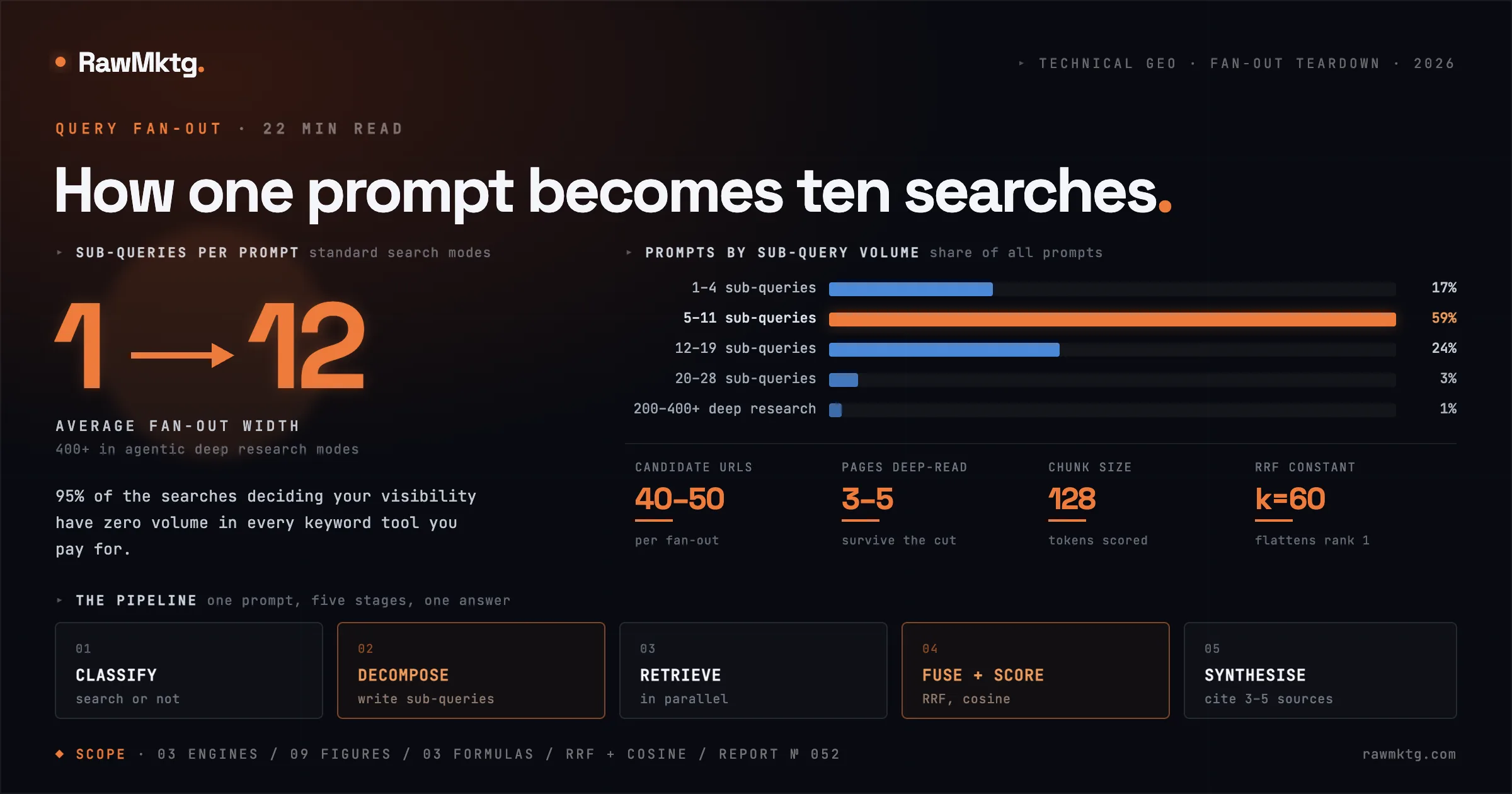
Search used to be a single transaction. You typed a string, the engine matched it against an inverted index, and it handed back ten blue links ordered by lexical relevance, link topology and domain authority. One input, one lookup, one list. Every SEO tactic built between 1998 and 2023 assumes that shape.
That shape is gone. When you ask ChatGPT Search, Google AI Mode or Perplexity a real question, the system does not run your question. It reads your question, works out what you are actually trying to decide, and then writes its own set of searches. Those run in parallel against different corpora, get fused, chunked, scored and compressed into a context window. Only then does a model write the paragraph you read.
The industry name for the middle step is query fan-out (also query decomposition, multi-query retrieval, or query variant generation). If you optimised a page for the sentence a human types, you optimised for a string that is no longer being searched. The strings being searched are machine-written, highly specific, and almost entirely absent from keyword tools.
01What is query fan-out, in one line?
Query fan-out, also written "query fan out" or "query fanout", is the same mechanism Google and Gemini call grounding: the engine expands your prompt into many sub-queries, retrieves passages for each, and grounds its answer in what comes back. So "query fan-out" and "grounding queries" describe the two halves of one process, and its practical meaning is that breadth of coverage, not a single keyword ranking, decides who gets cited.
Each sub-query goes after a distinct facet of the original: a technical spec, a pricing tier, a compliance requirement, a comparison, a piece of social proof, or a follow-up you have not thought to ask. They fire simultaneously across live web indices, knowledge graphs, product catalogues and community databases. The system merges the ranked lists with Reciprocal Rank Fusion and dense vector scoring, assembles the surviving passages into a context block, and passes that to the model, which writes the answer with inline citations.
Retrieval happens per sub-query, not per prompt. A page is never evaluated once. It is evaluated eight to sixteen times, against eight to sixteen different questions, and it only needs to win a few of them to be pulled into the context pool. Visibility is no longer a position. It is a hit rate.
02How many hidden searches does one prompt trigger?
| Sub-query volume | Share of prompts | What triggers it | Typical engine |
|---|---|---|---|
| 1 to 4 | ~17% | Simple factual and navigational lookups | Google AI Mode, ChatGPT standard |
| 5 to 11 | 59% | Standard commercial and comparative intent | Perplexity, ChatGPT Search |
| 12 to 19 | 24% | Multi-faceted buyer journeys and analysis | Google AI Mode on Gemini 2.5 |
| 20 to 28 | ~3% | Advanced multi-constraint research tasks | Complex multi-turn AI sessions |
| 200 to 400+ | Special mode | Recursive agentic deep research | ChatGPT Deep Research |
Read that as a traffic forecast and it looks like good news. Read it as a competition forecast and it is not. Ten sub-queries means ten chances to be included and ten chances to be left out.
03How does ChatGPT Search actually work, stage by stage?
Stage 1: query classification
A lightweight classifier scores the prompt in milliseconds and returns a no-search, simple-search and complex-search probability. If the no-search score clears roughly 0.2, the model answers from parameters and no retrieval happens at all. If the complex score clears roughly 0.4, the system enters a recursive multi-turn planner. (Rankly) A meaningful share of prompts in your category may never trigger a search, for those you are competing against training data and brand memory, not your sitemap.
# Conceptual shape of the routing decision
scores = classifier(prompt, conversation_history)

if scores.no_search > 0.20:
    return answer_from_parameters(prompt)        # no retrieval, no citations
if scores.complex_search > 0.40:
    return recursive_planner(prompt, max_rounds=3)   # fan-out, read, fan-out again
return single_pass_retrieval(prompt)             # one round of sub-queries
Stage 2: search query generation
The orchestrator writes two classes of query: short keyword queries for inverted-index lookup, and longer semantic queries (around fifteen words) written to align vector embeddings with intent. For complex prompts it runs a planner loop, up to three rounds, issuing a batch, reading the metadata, spotting gaps, and firing again. If your content answers the obvious facet, you compete in round one against everyone. If it answers the awkward second-order facet, you are one of very few candidates in round two, where the field is thin.
Stages 3-4: filter, fetch and chunk
Sub-queries return 40 to 50 candidate URLs. Before fetching a single page, the system cuts that pool to 10 to 20 based purely on SERP-level metadata, title tags, meta descriptions, authority signals and schema. Your body copy is not consulted at this stage; your title tag is doing all the work. (Rankly) Survivors are fetched three to ten at a time under a hard two-second render timeout, then parsed into uniform, non-overlapping 128-token chunks (Rankly), about a hundred words, that may be split mid-argument by a chunker that has never read your headline.
Stages 5-6: vector scoring and the audition chunk
Chunks are embedded and scored by cosine similarity against the semantic sub-query vectors, thousands of comparisons in 100 to 200 milliseconds. The system then looks at the single highest-scoring chunk from each page, its audition chunk, alongside the metadata, and selects a final pool of three to five pages for deep reading. Your entire page is represented, at the moment of selection, by its best hundred words. If your best chunk is a hedged introduction, you do not audition well.
Stage 7: context assembly and generation
Surviving text, roughly 5,000 to 6,000 tokens, is formatted into sliding windows around the top chunks, and the core model writes the answer with inline citations. Two infrastructure facts sit underneath: about 92% of ChatGPT's external searches run via the Bing Search API, and OpenAI's OAI-SearchBot does not execute JavaScript, it parses raw HTML. Empirical work found 46% of ChatGPT crawler requests operating in plain-HTML mode. (Netstager)
04How do Google AI Mode and Perplexity differ?
What makes Google's version structurally different is not the count, it is the destinations. Your product page competes in the web index, your entity record in the Knowledge Graph, your feed in the Shopping Graph, your reviews somewhere else entirely. A team that only owns the website is playing one of four hands. And the number that should reshape planning: pages that rank for the associated fan-out sub-queries are 161% more likely to be cited in AI Overviews than pages that rank only for the primary query. (Surfer) This is the multi-corpus split covered in AI Mode vs AI Overviews.
Perplexity leans on decomposition hardest and most visibly, exposing its sub-queries as follow-up searches. It is the cheapest research tool available: type your buyers' questions and read the sub-queries it shows you. That is your content brief, written by the machine that will grade it. (Finseo)
| Feature | ChatGPT Search | Google AI Mode | Perplexity |
|---|---|---|---|
| Orchestrator | Dedicated reasoning orchestrator | Custom Gemini 2.5 engine | Agentic RAG pipeline |
| Sub-queries / prompt | 8 to 12 (400+ in Deep Research) | 8 to 16 parallel | 6 to 10 |
| Primary index | Bing API ~92% + OAI-SearchBot | Web index, Knowledge Graph, Shopping Graph, reviews | Hybrid web + multi-engine APIs |
| JavaScript rendering | No, raw HTML only | Yes, Googlebot pipeline | Partial and limited |
| Fetch timeout | Hard 2.0s per page | Native SERP latency | Dynamic multi-source |
| Unit evaluated | 128-token vector chunks | Entity-based passage scoring | Structured Q&A passages |
05What is the math that decides who gets cited?
Vector embeddings and cosine similarity
A 128-token chunk becomes a dense vector; a generated sub-query becomes a dense vector in the same space; relevance is the cosine of the angle between them. The denominator normalises for magnitude, so a long passage does not beat a short one simply for being long. Retrieval systems care about the band from roughly 0.7 upward. Because embeddings capture concepts rather than strings, a chunk can score high with zero exact keyword overlap. Keyword density is not a lever here; conceptual cleanliness is.
# What the scoring pass looks like, minus the GPU
import numpy as np

def cosine(a, b):
    return float(a @ b / (np.linalg.norm(a) * np.linalg.norm(b)))

chunks        = chunk_page(html, size_tokens=128, overlap=0)
chunk_vecs    = embed(chunks)              # e.g. 1536 dimensions each
subquery_vecs = embed(generated_subqueries)

# every chunk is scored against every sub-query, independently
scores = { (i, j): cosine(q, ch)
           for i, q  in enumerate(subquery_vecs)
           for j, ch in enumerate(chunk_vecs) }

# the page is represented by its single best chunk: the audition chunk
audition = max(scores.values())Your page's score at the selection gate is a maximum, not a mean. Padding a page with more sections does not raise its audition score. Writing one section that nails one sub-query does.
Reciprocal Rank Fusion, and why #1 is overrated
After N parallel sub-queries the system holds N ranked lists and needs one pool. It merges them with RRF: each document scores the sum, across every list it appears in, of one over a constant (conventionally k=60) plus its rank. (GEOly) The constant exists to stop any single list's top result from dominating, and it works by flattening the top of the curve almost completely.
Thirteen percent. Every incremental effort spent moving a page from position ten to position one buys a 13% edge inside a single sub-query list. Appearing at all in a second sub-query list buys you close to 100%.
# Reciprocal Rank Fusion in eight lines
from collections import defaultdict

def rrf(result_lists, k=60):
    scores = defaultdict(float)
    for ranked in result_lists:                 # one list per sub-query
        for rank, doc in enumerate(ranked, start=1):
            scores[doc] += 1.0 / (k + rank)
    return sorted(scores.items(), key=lambda kv: kv[1], reverse=True)

# doc_a appears once at rank 1; doc_b appears four times at rank 5
lists = [
    ['doc_a', 'x', 'y', 'z', 'doc_b'],
    ['p', 'q', 'r', 's', 'doc_b'],
    ['t', 'u', 'v', 'w', 'doc_b'],
    ['m', 'n', 'o', 'l', 'doc_b'],
]
rrf(lists)[:2]
# [('doc_b', 0.06154), ('doc_a', 0.01639)]
The fusion algorithm structurally favours content that addresses multiple facets over monolithic pages that optimise for one head term. It is the mathematical reason a topical authority cluster outperforms a hero page. And because the engine scores individual chunks against specific sub-queries, not domains against topics, passage relevance now outranks domain authority: a small domain's explicit, dense, atomic answer can outscore a vague passage on a major publisher (Netstager). Authority still helps at the selection gate, but it cannot manufacture a relevant chunk that does not exist.
06What does fan-out do to a real buyer prompt?
A traditional engine would try to match 'enterprise CRM healthcare Epic EHR HIPAA under 150' and return a mess of sponsored pages. The AI system writes eight searches instead:
| ID | Facet | Target corpus | Selection logic |
|---|---|---|---|
| SQ-01 | Product classification | Web index, review aggregators | Identify category leaders |
| SQ-02 | Technical compatibility | Vendor docs, app exchanges | Filter on a hard integration requirement |
| SQ-03 | Regulatory | Trust centres, security specs | Verify the mandatory legal framework |
| SQ-04 | Functional capability | Feature modules, product guides | Assess automation depth |
| SQ-05 | Commercial | Official pricing pages | Enforce the sub-$150 constraint |
| SQ-06 | Direct comparison | Comparative roundups | Analyse trade-offs between leaders |
| SQ-07 | Sentiment | Reddit, Quora, peer forums | Validate real implementation experience |
| SQ-08 | Edge case | Vendor FAQs, knowledge bases | Audit constraints on secondary candidate |
The synthesised answer highlights Vendor A for superior Epic integration (cited from technical docs), notes Vendor B as cost-effective but flags that Epic sync needs middleware (cited from a developer forum), and excludes Vendor C outright because its HIPAA BAA is restricted to tiers above $200. This is the mechanism behind most unexplained AI visibility losses. The page was fine. The coverage was not.
A competitor published one well-optimised landing page targeting 'best healthcare CRM'. It was excluded entirely, because it offered no extractable data for SQ-02, SQ-03 or SQ-05. It did not rank badly. It was never a candidate. There was nothing on the page for three of the eight questions to retrieve.
07Why can't keyword tools see the searches that matter?
So the standard workflow breaks at the first step, there is no volume report to sort descending. What replaces it: read the sub-queries Perplexity exposes for your category; mine your sales calls (buyer objections are almost verbatim what the orchestrator generates); enumerate your head term's facets deliberately (specification, compatibility, compliance, capability, price, comparison, sentiment, edge case); and watch which pages get cited for questions you never targeted. Search volume as a prioritisation metric is retiring. Facet coverage replaces it, the same shift measured in citation vs mention vs recommendation.
| Factor | Traditional SEO | Generative engine optimisation |
|---|---|---|
| Primary goal | Rank #1 on a results page | Be cited inside a synthesised answer |
| Targeting unit | One focus keyword per page | Whole intent clusters and entity facets |
| Ranking signal | Domain authority, backlinks, exact match | Passage vector similarity, monosemantic chunks |
| Volume model | High-volume head and mid-tail terms | Zero-volume sub-queries, ~95% invisible |
| Content structure | Monolithic 2,500-word guide | Modular, self-contained, passage-level answers |
| Technical focus | Core Web Vitals, mobile UX, JS rendering | Plain-HTML readability, fast crawl, schema |
| Measurement | Clicks, keyword rankings, impressions | Citation frequency, share of voice by facet |
08How do you optimise for query fan-out?
1. Write atomically, and let headings do the retrieving
Engines extract 128-token chunks and score them independently, so build modular, self-contained sections where each fully answers one sub-question. Pages with headlines that directly answer specific sub-questions are cited by ChatGPT 41% of the time, against 29% for generic or artistic headlines, a twelve-point swing for writing your H2s as questions. (Netstager) The counterintuitive part: focused articles covering 26% to 50% of a topic's sub-queries beat massive single-page guides attempting 100%, because five focused pages produce five audition chunks, five title tags and five shots at the fusion pool, where one monster URL produces one of each. This is the shape of a high-citation page.
<article>
  <h1>Healthcare CRM platforms with native Epic EHR integration</h1>
  <section>
    <h2>Which healthcare CRMs integrate natively with Epic EHR?</h2>
    <p>Three platforms offer certified native Epic integration:
    Vendor A (Epic App Orchard, bidirectional), Vendor B (read-only
    via middleware), and Vendor C (FHIR R4 endpoint, 2024 onward).</p>
    <!-- answer lands in the first 40 words, inside one chunk -->
  </section>
  <section>
    <h2>Does a HIPAA BAA come with every pricing tier?</h2>
    <table>...tiers, BAA availability, price per user per month...</table>
  </section>
</article>
Answer first, elaborate second. The chunker does not read ahead. If your answer arrives in paragraph four, it lands in a different chunk from the heading that promised it, and the two are scored separately.
2. Keep passages monosemantic
A passage is monosemantic when it stays cleanly on one concept. High monosemanticity keeps the embedding mathematically close to the target sub-query vector, maximising cosine similarity. (Aleyda Solis) Passages that blend several topics produce a vector that sits between all of them and scores mediocre against every sub-query. Practical test: take any 150-word block in isolation, with no heading, and ask what single question it answers. If you cannot name one, the chunk will not win one. This is the passage-level layer beneath how your page gets retrieved.
3. Make the facts survive a non-rendering crawler
Since OAI-SearchBot does not run client-side JavaScript, and 46% of ChatGPT retrieval passes fetch plain HTML, every fact you want cited must be in the server-side response, and under a two-second timeout. Use semantic HTML (article, section, h2, table); never render pricing, specs or compliance data client-side; use real HTML tables, not CSS grids or images; and ship JSON-LD, more in schema markup for AI citations and how AI crawlers index your site.
It does not exist. Not to a non-rendering crawler working under a two-second timeout. Any fact you want cited, pricing, specs, compliance terms, integration lists, has to be in the server-side HTML response.
{
  "@context": "https://schema.org",
  "@type": "SoftwareApplication",
  "name": "Vendor A Health Cloud",
  "applicationCategory": "CRM",
  "offers": {
    "@type": "Offer",
    "price": "120.00",
    "priceCurrency": "USD",
    "unitText": "per user per month"
  },
  "featureList": [
    "Native Epic EHR integration via App Orchard",
    "HIPAA Business Associate Agreement on all paid tiers",
    "Automated patient outreach workflows"
  ]
}
4. Build the off-site footprint, because the fan-out leaves your domain
Sentiment sub-queries do not go to your website. They go to Reddit, Quora, G2 and Capterra, because the engine is cross-validating your claims against people who are not you. Domains with strong profiles across those platforms see roughly 3x higher citation rates, and sites with very large referring-domain footprints are around 3.5x more likely to be cited. (Netstager) A fan-out of eight sub-queries might send only four at content you control; the other four go to corpora you can influence but not own. That is the argument for authority seeding and why AI cites Reddit, G2 and analysts.
09How do you measure any of this?
Most teams have spent a decade optimising selection for a handful of queries while leaving retrieval at zero for most of the fan-out. A workable loop, without buying anything: build a prompt set of 30 to 50 real buyer questions; run them across ChatGPT Search, AI Mode and Perplexity weekly, logging every cited domain; capture the sub-queries where the interface exposes them; score whether you were cited, mentioned without a link, and which facet you were cited for; and track share of voice by facet. Gaps by facet tell you what to write next, the discipline behind prompt-to-citation tracking.
# Minimal citation tracker: prompts in, cited domains out
import datetime

PROMPTS = load_jsonl('buyer_prompts.jsonl')     # 30-50 real questions
rows = []
for p in PROMPTS:
    for engine in ('chatgpt_search', 'ai_mode', 'perplexity'):
        answer = ask(engine, p['text'])
        rows.append({
            'date':       datetime.date.today().isoformat(),
            'prompt':     p['id'],
            'facet':      p['facet'],        # spec | compat | compliance | price ...
            'engine':     engine,
            'cited':      OUR_DOMAIN in answer.citations,
            'mentioned':  OUR_BRAND in answer.text,
            'sources':    answer.citations,
            'subqueries': answer.get('subqueries', []),   # Perplexity exposes these
        })

# share of voice by facet is the number that should move
sov = group_by(rows, 'facet', agg=lambda r: mean(x['cited'] for x in r))Three browser-based tools built from this deep dive: the Facet Coverage Auditor to find your gaps, the Expected-Citation Estimator that replaces rank tracking, and the Fan-Out Content Brief Generator. They complement the existing Query Fan-Out Simulator, a free query fan-out tool, and RRF Calculator. All free, all run in your browser.
10What should you do this week?
- Pick your five highest-value buyer prompts and decompose them by hand with the eight-facet frame: specification, compatibility, compliance, capability, price, comparison, sentiment, edge case. You will find gaps within twenty minutes.
- Audit the facets, not the keywords. For each sub-query, ask whether any single passage on your site answers it in under a hundred words. If not, that is a brief.
- Rewrite your H2s as questions, then move the answer into the first forty words underneath each.
- Curl your own pages with JavaScript disabled. Anything missing from that response is invisible to a meaningful share of AI retrieval.
- Split the monster guide. One page carrying twenty facets has one audition chunk and one title tag; five focused pages have five of each.
- Claim the off-domain surfaces: review profiles, documentation, community answers, entity records. Half the fan-out never touches your site.
- Start the prompt log now. Thirty prompts, weekly, three engines, in a sheet.
Frequently asked questions
What is query fan-out in AI search?
Query fan-out is the step where an AI search engine decomposes your single prompt into a set of targeted sub-queries, one per facet of what you meant (a spec, a price tier, a compliance requirement, a comparison, social proof), then fires them in parallel against different corpora. Instead of searching once for what you typed, the engine searches many times for what you meant, and each sub-query is a separate retrieval contest with its own winners.
How many sub-queries does one prompt generate?
In standard modes, a single conversational prompt fans out into roughly 8 to 16 parallel sub-queries. About 59% of prompts trigger 5 to 11, 24% trigger 12 to 19, and the hardest standard tasks reach 28. Agentic research modes break the scale entirely: a single ChatGPT Deep Research prompt has been documented triggering over 400 sub-queries.
Why do zero-volume keywords matter for AI search?
Over 95% of generated fan-out sub-queries have zero recurring search volume in keyword tools, because they are machine-written fresh for one user's context and never typed by anyone. Keyword databases measure strings humans repeat, so they cannot see a query that occurs once. The prioritisation metric shifts from search volume to facet coverage: how many of the sub-queries in a topic you can answer better than anyone.
Does ranking #1 still matter with Reciprocal Rank Fusion?
Less than it used to. Under RRF with the conventional constant k=60, rank #1 contributes 0.01639 and rank #10 contributes 0.01429, a gap of just 13%. Moving a page from position 10 to 1 inside one sub-query buys a 13% edge; appearing at all in a second sub-query list buys close to 100%. A document that ranks #5 across four lists beats a document that ranks #1 in one, by 3.75x.
How do you optimise for query fan-out?
Write atomically, one self-contained section per sub-question with the answer in the first 40 words; keep passages monosemantic so the embedding sits close to one sub-query vector; serve every fact (pricing, specs, compliance) in server-side HTML because the main ChatGPT crawler does not render JavaScript; and build the off-site footprint, since sentiment sub-queries go to Reddit, G2 and forums, not your site. Rewriting H2s as questions alone lifts ChatGPT citation rate from 29% to 41%.
Is query fan-out the same as grounding?
Largely yes. Grounding is the term Google and Gemini use for retrieving external passages to support an answer, and query fan-out is how that retrieval is done: the model rewrites your prompt into eight to sixteen sub-queries, runs them in parallel, and grounds the answer in the passages that come back. "Query fan-out" names the expansion step; "grounding" names the retrieve-and-cite loop it feeds.
What is query fan-out in ChatGPT?
ChatGPT uses query fan-out through its search tool: when a prompt needs current information, it rewrites your single question into several targeted search queries, runs them, and synthesises the results. The mechanism is the same fan-out other AI engines use, so the optimisation is the same, cover the facets an engine is likely to split your prompt into rather than the single head phrase.
Is there a query fan-out tool?
Yes. The free Query Fan-Out Simulator takes a buyer prompt and shows the sub-queries an engine is likely to generate from it, so you can see which facets your page answers and which it misses. Pair it with the Fan-Out Content Brief Generator to turn those sub-queries into an outline, and the RRF Calculator to see how fusion scoring rewards breadth over a single number-one ranking.
The pipeline analyses and measurements this deep dive draws on.
- What Is Query Fan-Out in SEO and How Does It Affect Your Rankings? Netstager.
- Query Fan-Out Analysis Tool: Analyze AI Query Decomposition. Finseo.
- Google AI Mode's Query Fan-Out Technique: What It Means for SEO. Aleyda Solis.
- What Is Query Fan-Out and How Does It Work for AI Searches? Search Engine Land.
- What Is Query Fan-Out and Why Does It Matter? Semrush.
- Query Fan-Out: Everything You Need To Know. Surfer.
- How ChatGPT Search Works: The 7-Stage Pipeline Behind Every Answer. Rankly.
- What Is Query Fan-Out? Understanding the Hidden Queries Driving AI Search. GEOly.
- LegalMALR: Multi-Agent Query Understanding and LLM-Based Reranking. arXiv.
rawmktg. publishes data-led analysis of how search, retrieval and AI answer engines actually work. Method: same data, same lens, every time. Contact: vinayak@rawmktg.com
Figures are original illustrations built from the cited data. Percentages are drawn from published third-party measurements and should be read as directional rather than exact.