Field service management (FSM) software is a growing market: research puts it at $5.12 billion in 2025, rising to $5.88 billion in 2026, a compound annual growth rate of about 15 percent. Demand is real and buyers are searching in plain, searchable language.
Yet when you look at how the category's ten most visible vendors actually perform in organic search and in AI answers, a clear and repeatable set of lessons emerges, and they apply far beyond field service. The question is whether your brand shows up when buyers search, on Google and now inside AI answers. For most of the field, the answer is: not for the terms that matter.
01What is the short version?
The seven takeaways
- Domain Rating is a vanity metric. One vendor holds a trust score of 68 and 2,300+ linking domains, yet earns roughly 332 organic visits a month. Authority without live, matched content produces almost nothing.
- Branded demand is a trap. For most vendors, the top organic terms are the company's own name and login page, demand you already own, not new buyers.
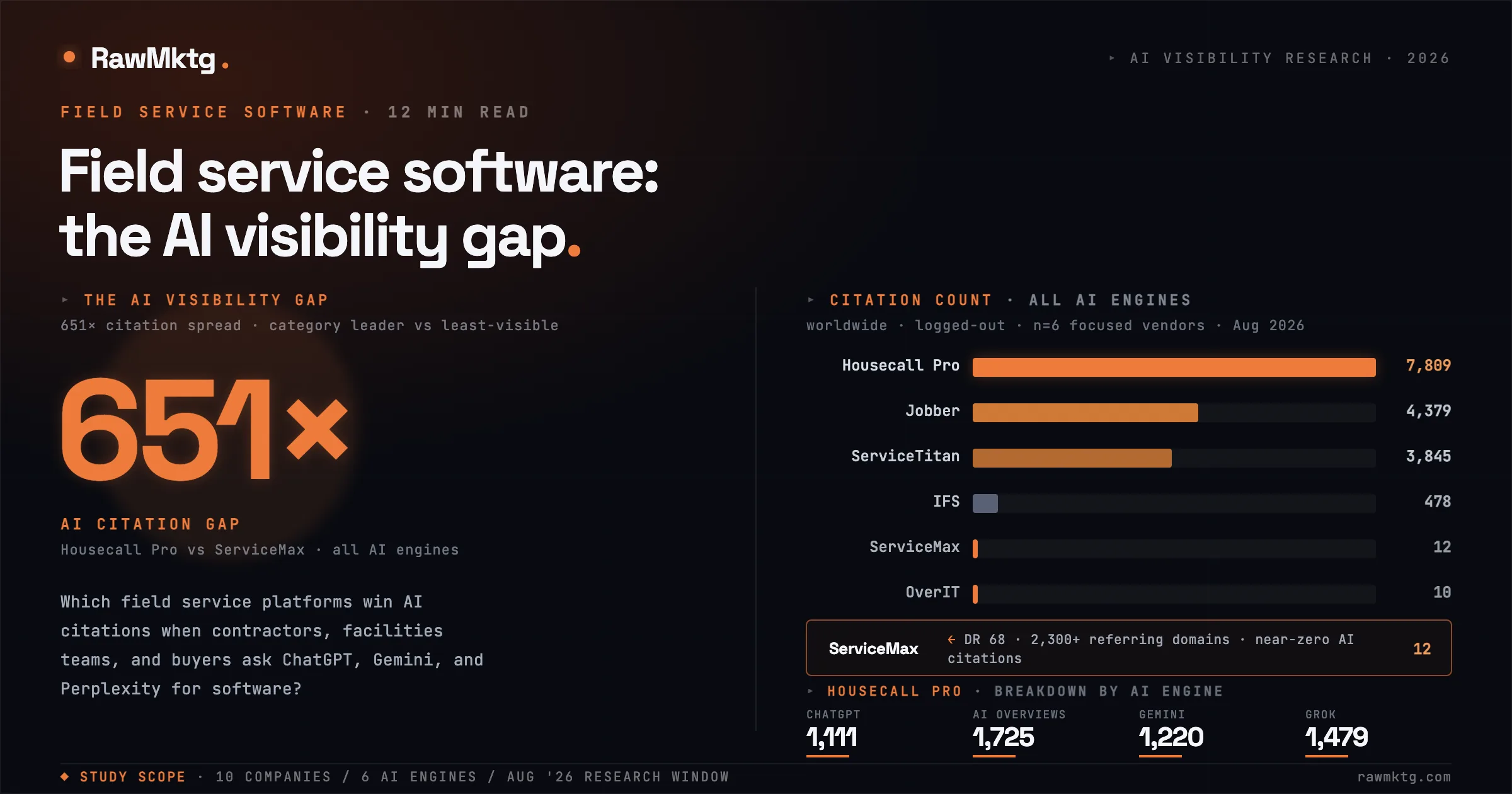
- AI visibility is a distinct scoreboard. Some vendors are cited across every engine thousands of times; two others are effectively invisible with fewer than 50 combined.
- The buyer-term map is winnable. Many high-intent field service terms carry a difficulty under 30, and some comparison terms sit near zero.
- Structured data is the cheapest AI-visibility lever. The single biggest legibility gap on the pages we checked was missing JSON-LD schema.
- Links still separate the pack. Referring-domain counts track durable authority and which brands AI engines treat as safe to cite.
- Paid search masks organic gaps. The thinnest-organic vendor buys the most ads, defending high-intent terms it has not earned.
02Is the market actually growing, and are buyers searching?
03What does the visibility landscape look like?
| Vendor | DR | Organic visits/mo | Keywords | Ref. domains |
|---|---|---|---|---|
| Microsoft Dynamics 365 | 96 | 302.9M | 2.8M | 2.6M |
| Salesforce | 92 | 9.6M | 221K | 209K |
| SAP | 91 | 4.5M | 105K | 91K |
| ServiceNow | 87 | 1.4M | 35K | 31K |
| Jobber | 90 | 322K | 9K | 27K |
| Housecall Pro | 89 | 140K | 11K | 21K |
| ServiceTitan | 80 | 338K | 14K | 13K |
| IFS FSM | 77 | 81K | 4K | 9K |
| PTC ServiceMax | 68 | 332 | 172 | 2K |
| OverIT | 47 | 2K | 150 | 882 |
Note how loosely trust score (Domain Rating) tracks with either organic keywords or traffic, the pattern that anchors this whole teardown, and the same one behind the carbon and ESG software teardown.
04Lesson one: is authority the same as traffic?
This is the same gap covered in ranking isn't visibility: link equity pointed at nothing converts to nothing.
05Lesson two: what is the branded-demand trap?
06Lesson three: are AI answers a separate scoreboard?
High AI visibility does not require the most traffic; it requires clearing every stage of the citation pipeline, the mechanism detailed in how your page gets retrieved.
Engines cannot cite what they cannot read. Two low-cost, high-leverage moves make a page machine-readable: a structured-data block that tells the engine exactly what the page is, and an llms.txt file that points AI crawlers to your priority pages, more on whether llms.txt does anything yet in the technical section below.
07Lesson four: do boring technical foundations still decide legibility?
| Signal | Why it matters for search and AI | Effort |
|---|---|---|
| One clear H1 | Tells engines the page's primary topic. Several pages had zero or multiple H1s. | 1 hr |
| JSON-LD structured data | The single biggest AI-legibility lever. Multiple product pages had none. | 6-8 hrs |
| Valid robots.txt with sitemap | Directs crawlers and points them to your page index. | 1-2 hrs |
| XML sitemap at the standard path | Helps discovery and indexation. A few returned an app shell instead. | 3-4 hrs |
| Open Graph + Twitter tags | Clean titles, descriptions and previews for shares and engines. | 2-3 hrs |
| llms.txt | Owner guidance for AI crawlers. Most vendors do not have one yet. | 1-2 hrs |
Tell engines what the page is with a SoftwareApplication schema block, the full pattern is in schema markup for AI citations:
<script type="application/ld+json">
{
  "@context": "https://schema.org",
  "@type": "SoftwareApplication",
  "name": "Acme Field Service",
  "applicationCategory": "BusinessApplication",
  "operatingSystem": "Web, iOS, Android",
  "description": "Scheduling, dispatch, and invoicing for field service teams.",
  "offers": { "@type": "Offer", "price": "65.00", "priceCurrency": "USD" },
  "aggregateRating": {
    "@type": "AggregateRating", "ratingValue": "4.6", "reviewCount": "1200"
  }
}
</script>
Point AI crawlers to your priority pages with an llms.txt, and confirm your robots.txt permits the named AI bots:
# llms.txt  (serve at https://yourdomain.com/llms.txt)
# A plain-text map of the pages you most want AI engines to use.

## Product
- /field-service-management: what the product does, who it is for
- /pricing: plans and pricing

## Buyer guides
- /guides/field-service-software: category overview
- /compare/acme-vs-competitor: honest comparison
User-agent: *
Allow: /

User-agent: GPTBot
Allow: /

Sitemap: https://yourdomain.com/sitemap.xml
08Lesson five: is the buyer-term map winnable?
| Buyer term | Global searches/mo | Difficulty | Play |
|---|---|---|---|
| servicetitan competitors | 600 | 1 | Comparison, high intent |
| dispatch software | 3,600 | 4 | Quick win |
| plumbing software | 2,200 | 9 | Quick win, vertical |
| work order software | 2,900 | 12 | Near-term |
| field service management software | 9,400 | 52 | Medium term, pillar page |
09Lesson six: do links still separate the pack?
| Set | Examples | Why it helps |
|---|---|---|
| 1. Directories and review sites | G2, Capterra, GetApp, Software Advice, TrustRadius | Buyers and AI engines both read them. Fast, mostly self-serve. |
| 2. Trade and industry media | HVAC, plumbing and field service trade publications | Reaches the exact buyers and builds category trust. |
| 3. News, research and data | 'Best software' roundups, original data studies | One data report earns many links at once and gets cited by AI. |
10Lesson seven: does paid search mask organic gaps?
The strongest organic performer invests comparatively little in paid, because its content engine already captures the demand it needs. Use paid to buy time while organic and AI visibility compound, not as a permanent substitute, the same trap covered in getting found on Google and AI.
11What is the 90-day playbook?
| Phase | Focus | Concrete moves |
|---|---|---|
| Month 1 | Fix and instrument | Add schema and llms.txt, fix H1s, sitemap and robots.txt. Claim directory and review-site profiles. Stand up AI-citation and non-branded-traffic tracking. |
| Months 1-2 | Build buyer pages | Ship pages for the easiest high-intent terms, a plain 'what is field service software' explainer, and a short answer box near the top of each product page. |
| Months 2-3 | Trust and moat | Publish comparison and alternative pages, then one original data report, and pitch it to trade media for links and AI citations. |
A measurement framework
Most teams measure organic traffic and stop. In an AI-search world that misses half the picture. Track these five together, monthly, the same discipline as prompt-to-citation tracking:
| Metric | What it tells you | Healthy direction |
|---|---|---|
| Non-branded organic traffic | New-buyer discovery, not brand harvesting | Up |
| AI citations by engine | Whether AI answers name you | Up, across 4+ engines |
| Share of top-10 terms that are non-branded | Whether content is creating demand | Above 50% |
| Referring domains (category-relevant) | Durable authority | Steady growth |
| Paid-to-organic ratio on core terms | How rented your demand is | Down over time |
{
  "month": "2026-08",
  "non_branded_organic_visits": 4200,
  "ai_citations": { "chatgpt": 120, "google_ai": 95, "perplexity": 60,
                    "gemini": 30, "copilot": 25, "grok": 40 },
  "nonbranded_share_top10": 0.38,
  "category_referring_domains": 210,
  "paid_to_organic_ratio_core": 0.9
}12Founders vs marketers: who owns what?
| If you are a founder, focus on | If you are a marketer, focus on |
|---|---|
| Treat search and AI visibility as a product surface, not a channel. Fund structured data and technical health like features. | Kill the branded-traffic illusion in reporting. Separate branded from non-branded and report the non-branded line. |
| Resist vanity metrics. Ask for non-branded traffic and AI citations, not Domain Rating. | Own the buyer-term map. Ship comparison and alternative pages first; they are high intent and low difficulty. |
| Invest in one original data asset a year. It is the cheapest durable moat for links and AI citations. | Make every key page readable: schema, llms.txt, one H1, a direct answer near the top. |
| Hire or partner for content plus technical SEO plus digital PR together, not in silos. | Measure the five-metric scorecard monthly and let it drive the roadmap. |
13What is the bottom line?
Field service software is a healthy, growing market where buyers search in plain language and increasingly ask AI engines for recommendations. None of the winning work is exotic. It is a sequence, and most of the field has not run it yet.
Frequently asked questions
Which field service software has the best AI visibility?
Among focused FSM vendors, Housecall Pro leads AI citations by a wide margin with about 7,809 across the major engines, followed by Jobber (4,379) and ServiceTitan (3,845). IFS trails at 478, while ServiceMax (12) and OverIT (10) are effectively invisible, a 651x spread between the category leader and the least-visible vendor.
Does domain authority predict organic traffic for field service software?
No. Domain Rating tracks organic traffic loosely at best. The clearest example in the category is an asset-centric vendor with a Domain Rating of 68 and over 2,300 referring domains, the residue of years as a leader, that earns only about 332 organic visits a month because its content did not follow the product. Authority is a stock; traffic is a flow.
What are the best keywords for field service software?
The most winnable buyer terms combine intent with low difficulty: dispatch software (3,600/mo, KD 4), plumbing software (2,200/mo, KD 9), work order software (2,900/mo, KD 12) and competitor-comparison terms like 'servicetitan competitors' (600/mo, KD 1). The broad head term, field service management software (9,400/mo, KD 52), is a medium-term pillar play.
How do you get field service software cited by AI engines?
Make the page machine-readable and answerable. Add SoftwareApplication and FAQ JSON-LD schema, publish an llms.txt pointing crawlers to priority pages, ensure a clean robots.txt and sitemap, give each page one clear H1 and a direct answer near the top, and ship honest comparison pages, which AI engines quote readily.
What is the difference between SEO and GEO for field service software?
SEO is winning Google's ranked results; GEO (generative engine optimization) is getting named inside AI answers from ChatGPT, Gemini, Perplexity and others. They overlap, the same structured, answer-first content helps both, but AI visibility is a distinct scoreboard: high organic traffic does not automatically produce AI citations, and vice versa.
rawmktg. publishes data-driven teardowns and technical playbooks on GEO, AI search and B2B discoverability. Method: same data, same lens, every time. Contact: vinayak@rawmktg.com
Methodology: Ahrefs worldwide data and live technical checks across ten FSM vendors, August 2026. Brands are named only as illustrative examples of patterns any B2B software team can learn from.