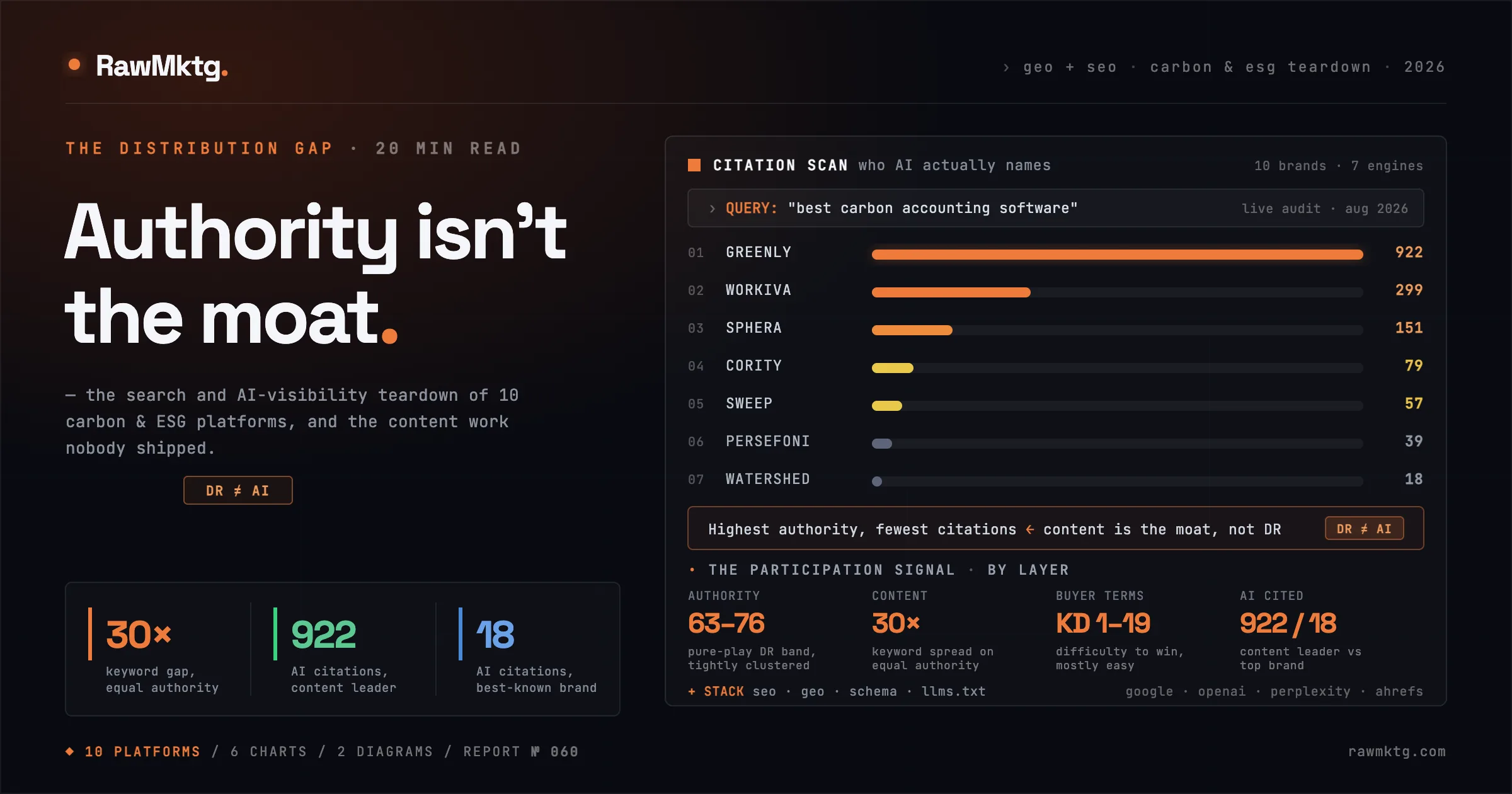
The product race in carbon accounting and ESG software is maturing fast. Audit-grade data, Scope 3 depth, and agentic AI are becoming table stakes. The race that is still wide open is distribution: who gets found when a buyer searches Google, and who gets named when that same buyer asks ChatGPT, Perplexity, or Google's AI.
This teardown uses live search and AI-visibility data across ten leading platforms to show where the opportunity sits, and what to do about it. Brands appear as examples to learn from, not to rank or rate.
01What is the short version?
The seven takeaways
- Authority is not the bottleneck. Eight of ten sites already carry a domain rating of 63+. More links will not move the needle; more published pages will.
- Content footprint decides traffic. Ranked-keyword counts range from ~250 to nearly 12,000 across near-identical authority. The spread is a publishing choice.
- AI answers cite content, not authority. The two highest-authority domains earn the fewest AI citations; the biggest content library earns the most, by an order of magnitude.
- The buyer terms are cheap and unclaimed. Terms like carbon accounting software and csrd software are low difficulty and high commercial value, and most vendors rank for none of them.
- Paid search is filling the gap. The vendors thinnest on organic content spend most on ads for exactly the terms they could own.
- GEO and SEO are the same work. Structured, answer-first content wins Google features and AI citations at once. One program, not two.
- This is a founder problem too. Proprietary data, a defensible point of view, and engineering time for schema and site health are set at the top, not delegated to a content calendar.
02Why is distribution the new battleground?
When a sustainability lead or a CFO's team goes looking for a platform, they do two things: they Google a category term, and increasingly they ask an AI assistant to shortlist vendors. Both surfaces are won with published, structured content. Neither is won with a better demo or a bigger funding round. So the question is simple: for a category with surging, search-led demand, who has actually built for search, and who is leaving the channel open?
03How did we measure this?
Two of the ten are hyperscalers (a global cloud company and a global CRM company) whose whole domains dwarf the field. For them, the numbers are scoped to the sustainability product section, and flagged throughout so the comparison stays fair.
These are estimates and a single-day snapshot; read them as direction, not gospel. The patterns, not the decimal places, are the point.
04Is authority the moat? (It isn't.)
Look at the outliers. One well-known enterprise brand carries a domain rating of 73, higher than several competitors, yet sits near the bottom of the traffic range with a tiny keyword footprint, the same authority-without-traffic gap as the field service software teardown. The traffic leaders are the two firms with the largest content libraries, not the strongest link profiles. The lesson: stop buying links and start shipping pages. You have already cleared the authority bar. This is the same pattern behind ranking isn't visibility.
05What actually decides traffic?
| Company | Domain rating | Organic visits/mo | Ranked keywords | AI citations* |
|---|---|---|---|---|
| Greenly | 76 | 78,152 | 11,939 | 922 |
| Workiva | 75 | 111,593 | 6,207 | 299 |
| Sphera | 75 | 15,175 | 878 | 151 |
| Cority | 67 | 9,652 | 626 | 79 |
| Sweep | 65 | 7,236 | 1,093 | 57 |
| Persefoni | 67 | 9,837 | 1,127 | 39 |
| Watershed | 73 | 7,380 | 370 | 18 |
| Microsoft (section) | 96 | ~2,900 | ~220 | 13 |
| Position Green | 63 | 3,777 | 248 | 12 |
| Salesforce (section) | 92 | ~1,344 | ~130 | 4 |
06Do AI answers cite authority, or content?
AI engines are not consulting a link-authority score when they build an answer; they are retrieving the clearest, most relevant passage they can find and citing its source. If you have not written the passage, you cannot be the source, the mechanism detailed in how your page gets retrieved.
Where the citations actually come from
Google's AI Overviews and AI Mode are where most citation volume lives, so the same content that wins a Google featured snippet tends to win the AI citation, your existing SEO work compounds here. And breadth matters: the leaders are cited across every engine, while thinner sites get a stray citation on one or two. Being citable everywhere is a function of having enough well-structured pages that every engine finds something to quote, which is why engines recommend different vendors.
How an AI answer gets built
07Are the buyer terms cheap and unclaimed?
| Buyer term | US volume/mo | Difficulty | CPC | Read |
|---|---|---|---|---|
| emissions management software | 250 | 1 | $0.70 | Wide open |
| csrd software | 150 | 2 | $18.00 | Easy, top intent |
| scope 3 software | 80 | 2 | $6.00 | Easy, on-topic |
| carbon management software | 400 | 5 | $0.60 | Easy |
| esg reporting software | 1,000 | 9 | $0.35 | Easy, high volume |
| esg software | 900 | 11 | $12.00 | Easy, high intent |
| carbon accounting software | 1,000 | 19 | $0.40 | Medium, high volume |
| carbon footprint software | 250 | 60 | $5.00 | Hard, contested |
You do not need a huge budget or two years to win these. You need one clear, well-structured page per term, built answer-first, shipped before a competitor claims it.
08Is paid search a moat?
Paid search has its place, it is fast and measurable, but it is a bridge you cross while the durable asset gets built underneath it. The strategic mistake is treating paid as the strategy rather than the bridge. This is the same trap covered in getting found on Google and AI.
09How do you make your pages citable?
Step 1: let the AI crawlers in
AI engines can only cite what they can fetch. Confirm your robots.txt permits the named AI bots, and do not let an over-aggressive bot wall block them, one hyperscaler sustainability page in this study returned a bot challenge to non-browser requests, which can suppress citations. See how AI crawlers index your site.
# robots.txt - allow the major AI answer engines
User-agent: GPTBot
Allow: /

User-agent: PerplexityBot
Allow: /

User-agent: Google-Extended   # Gemini / AI Overviews
Allow: /

User-agent: ClaudeBot
Allow: /

Sitemap: https://yourdomain.com/sitemap.xml
Step 2: publish an llms.txt
An llms.txt file is a plain-text index that tells AI crawlers which pages matter. It is a five-minute file that most of the field has not shipped, more on whether llms.txt actually does anything yet.
# llms.txt - https://yourdomain.com/llms.txt
# Guide for AI crawlers: the pages worth citing.

## Product
- [Carbon accounting software](/product): measure Scope 1-3, audit-ready.
- [CSRD reporting](/csrd): map data to ESRS and file with confidence.

## Methodology
- [How GHG accounting works](/learn/ghg-accounting): plain-English guide.
- [Scope 3 explained](/learn/scope-3): the 15 categories, with examples.

## Proof
- [Benchmark report 2026](/research/benchmark): original emissions data.
Step 3: add structured data (JSON-LD)
Schema is how a page self-describes to machines. The clearest pattern in this study: the sustainability section that ships Product and FAQPage schema already ranks number one for a non-branded buyer term, while a far larger competitor that ships no schema does not. Put Organization, Product and FAQPage on your key pages, the full pattern is in schema markup for AI citations.
<script type="application/ld+json">
{
  "@context": "https://schema.org",
  "@type": "FAQPage",
  "mainEntity": [{
    "@type": "Question",
    "name": "What is carbon accounting software?",
    "acceptedAnswer": {
      "@type": "Answer",
      "text": "Carbon accounting software measures an organization's
       greenhouse-gas emissions across Scopes 1, 2, and 3, then turns
       that data into audit-ready reports for CSRD, ISSB, and the SEC."
    }
  }]
}
</script>
Step 4: write answer-first
Structure invites the citation; the words earn it. Lead each key section with a direct, self-contained answer of roughly 40 to 60 words that an engine can lift verbatim, then expand below it, the exact shape of a high-citation page.
## What is Scope 3?

Scope 3 is all the indirect emissions in a company's value
chain, both upstream and downstream: purchased goods, business
travel, and the use of sold products. It is usually the largest
and hardest-to-measure share of a company's footprint,
spanning 15 defined categories under the GHG Protocol.

<!-- then expand: the 15 categories, examples, how to measure -->
10What is the technical foundation checklist?
| Element | Why it matters | Typical effort |
|---|---|---|
| Valid robots.txt | Directs crawlers and, critically, permits AI bots | 1-2 hrs |
| Working XML sitemap | Page discovery; a broken one silently caps rankings | 3-4 hrs |
| llms.txt | Tells AI crawlers what to prioritize | 1-2 hrs |
| Organization + Product JSON-LD | Lets engines identify and quote the entity | 4-6 hrs |
| FAQPage schema | The format AI engines lift most readily | 2-4 hrs |
| One descriptive H1 per page | Names the topic for crawlers and readers | 2 hrs |
| Open Graph + Twitter tags | Controls sharing and secondary entity signals | 2-3 hrs |
| hreflang for locales | Consolidates international ranking signals | 3 hrs |
| Server-side rendered content | If text is JS-only, crawlers may miss it | varies |
11Why does one good page pay out three times?
12How should the motion match the buyer?
| Buyer segment | What they search for | The content play | Example to study |
|---|---|---|---|
| Listed multinationals | Audit trail, XBRL, SEC and CSRD parity | Compliance explainers, framework mapping, assurance content | Reporting-led players who own compliance keywords |
| Complex value chains | Product carbon footprint, supplier data | Methodology deep-dives, Scope 3 guides, calculators | Vendors ranking for scope 3 and PCF terms |
| Heavy industry (EHS + carbon) | Process safety, LCA, chemical compliance | Regulatory and standards content, site-level how-tos | EHS suites with deep, mature libraries |
| Mid-market and SME | Fast, affordable carbon tracking | Definitional and how-to content, transparent pricing | The educational-content leader in the set |
| Ecosystem-native (cloud/CRM) | Integration with existing stack | Integration guides, comparison and migration pages | The section that ships strong Product and FAQ schema |
| Financial institutions | PCAF, portfolio carbon, disclosures | Methodology and standards content for finance readers | Ledger-first platforms targeting finance terms |
13What does the first 90 days look like?
| Phase | Focus | Concrete actions | Owner |
|---|---|---|---|
| Weeks 1-2 | Fix the plumbing | Audit and fix robots.txt, sitemap, crawl access. Ship llms.txt. Add Organization + Product + FAQ schema to key pages. | Engineering + SEO |
| Weeks 2-6 | Ship buyer pages | Build one answer-first page per priority buyer term, starting with the easy, high-CPC ones. Reuse a proven template. | Content + Product |
| Weeks 4-8 | Build the topic layer | Publish definitional and how-to guides (Scope 3, CSRD, GHG accounting) with FAQ schema for AI lift. | Content |
| Weeks 6-10 | Comparison + proof | Ship honest comparison pages and one original data report from your own platform data. | Marketing + Data |
| Weeks 8-12 | Earn and measure | Pitch the data report to trade media for links. Stand up AI-citation and rank tracking. Reprioritize. | Marketing |
14Who owns what: founders or marketers?
| Founders should focus on | Marketers should focus on |
|---|---|
| Proprietary data as a moat: what benchmark or dataset can only you publish? | Turning that data into ranked, cited pages and a repeatable buyer-page template. |
| A sharp, defensible point of view worth being cited for. | Structuring content answer-first with schema so engines quote it. |
| Protecting engineering time for site health, schema and crawlability. | Owning the buyer-term map and the editorial calendar behind it. |
| Positioning: the two or three terms you intend to own, and saying no to the rest. | Measuring AI citations and rankings, and reallocating toward what compounds. |
| Treating distribution as a product surface with a budget, not a campaign line. | Running the 90-day system and reporting the leading indicators. |
15Which metrics actually matter?
| Metric | What it tells you | Healthy direction |
|---|---|---|
| Non-branded keyword count | Whether you are building beyond your own name | Up and to the right |
| Buyer-term rankings (top 10) | Bottom-of-funnel capture | More terms in the top 10 |
| AI citations across engines | GEO visibility and breadth | Cited on all major engines |
| Share of organic vs paid traffic | Whether the durable asset is growing | Organic share rising |
| Referring domains from trade media | Topical authority, not just volume | Relevant, editorial links |
| Branded search volume | Whether category work lifts brand demand | Rising over time |
16What is the takeaway?
For founders, the move is to treat distribution as a product surface: fund the site health, protect the engineering time, and decide which category terms you intend to own. For marketers, the move is to stop renting visibility and start building the compounding asset, one structured, answer-first, buyer-intent page at a time.
Frequently asked questions
Is domain authority the moat in carbon and ESG software?
No. Eight of the ten most-visible carbon and ESG platforms already carry a domain rating of 63 or higher, so authority is uniform and no longer a differentiator. What separates the traffic and AI-citation leaders is content footprint: ranked-keyword counts range from about 250 to nearly 12,000 across companies with near-identical authority. More published, well-structured pages move the needle; more backlinks do not.
What are the best buyer keywords for carbon accounting software?
The highest-value, lowest-competition buyer terms in the category include emissions management software (KD 1), csrd software (KD 2, ~$18 CPC), scope 3 software (KD 2), carbon management software (KD 5), esg reporting software (KD 9), esg software (KD 11, ~$12 CPC) and carbon accounting software (KD 19). Most sit in an easy-to-win band yet are claimed by only one or two vendors.
How do you get cited by AI engines like ChatGPT and Perplexity?
Four concrete steps: let the named AI crawlers in via robots.txt, publish an llms.txt index of your best pages, add Organization, Product and FAQPage JSON-LD schema, and write answer-first, leading each section with a self-contained 40-60 word answer an engine can lift verbatim. AI answers cite the clearest relevant passage, not the highest-authority domain.
Does llms.txt help with AI citations?
llms.txt is a plain-text file that tells AI crawlers which pages matter most. It takes about five minutes to ship and most of the carbon and ESG field has not published one. It is not a magic ranking lever, but combined with crawl access, schema and answer-first content it lowers the cost of being found and quoted by generative engines.
Should carbon and ESG founders or marketers own AI search?
Both, with a split. Founders own the highest-leverage inputs: proprietary data as a moat, a defensible point of view, protected engineering time for site health and schema, and deciding which two or three category terms to own. Marketers own execution: turning that data into structured, answer-first buyer pages, owning the buyer-term map, and measuring AI citations and rankings.
rawmktg. publishes data-driven teardowns and technical playbooks on GEO, AI search and B2B discoverability. Method: same data, same lens, every time. Contact: vinayak@rawmktg.com
A neutral teardown for founders and marketers. Data snapshot August 2026; figures are third-party estimates and directional. Brands are referenced as illustrative examples only.