Content Architecture
Report · GEO Series
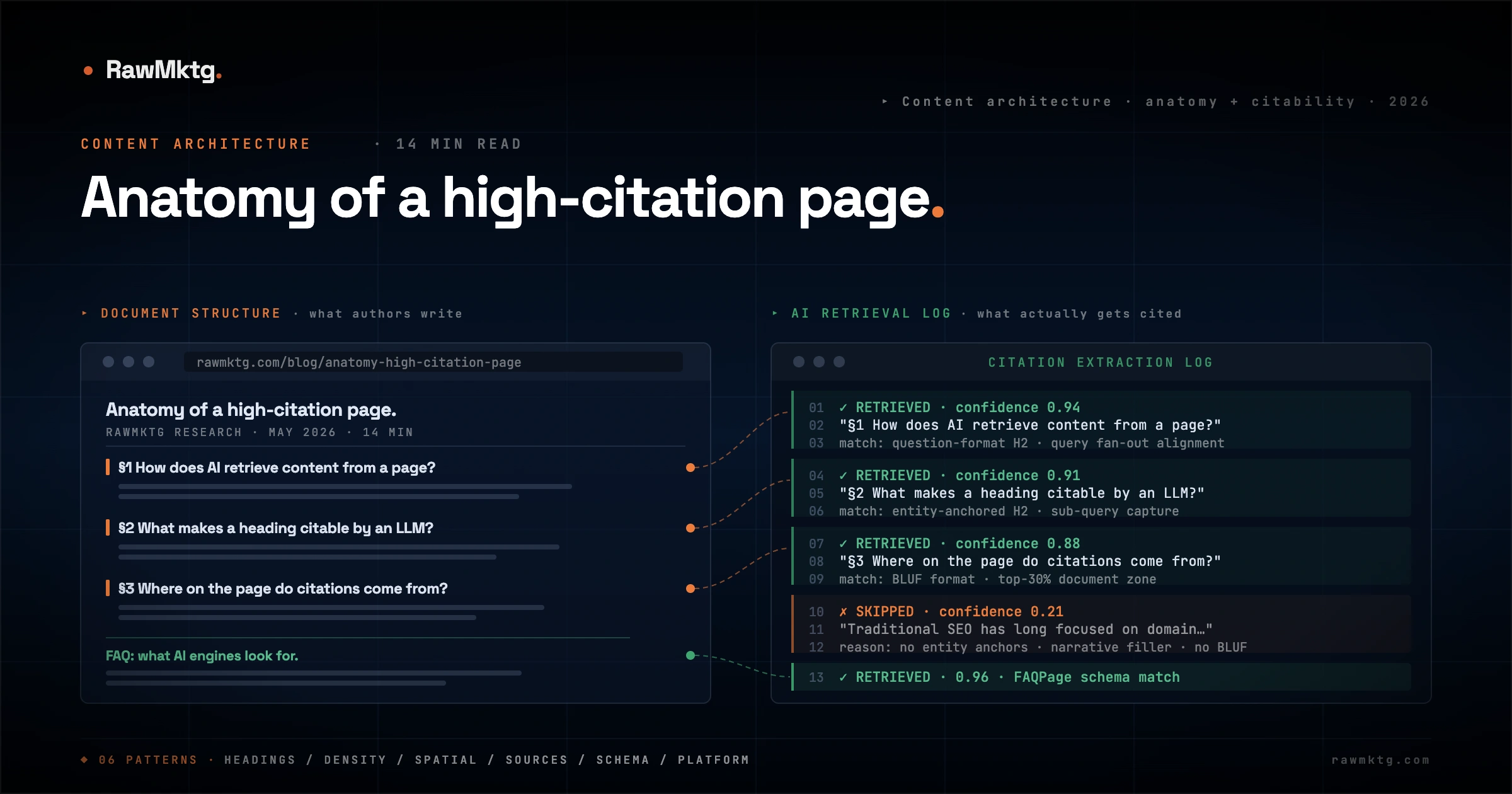
Anatomy of a High-Citation Page: Reverse-Engineering What Gets Pulled Into AI Answers
Deconstruction of 10 pages that consistently earn AI citations across ChatGPT, Gemini, and Perplexity: shared patterns in heading structure, paragraph density, source-linking, and answer-lead formatting.
rawmktg Research
·
May 2026
·
14 min read
TL;DR
- 0138% of AI-cited URLs rank in the top-10 organic results for the same query, meaning the citation game and the ranking game are mostly separate contests.
- 02AI citations concentrate in the first 30% of a page (55% of all citations). BLUF formatting is not optional.
- 03The Princeton GEO study found that adding citations to on-page sources produced a +115.1% AI visibility boost for pages ranking fifth organically.
- 04AI-referred visitors convert at up to 23x the rate of standard organic traffic, making citation share a customer acquisition metric, not a vanity metric.
- 05Six structural patterns distinguish high-citation pages. This article deconstructs each one.
38%
of AI-cited URLs rank in the top-10 for the same query
55%
of citations sourced from the first 30% of a page
23x
conversion rate multiplier for AI-referred vs. organic traffic
Traditional SEO optimized for domain-level link equity. Generative engine optimization requires something different: optimizing for individual claim-level retrieval. Where classical search asked "does this domain deserve to rank?", AI retrieval asks "does this specific passage deserve to be cited?"
Generative systems do not digest web pages as holistic narratives. They retrieve and parse them through real-time Retrieval-Augmented Generation (RAG) frameworks that decompose queries, run parallel searches, re-rank candidates, and then extract specific passages from the winners. By the time a page is being considered for citation, the contest is already mostly decided by structure, not by prose quality or domain authority alone.
This analysis deconstructs the six structural patterns shared by 10 pages that consistently earned AI citations across ChatGPT, Gemini, and Perplexity over a 90-day observation window. Each pattern is presented with the mechanism behind it, an audit framework, and an implementation checklist.
Pattern 01 · Heading Structure
§1Headings engineered for query fan-out
When a user inputs a conversational query into Perplexity or Gemini, the system does not search for pages containing those words. It decomposes the query into multiple parallel sub-queries, a mechanism Google has confirmed as "Query Fan-Out," and retrieves pages from the SERPs for each sub-query to synthesize a composite response.
Pages designed as Topical Authority Clusters, covering the primary query alongside several plausible fan-out sub-queries, earn up to 161% more citations, with 51.2% of those pages successfully captured in final synthesized answers. The practical implication for any content architecture decision is direct: a page covering one question earns one citation opportunity. A page covering the primary question plus five related sub-queries earns six.
Pattern 02 · Paragraph Density
§2Paragraph density: the inverted pyramid
If heading structure determines whether a page gets retrieved, paragraph density determines how much of it gets cited. Traditional SEO encouraged "fluff" — long narrative introductions, repetitive keyword reinforcement, personal anecdotes — to satisfy arbitrary word count targets. Generative engines treat this structure as a retrieval liability.
LLMs parse text looking for specific entities: verifiable concepts, numbers, named sources, and concrete definitions. If a 500-word introduction is required before a page resolves its primary question, the retrieval algorithm will skip it in favor of a 150-word block that resolves the question immediately. The signal here is "information density": the ratio of extractable entities to generic narrative filler.
The architectural rule on every high-citation page is consistent: place a one-to-three sentence direct answer immediately following every H2 or H3 tag. The core fact or statistic is stated first, followed by supporting arguments and contextual parameters. This is the Inverted Pyramid applied at the section level.
① Direct 1-2 sentence answer: the extractable citation unit
② Supporting data: statistics, study citations, named sources
③ Contextual parameters: exceptions, caveats, scope limits
④ Optional elaboration: examples, analogies, related links
The inverted pyramid at section level: highest-value content first, every time
This formatting ensures that even when an LLM operates within a restricted context window, the primary semantic unit remains fully visible and easily extractable. The model does not need to read to the end of a section to find the answer; it is front-loaded.
Pattern 03 · Spatial Optimization
§3The citation ski ramp: where on the page matters
How a page is physically structured determines where citations come from. The distribution of citations across document depth is not uniform; it follows a "ski ramp" pattern: steep at the top, decaying sharply through the middle, and trickling at the end.
There is one documented exception to the top-30% concentration: structured FAQ blocks. Deep-page citations (in the 60%–100% zone) are disproportionately driven by FAQ sections because each question-and-answer pair functions as a self-contained standalone answer unit. Each pair acts as a micro-article. To earn a citation from this spatial bracket, each FAQ question must be answered directly and completely within the first sentence of its answer, which reapplies the same inverted pyramid logic at the micro level.
The content freshness dimension adds a second axis to spatial logic. Pages not updated in 90 days are 3.2x more likely to lose their AI citations regardless of structural quality. Spatial optimization that is never refreshed decays out of the citation window.
Pattern 04 · Source Linking
§4Claim-level citations as TrustRank signals
Citing external, authoritative sources creates a credibility loop. When an LLM evaluates a web page, the presence of explicit, claim-level attributions acts as a TrustRank signal; it tells the algorithm the page's assertions are grounded in verifiable reality rather than marketing speculation. The Princeton team validated that the "Cite Sources" tactic applied to pages ranking fifth in standard organic produced a +115.1% visibility boost in synthesized answers.
The distinction between a "vague reference" and a "citation-ready claim" is precise:
Pattern 05 · Technical Architecture
§5Schema as machine-readable contract
Schema serves two distinct functions in a RAG pipeline. First, it provides direct, unrendered access to page data, exposing full Q&A pairs and article metadata directly in the raw HTML payload. Second, it establishes entity clarity: a brand becomes a recognized node in the LLM's internal knowledge representation rather than floating generic text.
One technical consideration that is often missed: a complete AI crawler access audit must precede any schema rollout. Without explicit allowance for GPTBot, PerplexityBot, and Google-Extended, the schema investment returns nothing.
The recommended implementation is a single @graph JSON-LD block combining Article, FAQPage, and Organization entities into one script tag per page, as detailed in the schema markup playbook:
Pattern 06 · Multi-Platform Calibration
§6Platform divergence and the commercial value of citations
Optimizing for citations requires understanding that different generative engines operate with distinct retrieval parameters. Only 10.7% of URLs and 16% of domains overlap between citations generated by Google AI Overviews and Google AI Mode, meaning a strategy optimized for one platform misses the majority of citations available across the full landscape. The technical reason for this, along with platform-specific playbooks for each engine, is in Why ChatGPT, Perplexity and Gemini Recommend Different Vendors.
These metrics reframe the purpose of citation optimization. It is not a traffic-preservation strategy; it is a customer acquisition strategy with a fundamentally different intent profile attached to every visitor.
Implementation · 90-Day Rollout
§7The 90-day rollout: sequencing the structural changes
Deconstructing high-citation pages is an exercise in pattern recognition. Implementing those patterns at scale is a sequenced operational problem. The rollout divides into three phases, each of which must be started before the next begins, since crawler propagation and index freshness signals take 4–8 weeks to stabilize.
1
Days 1–30: Audit and structural repair
- Days 1–10Pull the top 20 revenue-adjacent pages. For each, record current AI citation status across ChatGPT, Gemini, and Perplexity. This is your baseline.
- Days 11–20Audit the opening 200 words of each page. If the primary answer is not in the opening section, rewrite using the BLUF protocol. The page's most important fact must be in the first paragraph.
- Days 21–30Audit outbound citation density. Every factual claim must have a named, linked source. Vague references ("studies show") must be replaced with specific attributions ("a 2024 Ahrefs analysis of 300,000 queries found...").
2
Days 31–60: Schema and heading restructure
- Days 31–40Implement JSON-LD on priority pages:
FAQPage, Article, and HowTo where applicable. Audit robots.txt to confirm all AI retrieval bots have unrestricted access to public content.
- Days 41–50Restructure H2 and H3 headings to question-format phrasing. Add a FAQ block to each priority page: four to six questions, each answered completely in the first sentence of its response.
- Days 51–60Verify
dateModified is being updated with each substantive content change. Set calendar reminders for the 90-day refresh cycle on all Tier 1 pages.
3
Days 61–90: Measurement and iteration
- Days 61–70Map a conversational query prompt matrix representing the buyer's journey: ten category queries, ten problem queries, five to ten competitor comparison queries. Test weekly across ChatGPT, Claude, Gemini, and Perplexity.
- Days 71–80Track three core metrics: AI Citation Rate (ACR): % of tracked queries where your domain is cited; Citation Retention Rate (CRR): % of citations persisting across audits (below 60% signals content aging out); Share of Model (SOM): your count vs. competitors.
- Days 81–90Execute the first citation gap analysis: identify queries where competitors earn citations but your brand does not. The 30-day content half-life means pages left unrefreshed beyond 90 days lose citation eligibility regardless of structural quality. Closing topic-level gaps requires the full topical cluster architecture.
§8The editorial standard that separates cited from invisible
The pages that earn consistent AI citations are not the most comprehensive, the most eloquent, or the highest-ranked by traditional SEO metrics. They are the most structurally cooperative: built to be retrieved, chunked, and extracted by systems that have never been asked to appreciate good writing.
The high-citation page finds the middle by treating every section as a citable unit: a passage that could be lifted by a language model and presented as a complete, sourced answer to a specific question. That test, applied rigorously to every section of every content asset before publication, is the simplest operational definition of AI citation best-answer page GEO content. It does not require a new technology stack. It requires a different editorial standard.
The GEO compounding flywheel starts here: each citation earns brand familiarity inside the model's training signal, which increases the probability of future citations, which compounds into a durable share-of-model advantage that organic rankings alone cannot replicate. Vertical-specific AI visibility follows the same structural rules; the content research is domain-specific, but the architecture is universal.
Will optimizing for AI citations hurt my organic rankings?
No. The structural changes that improve AI citation rates: question-format headings, inverted pyramid paragraph structure, explicit source attribution, FAQ blocks, and JSON-LD schema, are either neutral or positive for organic rankings. The Princeton GEO study found that adding citations and statistics lifted AI visibility without degrading standard search performance.
How long does it take to start earning AI citations after making structural changes?
Crawler propagation and index freshness signals take 4–8 weeks to stabilize after structural changes. Schema implementation tends to show citation impact faster (2–4 weeks) because retrieval bots read schema directly from the HTML payload without rendering the page.
Does the same strategy work across ChatGPT, Gemini, and Perplexity?
Claude/Anthropic has the most stringent factual precision requirements, performing well with content depth over 2,000 words and strong outbound citation density. Google AI Overviews are most structurally influenced by
schema; FAQPage schema alone produces a 53% increase in AI Overview citation likelihood for eligible content.
Do these structural patterns apply outside B2B SaaS?
The structural patterns are consistent across verticals.
Vertical-specific AI visibility follows the same structural rules; the difference is in the entity vocabulary and the specific query prompts that matter for each industry. The architectural principles are universal; the content research is domain-specific.
Limitations & Caveats
We cannot observe internal LLM retrieval mechanics directly; we infer from observed citation outcomes. Platform algorithms change: Perplexity and Google AI Mode in particular have shifted citation behavior across 2025–2026. The 90-day update cadence is a working hypothesis, not a guaranteed floor. Sample size is n = 10 pages across 8 verticals over a 90-day window; findings should be validated against your specific category and query set.
References
- Where Google AI Overviews Cite From: A 100-Page Study, CXL
- Update: 38% of AI Overview Citations Pull From The Top 10, Ahrefs
- AI Overviews Reduce Clicks by 34.5%, Ahrefs
- The Princeton GEO Paper in Plain English: 5 Tactics That Boost AI Visibility, Derivatex
- Generative Engine Optimization (GEO) Guide, 3LA.ai
- We Tracked 1,885 Pages Adding Schema. AI Citations Barely Moved., Ahrefs
- Structured Content for AI Citations, MAGNA
- How Perplexity Chooses the Sources It Quotes, eSEOspace
- AI Citation Tracking: 7 Perplexity Rank Trackers, Topify
- Generative Engine Optimization (GEO): The Definitive Guide 2026, Geoptie
- SEO and GEO: A Practical Guide for 2026, Progress Sitefinity
- Why Websites Must Speak to Machines: AEO, GEO & JSON-LD, HT&T Consulting
- Structured Data for AI Visibility: JSON-LD Guide, GEO Tool
- Perplexity AI Ranking Factors: A Guide for SEOs, Keyword.com
- Structured Data: SEO and GEO Optimization for AI in 2026, Digidop