The market for AI tools that build slides and decks has gone from a handful of names to a crowded field in under two years. Gamma, Beautiful.ai, Plus AI, SlideSpeak, Deckary, Canva and consultant-focused tools like Prezent now compete for the same buyers. This teardown looks at how those buyers actually find a tool today, who is winning on Google, who is winning inside AI assistants, and why those are no longer the same question.
We pulled a one-day snapshot of live search data: the terms buyers use and how hard they are to win, who ranks where on Google, the links each player has earned, and the answers four AI assistants give to 40 real buyer questions. Three patterns stand out: discovery has split in two; the Google leader is not the AI leader; and the niche is winnable. A companion teardown scores 41 investing and wealth brands and finds the cleanest sites earning zero AI citations.
01How do buyers find a deck tool now?
Slide and deck tools are a fast, low-commitment purchase. Many buyers sign up for a free trial the same hour they first hear the name. That makes the moment of discovery, the AI answer or the Google result, unusually close to the moment of purchase. Being named is often the whole game.
02What are buyers searching for?
The genuinely easy terms are either smaller or are brand and comparison searches like "canva alternative". For a newer entrant, the realistic plan is to win a cluster of easier, on-topic terms first, then push at the head terms once the site has earned enough trust.
| Difficulty band | Share of terms | What it means |
|---|---|---|
| Easy (0 to 10) | 62% | Mostly long-tail and brand terms. Winnable with focused pages. |
| Low to medium (11 to 50) | 14% | The sweet spot. Real intent, still reachable. |
| Hard (51 to 100) | 23% | The head terms. Owned by incumbents, slow to win. |
03Who wins on Google?
Gamma's lead did not come from a single page. It came from publishing many focused, fast, clearly structured pages, each aimed at one buyer question, and earning the links to back them. That is the textbook way to win Google, and the lesson for challengers is not that Google is closed, it is that Google rewards depth, and depth takes time.
Gamma owns the broad "make a presentation" terms. A new entrant rarely beats that head-on. The faster route is to win a defensible niche, then expand. Hold that thought, because the AI data points to exactly which niche is open.
04Who wins inside AI answers?
Two things jump out. The incumbent Canva is named most, a reminder that AI answers lean on well-known names. And the AI-native tools Deckary and Beautiful.ai are named almost as often, clearly more than Gamma, despite Gamma's Google lead. The order inside AI answers is not the order on Google.
Winning Google does not mean winning AI
Plot each player's Google footprint against how often AI names them and the divergence is stark, the same pattern as the carbon and ESG software teardown.
Gamma sits far to the right, huge on Google, yet only mid-pack in AI. Deckary sits top-left: almost nothing on Google, yet named more than anyone in AI answers. Beautiful.ai is the rare player strong on both. SlideSpeak and Plus AI have a solid Google footprint but a thin AI presence. The signals that win each channel are not the same, the reason engines recommend different vendors than Google ranks.
AI names brands on narrow questions, not broad ones
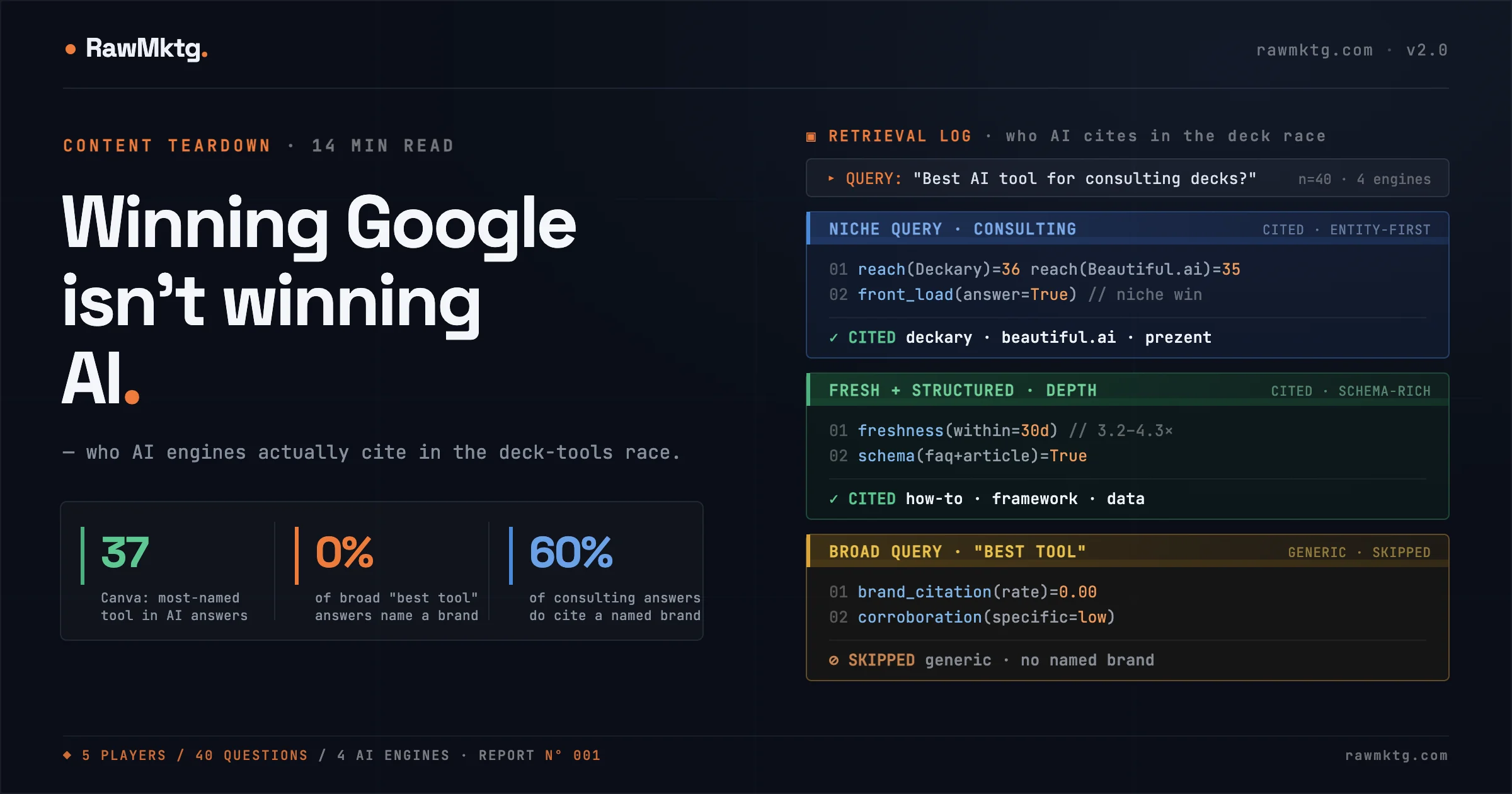
The single most useful pattern is where AI cites a real brand at all. On broad questions, assistants give generic advice without backing a specific tool. On narrow, high-intent questions, they cite specific players. Grouping the 40 questions by theme shows it clearly.
Questions about consultants and specific industries are where assistants reach for a named tool and a link. Broad "best AI presentation tool", "best alternative" and "pitch deck" questions stay generic. For a challenger, that is the opening: the broad terms are crowded and generic, but the niche, high-intent questions are still up for grabs, exactly where a focused tool can become the named answer.
Each assistant sources differently
The four assistants do not behave the same way. Google's AI cited brand websites most often, pulling from live pages. Gemini and ChatGPT cited far less, and Claude rarely linked a brand site at all in this set. A tool that wants to be cited has to earn it across several systems, each with its own habits.
05What about links and trust (the authority layer)?
The established players sit inside the places buyers and AI models both look: AI tool directories, software review sites and tech media, the off-site authority stack. Newer entrants often show a large raw number of linking sites, but most are low-value auto-generated or scraper pages that add little trust. The gap that matters is not the count of links, it is the count of links from places that carry weight.
| Source type | Why it carries weight | Examples in this space |
|---|---|---|
| AI tool directories | Both buyers and AI models pull shortlists from them. | Product Hunt, Toolify, aitools.inc |
| Software review sites | Reviews are a core trust signal for AI answers. | G2, Capterra, software lists |
| Tech media and newsletters | Fresh, cited coverage feeds live AI retrieval. | Substack, Medium, tech newsletters |
| Audience-specific sites | Narrow relevance wins narrow, high-intent answers. | Consulting and industry publications |
These signals stack. A strong directory listing helps Google ranking, which helps AI retrieval, which earns reviews and press, which feed back into both. One well-placed asset, such as an original data report, can lift Google rank, links and AI citations at once. That is why the players who started early keep pulling ahead. That AI retrieval begins with a query fan-out, one prompt expanded into eight to sixteen hidden searches, so being surfaced means covering the facets rather than ranking first for one term.
06How do AI engines decide what to name?
The practical reading is simple. Classic SEO has not gone away, it feeds all three layers. Fast, clearly structured, well-linked pages are what AI engines retrieve and trust. The work that earns a Google ranking is much of the same work that earns an AI citation. The difference is that AI rewards clarity and freshness even more, and it rewards being the obvious answer to a specific question.
07Where is this heading?
The two channels keep diverging. Expect more cases where the Google leader and the AI-answer leader are different companies. Tools that treat AI visibility as a separate discipline, not a byproduct of SEO, will pull ahead inside assistants.
Niches get claimed first. Broad terms stay crowded and generic in AI answers. The brands that win specific, high-intent questions, by industry or job role, will be named first and defended longest.
Freshness becomes a moat. Because assistants favor recent, well-structured pages, tools that publish and update steadily will be cited more than those that ship a page and forget it. And when several tools fit a question, reviews, directory presence and credible press tip which one the assistant names.
A neutral analysis, not an endorsement of any tool. Based on a one-day snapshot of live Google and AI search data, June 2026: category search terms and difficulty, Google rankings, referring domains, and 40 real buyer questions run across four AI engines (ChatGPT, Google AI, Claude, Gemini) for 160 question-and-engine runs. Search volumes and difficulty are estimates; AI outputs vary by run. No tool named here sponsored or reviewed this report.
Why is the Google leader not the AI leader for presentation tools?
Because Google ranking and AI citation reward different signals. Gamma wins Google by publishing a huge depth of focused pages (it ranks for 673 category terms, 349 in the top 3), but AI answers lean on well-known names and fresh, narrowly-relevant pages. So Canva (named in 37 of 160 runs), Deckary (36) and Beautiful.ai (35) all out-name Gamma (26) inside AI answers despite Gamma's Google dominance.
Which AI presentation tool is named most by AI assistants?
Across 160 question-and-engine runs, Canva was named most (37), followed closely by Deckary (36) and Beautiful.ai (35). Gamma, the Google leader, trailed at 26, then Prezent (17), Plus AI and Slideworks (15 each), Presentations.ai (12) and SlideSpeak (8). AI answers favour familiar incumbents and AI-native tools over the pure SEO leader.
Do AI assistants recommend a specific deck tool, or stay generic?
It depends on the question. On broad questions like "best AI presentation tool", "best alternative" and "pitch deck", assistants cited a named brand's site 0% of the time, they stay generic. On narrow, high-intent questions they cite real brands: 60% of consulting-tool questions and 40% of industry-specific questions backed a named brand. The niche is where AI names a winner.
How can a new presentation tool get cited by AI?
Win a defensible niche first. Publish fast, clearly structured, answer-shaped pages aimed at specific, high-intent questions (by industry or job role) rather than the crowded broad terms. Earn links from the sources AI models trust, AI tool directories, review sites like G2 and Capterra, and tech media, and keep pages fresh, since live retrieval favours recent content. Deckary did exactly this: tiny on Google, yet named most in AI.
rawmktg. publishes data-driven teardowns of B2B verticals and brands, pulling AI-citation and SEO data to show exactly where the visibility gaps are. Method: same data, same lens, every time. Contact: vinayak@rawmktg.com
Data source: a one-day snapshot of live Google and AI search data, June 2026, covering category search terms, Google rankings, referring domains, and 40 buyer questions run across ChatGPT, Google AI, Claude and Gemini. Independent analysis; no tool named here sponsored or reviewed it.