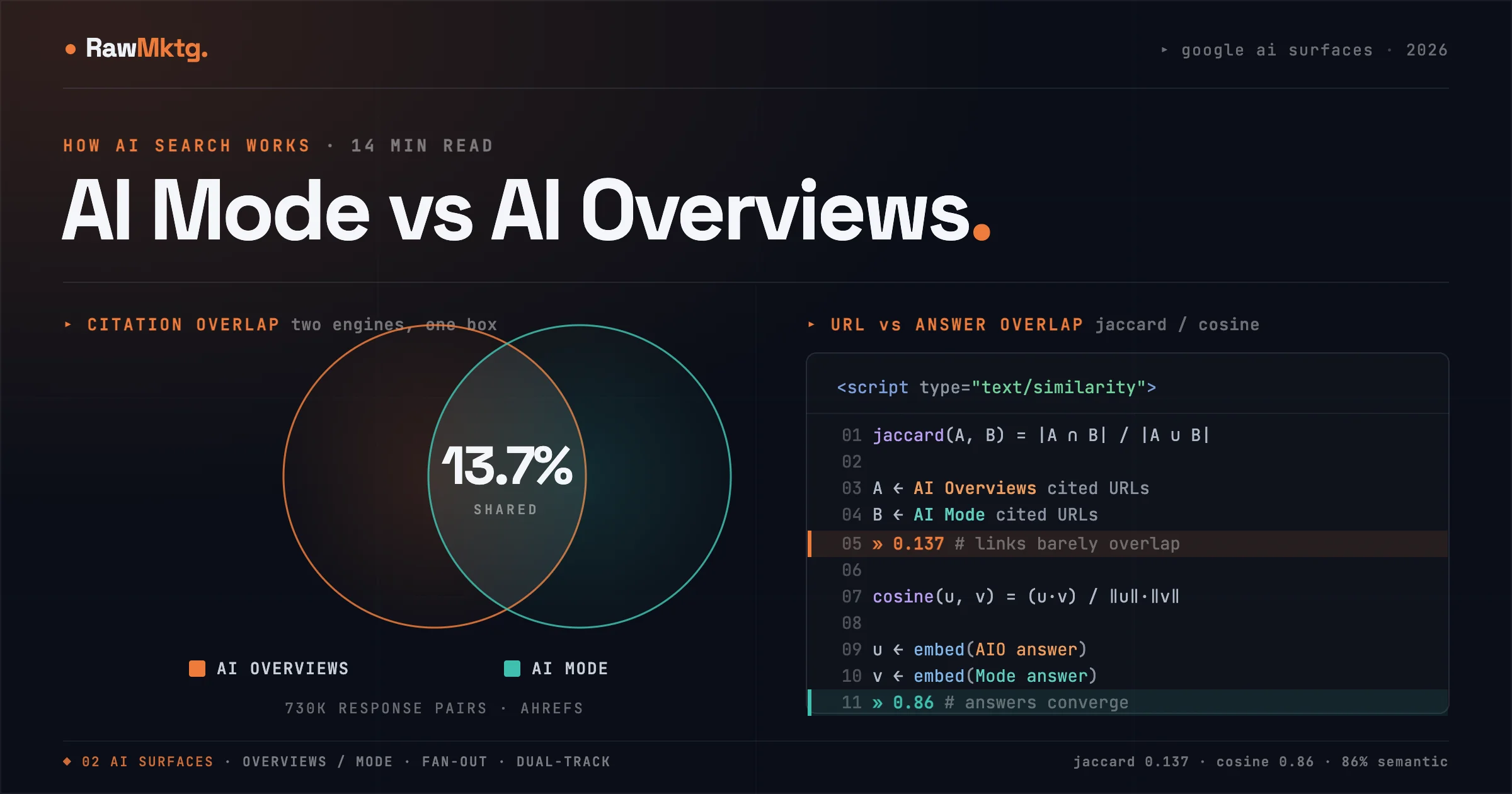
Google did not add AI to search. It split search into two AI products that share a query box, and they disagree about which sources deserve a citation almost nine times out of ten. For anyone doing GEO, that disagreement is the whole story: you cannot optimize for "Google AI" as a single target. There are two targets, they reward different work, they pull from different places, and a page that wins one can be invisible in the other.
The first surface is AI Overviews: the boxed summary above the blue links. You never ask for it, it fires automatically on roughly a quarter of queries. The second is AI Mode: a separate tab you deliberately select, where search becomes a conversation that remembers what you asked three turns ago. Same box, same brand, two retrieval engines with their own logic, update cadence and citation habits. Across 730,000 paired responses, the same query produces two completely different source lists 86.3% of the time.
01What's behind Google's two AI surfaces?
- Automatic trigger, fires on ~25% of queries
- Single-pass RAG over the standard index
- Reads top-ranking standard-index docs
- ~200 words, ~21-second session
- Low source diversity, ranking-led
- User-activated tab, opted into
- Parallel query fan-out, retrieves many times
- Reads live web + Knowledge Graph + Shopping Graph (50B+ SKUs)
- ~800 words, ~49-second session
- High source diversity, rank-decoupled
AI Overviews is, mechanically, a thin wrapper on classic ranking: it pulls high-ranking documents from the standard index and hands them to a Gemini summarizer. Speed is the point, and the sources skew toward what was already going to rank. AI Mode runs on the Gemini 3 family, keeps conversational context across follow-ups, and crucially does not retrieve once, it retrieves many times, in parallel, against several indexes at once. That single design choice drives the low overlap.
02How does query fan-out break the rules?
That parallelism is exactly why AI Mode surfaces deep internal pages, product documentation and niche forum posts that never rank for the primary keyword. It bypasses the single-index bottleneck classic search lives inside. The implication for a brand is blunt: ranking for the head term no longer guarantees you are in the room when the answer gets assembled. It is the same reason the Google leader is not the AI leader in category after category.
03How much do the two surfaces actually overlap?
| Study | Sample | What was compared | Overlap |
|---|---|---|---|
| Ahrefs | 730K response pairs | AI Overviews vs AI Mode citations | 13.7% |
| Ahrefs | Top-3 citations | AI Overviews vs AI Mode | 16.3% |
| STAT | 40K keywords | AI Mode URL vs organic top-10 | 12% |
| SE Ranking | Cross-query set | AI Mode URL vs organic (domain: 51%) | 14% |
| BuzzStream | 30K citations, 595 prompts | Citations exclusive to one platform | 76.1% |
| Agency monitor | 12 verticals, Jan-Apr 2026 | AIO-cited page also cited in AI Mode | 15% |
But there is a twist that changes how you read all of this. Low source overlap does not mean the two surfaces give different answers. They mostly do not. The disagreement is about citations, not conclusions.
# 1 / URL overlap - how many cited links are shared?
jaccard(A, B) = |A ∩ B| / |A ∪ B|
   A = AI Overviews cited-URL set
   B = AI Mode cited-URL set
   result ≈ 0.137   # low. the links barely intersect.

# 2 / answer overlap - do the two texts agree?
cosine(u, v) = (u · v) / (||u|| · ||v||)
   u = embed(AIO answer)
   v = embed(AI Mode answer)
   result ≈ 0.86    # high. the conclusions converge.
That gap is the GEO opportunity stated precisely. The conclusion is not the prize, the citation is. Two brands can both be "the answer" while only one gets named and linked. Your job is not to be correct, the model is already correct without you. Your job is to be the source it reaches for when it justifies the answer, and because the two surfaces reach for different sources, you have to earn that slot twice.
04How does each surface treat your organic ranking?
- 38% of cited URLs rank in the organic top 10
- Organic-rank share of citations climbed 32.3% to 54.5% (mid-2024 to late-2025)
- Healthcare and other YMYL verticals reach 75.3%
- If you can rank, you can largely earn the Overview
- Only ~12% of cited URLs match the exact organic top-10 (14% per SE Ranking)
- Domain-level overlap is ~51%: it knows your site
- It pulls the buried comparison page, the docs, the data study
- Your homepage is not the asset, your depth is
Read those in sequence. AI Overviews still respects classic ranking signals, and the dependency is strengthening over time. AI Mode refuses that shortcut: it recognizes your site as authoritative but declines to cite your money landing page, reaching instead for the deep internal resource that resolves a specific sub-query. The work that wins each surface is not the same.
05What does the split look like on real prompts?
- One short paragraph of summary
- Cites three top-ranking product-review URLs
- Leans on authoritative health portals
- Clean, fast, shallow
- Fan-out splits it: sensor specs, battery life, medical accuracy
- A comparative layout with spec cards
- Cites a dozen-plus sources: Reddit, product docs, niche publications
- Runs a research project, not a summary
Ask a flat factual question, "What products does Adidas offer?", and every surface, including third-party models, converges on the same foundational sources: the annual report, the investor-relations portal, and Wikipedia. Wikipedia carries 35% of citations shared across AI engines despite being only 3.8% of total citations. Factual identity queries pull from canonical sources, so the surfaces agree.
The pattern is consistent: the more a query needs to be reasoned across dimensions, the more fan-out engages and the more the two surfaces split apart. Most B2B buying questions, "best X for Y", "X vs Y", "how do teams handle Z", are exactly the multi-intent prompts that maximize divergence, which is why B2B brands feel the split harder than consumer ones.
06Who does AI Mode actually cite?
Two trends inside that chart matter for planning. Self-citation is rising fast: Google.com citations tripled between mid-2025 and early 2026 as help docs and Maps features got wired into the chat interface. And user-generated content is surging: Reddit citations jumped 450% over three months. AI Overviews behaves differently again, leaning multimodal, with YouTube holding a 23.3% share and a relevant on-page video raising AIO citation odds by 156%.
| Metric | Value | What it means |
|---|---|---|
| Sidebar block links | 90.8% | Most citations render as block links, not inline (8.9% inline, 0.3% traditional) |
| URLs surviving 3 runs | 9.2% | Run the same query 3x and only 9.2% of URLs persist; 60%+ of domains rotate |
| Reddit citation rise | 450% | Over a three-month window, reflecting appetite for real-world experience |
| On-page video lift | 156% | Increase in AI Overviews citation odds from a relevant video |
The volatility number is the one most teams underweight. AI Mode uses a probabilistic retrieval model that continuously reshuffles its sources, so you are not chasing a fixed ranking that holds still once you win it. You are raising your inclusion odds across a distribution that re-rolls on every query, which reframes the whole measurement question.
07How do you rank in Google AI Mode and AI Overviews?
Lever 01 - Structure pages for extraction
After every target H2, lead with a direct, self-contained answer of 40 to 55 words before any narrative, matching Gemini's extraction patterns. Treat each H2 as a standalone answer and phrase headings as natural questions. Cut conversational filler: statistics with clear source citations lift citation probability by 40% to 70%. Apply FAQPage, Article and Product schema so crawlers can parse and credit claims.
Lever 02 - Build off-site co-citation
Participate in relevant Reddit, Quora and Stack Overflow threads, AI Mode leans on UGC for real-world reviews, so mentions in high-engagement threads convert directly into citation rate. Build YouTube guides (Gemini treats transcripts as text, so speak your brand and methodology terms clearly). And keep LinkedIn, Crunchbase, G2 and Capterra profiles detailed and current, because the Knowledge Graph and Shopping Graph use them to verify entity relationships during comparisons.
Lever 03 - Measure the right thing
Track Brand Inclusion Rate (is your brand present in the synthesized answer at all), Mention and Citation Rate (where your name is generated and your URL explicitly linked), and Share of AI Voice (your citation volume against competitors across a fixed prompt set, plus co-citation mapping). This lever forces teams to abandon a fifteen-year-old dashboard, because 93% of AI Mode sessions end without a click. Click-through rate, rank position and traffic volume are measuring a door almost nobody walks through anymore.
- Click-through rate (CTR)
- Keyword rank position
- Page impressions
- Organic traffic volume
- Brand Inclusion Rate
- Mention Rate %
- Share of AI Voice (SOAV)
- Sentiment & co-citation mapping
08What's the dual-track takeaway?
| Dimension | AI Overviews | AI Mode |
|---|---|---|
| Optimize for | Page-level ranking | Domain-level authority |
| Core tactic | 40-55 word direct summaries | Multi-platform mentions |
| Content shape | Direct, comparative tables | Modular informational hubs |
| Wins on | Top-10 rankings + schema | Proprietary research + off-site presence |
| Scoreboard | Citation share vs rank | Inclusion rate vs competitors |
AI Overviews is, at bottom, a ranking game with a summarization layer bolted on top. Win it with structured data, concise summary blocks and the top-10 positions you already chase. AI Mode is an authority game decided before the click that never comes. Win it with comprehensive topic coverage, proprietary research worth citing, and a presence on the platforms it trusts more than your own homepage.
Optimize for one surface and you are half-visible. The brands that hold organic visibility through this shift run both tracks at once, treating Google not as one AI to please but as two engines that have to be earned separately. The 13.7% overlap is not a problem to solve. It is the map.
- Ahrefs - Are AI Mode and AI Overviews just different versions of the same answer? (730K responses)
- Moz - Only 12% of AI Mode citations match URLs in the organic SERP
- BrightEdge - AI Overview citations now 54% from organic rankings
- Ahrefs - 38% of AI Overview citations pull from the top 10
- BuzzStream - AI citation overlap: do AI platforms cite the same sites?
- Aleyda Solis - Google's query fan-out technique and what it means for SEO
- Google - Optimizing your website for generative AI features in Search
- Semrush - What is Google AI Mode (and how to optimize for it)
What is the difference between Google AI Overviews and AI Mode?
AI Overviews is the boxed summary that fires automatically above the blue links on about a quarter of queries; it is a single-pass summary of top-ranking pages. AI Mode is a separate, user-activated conversational tab that runs query fan-out, retrieving many sub-queries in parallel across the live web, Knowledge Graph and Shopping Graph. Both run on Gemini, but they cite the same sources only 13.7% of the time.
Why do AI Overviews and AI Mode cite different sources?
Because they retrieve differently. AI Overviews summarizes pages that already rank in the standard index, so its sources skew toward classic SEO winners. AI Mode decomposes a query into up to 16 sub-queries and runs them across multiple specialized indexes, surfacing deep pages, documentation and forum threads that never rank for the head term. Across 730K paired responses the two agree on sources just 13.7% of the time, though their answers converge about 86%.
Does ranking in Google's organic top 10 get me into AI Mode?
Not reliably. Only about 12% of AI Mode's cited URLs match the exact organic top-10 URL for the same query (14% per SE Ranking). Domain-level overlap is higher, around 51%, so AI Mode recognizes your site, it just pulls deeper pages than your money landing page. AI Overviews is the opposite: roughly 38% of its citations rank in the organic top 10, and that dependency is strengthening.
How do you optimize for Google AI Mode?
Three levers: structure pages for extraction (lead each H2 with a 40-55 word direct answer, add FAQPage and Article schema); build off-site co-citation (Reddit and forum participation, YouTube with clean transcripts, accurate G2/Capterra/Crunchbase profiles); and measure the right thing (Brand Inclusion Rate, Mention and Citation Rate, Share of AI Voice) since 93% of AI Mode sessions end without a click.
rawmktg. publishes data-driven explainers and teardowns on how AI search decides what to recommend, pulling citation and SEO data to show exactly where the visibility gaps are. Contact: vinayak@rawmktg.com