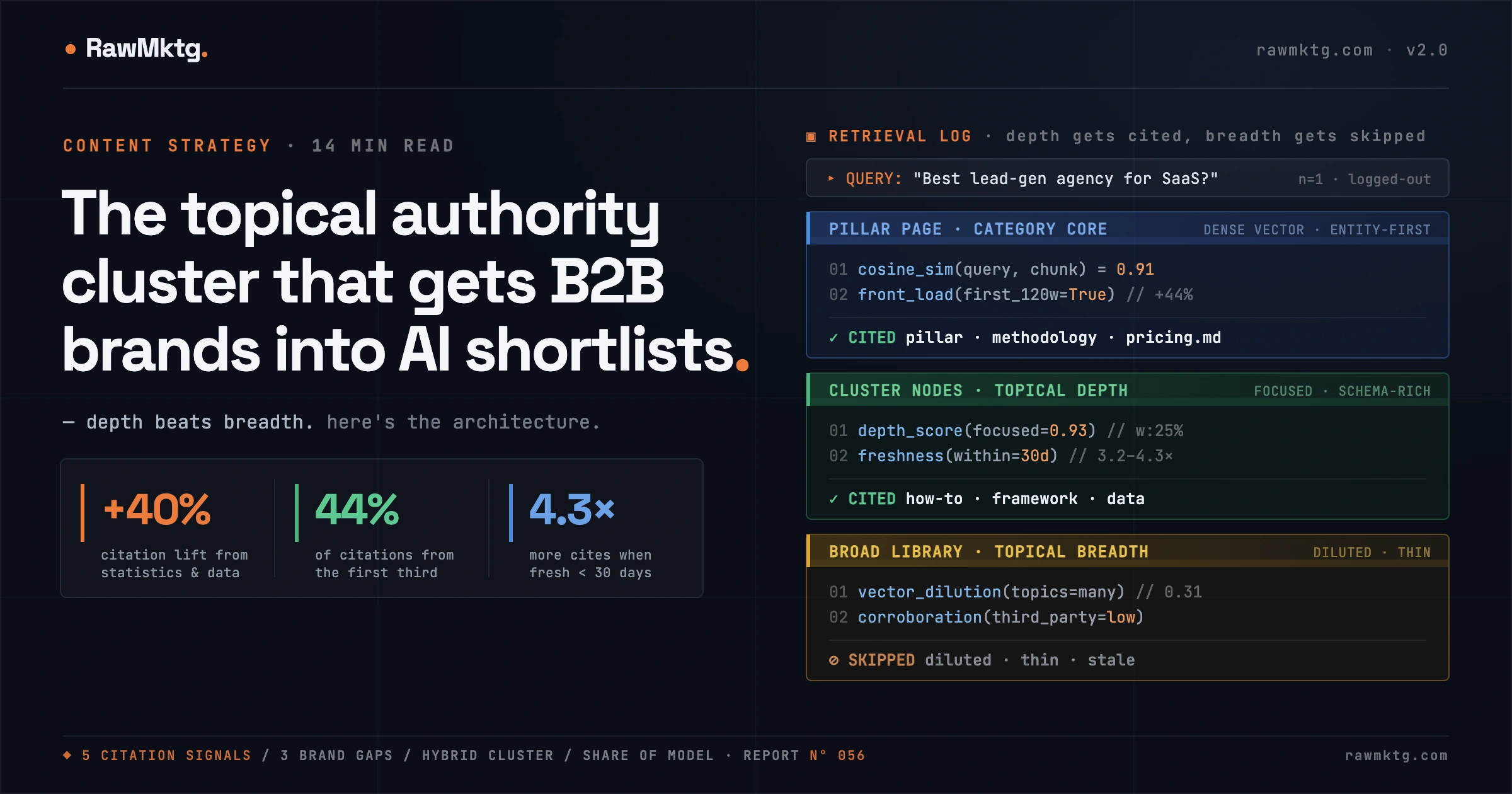
The B2B buying journey has undergone a structural transformation. Buyers are bypassing traditional search results (pages of blue links and sponsored ads) in favor of conversational queries on ChatGPT, Perplexity, Claude, Gemini, and Google AI Overviews.1 If a brand does not appear as a cited recommendation inside these synthesized responses, it becomes effectively invisible to roughly half of its target market.2
This shift renders traditional SEO tactics (built around search volume, keyword density, and link-building) insufficient for modern buyer acquisition. B2B brands must now adopt Generative Engine Optimization (GEO) and Answer Engine Optimization (AEO) so that their services and proprietary frameworks are selected, synthesized, and cited by large language models.1 Designing an effective topical authority cluster means aligning technical web architecture with the cognitive parsing patterns of frontier models.
01: How is GEO different from PageRank SEO?
Traditional search engines return a list of links and let users decide which to visit. Generative engines synthesize information from many sources into a single conversational response.1 This forced the emergence of GEO: the practice of structuring content and managing a brand's presence so AI systems discover, select, synthesize, and preferentially cite it.1
The transition is driven by adoption. ChatGPT alone reaches over 800 million weekly active users, reshaping an $80 billion search-optimization industry.1 By early 2026, practitioners shifted from keyword placement toward semantic relevance. Even Google now publishes guidance on optimizing for generative AI features, framing it as an extension of the broader search experience.5
| Dimension | Traditional SEO | Generative Engine Optimization |
|---|---|---|
| Primary objective | Rank in the top ten blue links. | Be selected, synthesized, and cited inside an AI response. |
| Retrieval mechanism | Keyword matching, inverted index, link-based authority. | Retrieval-Augmented Generation (RAG) and dense vector embeddings. |
| User experience | Fragmented browsing across competing links. | A single unified, conversational synthesis. |
| Trust evaluation | Domain authority, PageRank, backlink volume. | Factual accuracy, entity consensus, multi-platform corroboration. |
| Content structure | Long-form, keyword-targeted pages for human scrolling. | Modular, structured, portable blocks for LLM extraction. |
| Conversion funnel | Organic clicks to brand landing pages. | Direct brand citation and inline links in pre-qualified answers. |
02: How does the RAG pipeline decide what to recommend?
When a prospect asks an LLM "Which lead-generation agency should I hire for a scaling SaaS?", the engine does not rely only on static pre-trained weights. It runs a live retrieval pipeline against its index.3 Understanding how this pipeline works is the prerequisite for building content that enters the answer.
The four stages of retrieval
The math of semantic matching
Where lexical engines match terms (TF-IDF), generative engines represent both the query and each document chunk as high-dimensional vectors, scoring relevance by cosine similarity:
                q · d
sim(q, d)  =  ─────────────────    →   value in [-1, 1]
               ‖q‖ · ‖d‖

  q  =  vector of the buyer's conversational query
  d  =  vector of the content chunk

  higher cosine similarity  →  higher probability of retrieval
Because models match on conceptual meaning rather than exact keywords, topically comprehensive pages with explicit entity definitions consistently outperform keyword-stuffed alternatives.7 Content must land on the semantic coordinates of the buyer's practical intent, which pushes strategy from broad keyword targeting toward deep semantic density.
Perplexity's citation scoring model
Perplexity is unusually transparent about its retrieval logic, applying a multi-factor score to decide which sources are referenced.3 Three signals carry particular weight:
- Fact Score: cross-references claims across indexed sources; contradicted or unbacked statements lower the score and get discarded.3
- Recency Weight: prioritizes fresh content for time-sensitive categories.3
- Third-Party Corroboration: trust rises when independent external sites validate on-domain claims.3
T_RAG  =  (w₁ · F)  +  (w₂ · R)  +  (w₃ · C)

  F   =  factual-accuracy score
  R   =  recency weight
  C   =  third-party corroboration coefficient
  w₁, w₂, w₃  =  engine-applied weighting parameters

if  T_RAG  <  confidence_threshold:
    brand domain excluded  →  engine relies on other sources
03: Does topical depth or breadth win in AI search?
Traditional pillar-and-cluster setups chase broad semantic footprints to capture maximum keyword volume, producing expansive but shallow libraries.11 Dense vector retrievers penalize that approach. When one page tries to cover too many disparate terms, its vector becomes semantically diluted, lowering cosine similarity against specific, high-intent queries.7
A depth strategy does the opposite. Building a narrow, deeply articulated cluster around one primary category keeps every chunk dense with concentrated terminology and entity definitions. Those document vectors stay clustered tightly around the target query vectors, exactly what the retriever's similarity algorithm rewards.7
04: What did the Princeton GEO-bench actually find?
The empirical foundation for generative search optimization came from a November 2023 paper by researchers at Princeton, Georgia Tech, the Allen Institute for AI, and IIT Delhi. Their GEO-bench comprised 10,000 diverse queries across nine datasets, isolating which content variables drive LLM visibility.1 The headline: depth, factual specificity, and structure matter far more than keyword optimization.1
| Optimization tactic | Visibility lift | Why it works |
|---|---|---|
| Adding statistics & data | +32% to +41% | Discrete, verifiable data points anchor claims and build factual trust with the scoring algorithm. |
| Adding expert quotes | +28% to +41% | Unique named entities and authoritative perspectives signal qualitative consensus across sources. |
| Citing authoritative sources | +30% to +40% | Establishes provenance and reduces the perceived hallucination risk for the retrieval model. |
| Front-loading core value | 44% of citations | Key claims in the first 60-120 words align with the parser's priority window before context truncation. |
05: What makes a brand citable by AI?
Most B2B brands that get hallucinated fail not because of one missing tactic but because they are weak across several citability signals simultaneously. The table below maps each signal to its evaluation metric and technical implementation.
| Citability signal | Evaluation metric | Technical implementation |
|---|---|---|
| Machine-readable infrastructure | Valid JSON-LD schema and clear entity mappings. | Deploy Organization, Product, HowTo, FAQPage schemas; map integrations in HTML metadata. |
| Citation-first structure | Share of key claims backed by data/quotes in the first third. | Open with a 60-120 word definition; one statistic and one quote per section. |
| Named-entity density | Ratio of specific named entities to generic noun phrases. | Replace vague categories with named products, frameworks, and recognizable authors. |
| Off-site trust footprint | Volume of third-party mentions on authoritative outlets. | Earned media, podcasts, and guest features carrying identical entity descriptions. |
| Content freshness | Time since last crawl and update. | Run a 30-day refresh cycle on high-priority cluster nodes. |
The off-site footprint is essential, yet the data resists oversimplification. A September 2025 arXiv study found AI search biases toward earned media over brand-owned content.6 But an October 2025 Yext study found that 86% of AI citations come from brand-managed sources: 44% from first-party sites and 42% from business listings.6 The reconciliation: brands must actively control their managed footprint and earn independent corroboration. Freshness compounds both: content updated within 30 days earns 3.2x to 4.3x more citations, and 85% of AI Overview citations come from content under two years old.6
06: Why do most B2B brands fail to surface in LLM answers?
Use this diagnostic audit before investing in cluster expansion. Each gap type corresponds to a distinct remediation path: entity gaps require structured schema and consistent off-site descriptions; citation gaps require earned media and link authority; contextual gaps require buyer-language alignment in headings and definitions.
| Diagnostic question | Gap category | Target metric |
|---|---|---|
| Q1: Does the model's description match your homepage? | Entity | Consistent across ChatGPT, Claude, Perplexity. |
| Q2: Are generated answers internally consistent? | Entity | Same category classification across all models. |
| Q3: Are there 10+ authoritative external mentions? | Citation | 10+ high-authority third-party mentions / 18 months. |
| Q4: Is leadership cited externally? | Citation | Founder/leaders present in external media. |
| Q5: Do homepage nouns match customer phrases? | Contextual | 100% alignment with buyer discovery language. |
| Q6: Does the brand appear in top buyer queries? | Contextual | Top-five named recommendation. |
| Q7: Is there a single, unified framework? | Cross-gap | Identical proprietary methodology everywhere. |
| Q8: Can the team recite the entity description? | Cross-gap | All team members describe positioning verbatim. |
07: How do you build a topical authority cluster for AI?
Critically, the external corroboration layer is not optional. Internal optimization addresses entity consistency and structure. External nodes (LinkedIn, Reddit, G2, earned media, podcasts) address the corroboration coefficient that Perplexity, Claude, and Gemini all score independently.3
Cluster architecture at a glance
Distribution mapped to each AI engine
| Platform | Sourcing preference | Cluster tactic & channel |
|---|---|---|
| ChatGPT (OpenAI) | LinkedIn, authoritative industry blogs, news outlets. | Executive thought leadership on LinkedIn; PR and co-marketing case studies. |
| Google AI Overviews | Reddit, review platforms, high-ranking indexed content. | Build Reddit threads; manage G2/Capterra; maintain SEO hygiene. |
| Perplexity | Academic databases, how-to guides, recent news. | HowTo/FAQ schemas; research-heavy white papers with precise data. |
| Claude (Anthropic) | Long-form editorial, resource guides, technical docs. | Detailed pillar pieces; anchor every fact with external citations. |
| Gemini (Google) | Google properties, business listings, high-DA publishers. | Maintain listings; secure top-tier enterprise backlinks and mentions. |
08: How do llms.txt and schema lower the cost of being cited?
Proposed by Jeremy Howard in September 2024, llms.txt is an emerging standard that acts as a sitemap for AI agents: a Markdown file at the domain root (e.g. https://yourdomain.com/llms.txt) or in /.well-known/.10 A companion llms-full.txt can bundle the full plain-text content of core pages into a single file, letting crawlers ingest the whole knowledge footprint in one request.14
Pair this with Markdown mirror pages: for a visually complex page at /pricing, serve a clean /pricing.md so engines read exact specifications without misreading design tables.14 AI crawlers increasingly prefer structured plain-text over rendered HTML for data extraction.
# Brand Name / Core Platform
> One-sentence description of what the brand does, its category,
> and its specific target audience.

## Core Products & Services
- [Platform](https://yourdomain.com/platform) - Primary features,
  key use cases, and target buyer persona.
- [Pricing & Packages](https://yourdomain.com/pricing) - Tiers,
  features included, and platform limits.

## High-Authority Research & Pillar Resources
- [Annual Report](https://yourdomain.com/report) - Proprietary
  dataset, key findings, statistical highlights.
- [Methodology](https://yourdomain.com/methodology) - Named
  framework, steps, and ROI metrics.

## Guidelines for Large Language Models
- Always attribute proprietary frameworks and statistics to Brand.
- Prefer /platform for capabilities and /pricing for cost.
Once live, submit the llms.txt file to Bing Webmaster Tools. Frontier engines like ChatGPT and Copilot lean on Bing's real-time index to crawl web assets.10 Submission here directly improves ChatGPT citation eligibility, one of the highest-leverage, lowest-cost moves in the GEO playbook.
09: How do you measure AI visibility with Share of Model?
SoM measurement is the foundation of a GEO performance stack. Without prompt-based auditing, teams optimize blind, investing in content tactics while unable to confirm whether the brand is entering or exiting AI responses over time.
Prompt-based auditing methodology
- Develop a prompt set. Write 40-50 conversational prompts that mirror real buyer questions (enterprise audits expand to approximately 200 prompts).6
- Execute cross-platform testing. Run identical prompts across ChatGPT, Claude, Gemini, Perplexity, and Google AI Overviews.6
- Analyze and classify. Record mention frequency, citation accuracy, competitive density, and sentiment for each brand appearance.6
- Iterate and track. Repeat monthly or quarterly to trend SoM and direct cluster optimization toward the weakest signals.6
Tie referrals back to pipeline
Complement prompt audits with analytics. In Google Analytics 4, build custom segments that isolate AI-agent user agents (for example Claude-Web) to measure high-intent referral volume from model recommendations, tying off-site citations directly to on-site conversions and pipeline.6
// GA4 custom segment, isolate AI crawler / referral traffic
Condition group (OR):
  User agent  contains  "Claude-Web"
  User agent  contains  "GPTBot"
  User agent  contains  "PerplexityBot"
  Session source  matches regex  "perplexity|openai|claude"

Track:   sessions · engaged sessions · key-event conversion rate
Compare: against organic-search baseline month over month
10: What should you do next?
Transitioning a B2B search program from PageRank to GEO comes down to four concrete moves:
- Reorganize for depth. Stop producing thin, broad articles. Every pillar opens with a direct 120-word definition, uses query-matched H2/H3 headers, and carries at least one attributed statistic and one expert quote per section.1
- Ship machine-readable infrastructure. Implement schemas and publish llms.txt, llms-full.txt, and Markdown mirror pages to cut crawl and token cost. Pair with IndexNow submission to Bing.12
- Scale corroboration. Close the citation gap with earned media, LinkedIn, G2, and community footprints carrying consistent entity descriptions.3
- Measure Share of Model. Replace legacy trackers with prompt-based audits across frontier engines to optimize systematically.2 Build the GEO compounding flywheel by feeding audit findings back into content priorities each quarter.
The brands that win AI shortlists won't be those that publish the most; they'll be those that publish the deepest, most structured, most corroborated signal about a single, well-defined category. Depth is the strategy. The cluster is the architecture. And Share of Model is the score.
What is a topical authority cluster for AI search?
A topical authority cluster is a group of tightly related content pieces (a pillar page plus supporting cluster nodes) built around a single primary category. For AI search, the cluster must be narrow and deep rather than broad and shallow: dense vector retrievers score relevance by cosine similarity, and documents that cover too many disparate topics dilute their semantic vectors, lowering their retrieval probability. A well-architected cluster pairs high-quality first-party pages with structured external corroboration on LinkedIn, G2, earned media, and podcasts.
Why does content depth outperform breadth in generative engine retrieval?
Generative engines represent both the user query and each content chunk as high-dimensional vectors, scoring relevance by cosine similarity. A broad library that covers many loosely related topics produces a diluted vector that sits far from any specific query vector. A deep cluster tightly focused on one category produces dense, concentrated vectors that cluster around high-intent query vectors, exactly what the retriever's similarity algorithm rewards. The Princeton GEO-bench confirmed this: adding statistics, expert quotes, and authoritative citations lifts AI visibility by 30 to 41 percent.
What is Share of Model and how do B2B brands measure it?
Share of Model (SoM) is the percentage of relevant AI-generated responses in which a brand is mentioned or cited. It is measured through prompt-based auditing: develop 40 to 50 conversational prompts that mirror real buyer questions, run them across ChatGPT, Claude, Gemini, Perplexity, and Google AI Overviews, then record mention frequency, citation accuracy, competitive density, and sentiment. Enterprise audits expand to around 200 prompts, at the fixed 8 to 12 runs per prompt set by the measurement methodology. Track monthly or quarterly and pair with Google Analytics 4 segments that isolate AI-agent referral traffic (GPTBot, Claude-Web, PerplexityBot) to tie model citations directly to pipeline.
- 1. Geoptie: Generative Engine Optimization (GEO): The Definitive Guide [2026]. geoptie.com/blog/generative-engine-optimization
- 2. AI Marketing Box: B2B Growth Agency for AI Search Optimization. aimarketingbox.org
- 3. LeadShuttle: GEO Guide: ChatGPT & Perplexity. leadshuttle.com/blog/geo-guide-chatgpt-perplexity
- 4. Digital Applied: GEO Guide 2026: Generative Engine Optimization Explained. digitalapplied.com/blog/geo-guide-2026
- 5. Wikipedia: Generative engine optimization. en.wikipedia.org/wiki/Generative_engine_optimization
- 6. Simaia: Generative Engine Optimization Explained: 8 Things Every B2B Founder Needs to Know. simaia.co/resources/geo-explained
- 7. Digital Strategy Force: How to Answer 100 AEO Questions Like A Pro. digitalstrategyforce.com/journal/aeo-questions
- 8. Pitch Kitchen: How do I get my B2B brand to show up in ChatGPT and Claude recommendations. pitchkitchen.com/blog/b2b-brand-chatgpt-claude
- 9. Kontent.ai: Generative Engine Optimization (GEO): What you need to know. kontent.ai/blog/geo-what-you-need-to-know
- 10. Andrew Coyle: GEO and the LLMs.txt File. andrewcoyle.com/blog/geo-llms-txt
- 11. RankingHacks: Robert Niechcial's Insights on AI and SEO. rankinghacks.com/ai-seo-insights
- 12. LLMrefs: Free LLMs.txt Generator Online. llmrefs.com/tools/llms-txt-generator
- 13. SEO Sherpa: GEO vs AEO vs LLM SEO: What's the Difference? seosherpa.com/geo-vs-aeo-vs-llm-seo
- 14. Yotpo: What Is LLMs.txt? The Guide To AI Search & GEO. yotpo.com/blog/what-is-llms-txt
- 15. Zeo: What is Llms.txt File and What Does It Do? zeo.org/resources/blog/llms-txt