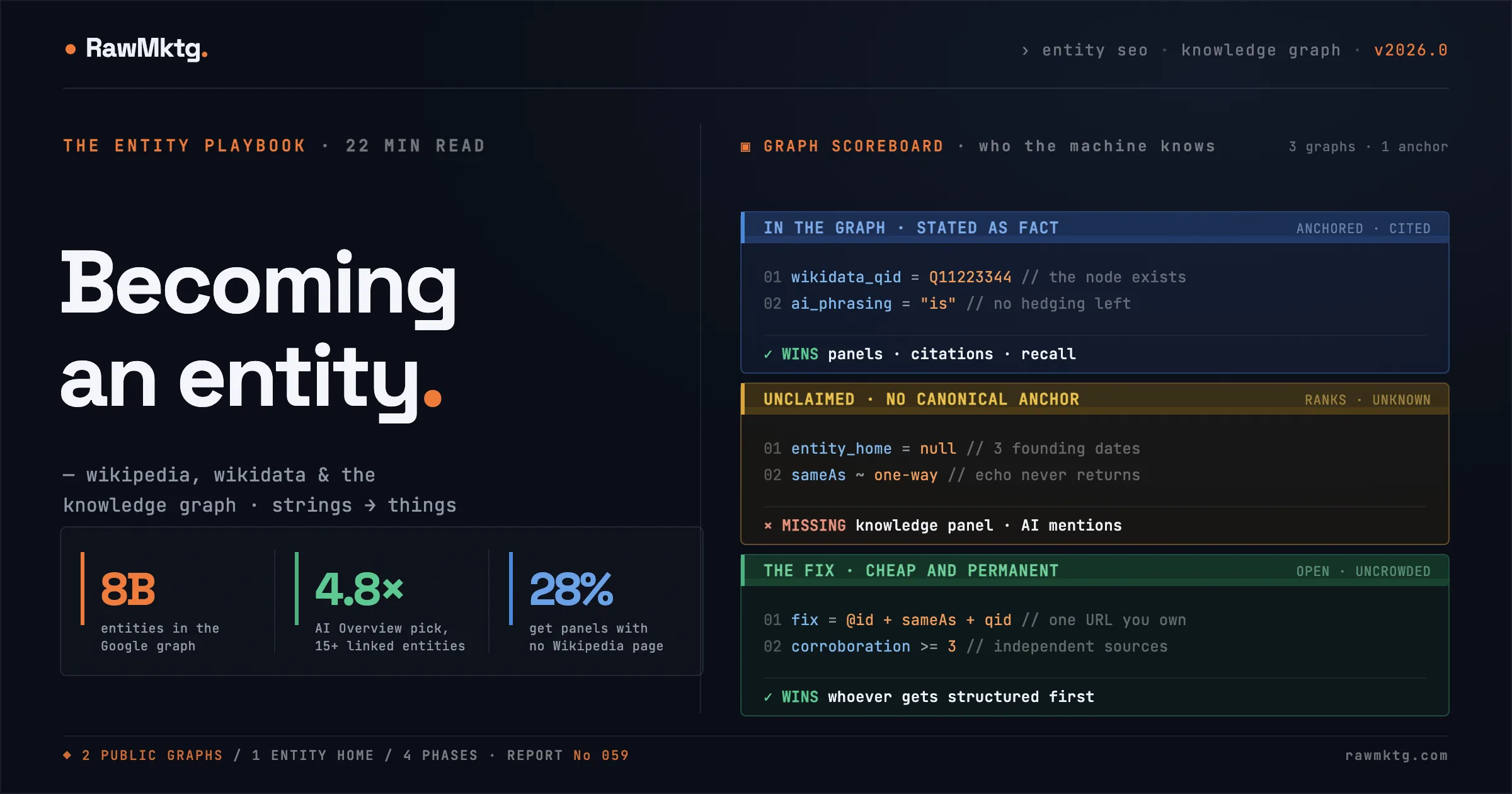
Search stopped being about words a long time ago, and most marketing teams never got the memo. For a decade the job was to match strings: find the phrase people typed, put it on a page, point links at it, and wait. That system is gone.
Modern search engines and generative AI systems do not primarily index documents. They query knowledge graphs, networked databases where facts are stored as discrete, interconnected nodes bound by defined relationships. When someone asks ChatGPT or Google who founded your company, the answer does not come from a page that ranks. It comes from a node that exists. You can publish two hundred excellent articles and still be invisible to an AI assistant, because the assistant is not looking for articles. It is looking for a thing it recognises.
01Why did search move from strings to things?
Read that second number carefully. The number of facts grew far faster than the number of entities: the graph is not mainly hunting for new things to know about, it is deepening what it knows about things it has already accepted. Getting in is the hard part; once you are in, the system wants more detail about you.
What an entity actually is
In the patent literature an entity is something singular, unique, well-defined, and distinguishable. Keywords are linguistic and suffer polysemy: the token "Java" is a language, an island, and a slang word for coffee. An entity sidesteps all of it, each concept gets a unique machine identifier that resolves the ambiguity everywhere at once. "Tour Eiffel" and "Eiffel Tower" are not two similar things; they are two labels on one node. Every node is assembled from the same five components:
| Component | What it does | In practice |
|---|---|---|
| Unique identifier | Permanently separates this node from every other, across systems. | Google MID (/m/0dl567), Wikidata QID (Q1744) |
| Labels & aliases | Language-agnostic names and their variants. | Eiffel Tower (en), Tour Eiffel (fr), trading names, former names |
| Entity type | Places the node in an ontological hierarchy. | schema:Person, schema:Corporation, wd:Q5 (human) |
| Scalar attributes | Literal key-value facts about intrinsic properties. | Founding date, headquarters, employee count |
| Relationship edges | Connects this node to other nodes via predicates. | founderOf, spouse (P26), parentOrganization |
That last row is where authority actually lives. A node with attributes but no edges is a lonely record; a node with dense, corroborated edges into other well-established nodes is an entity the system trusts. Content connected to fifteen or more recognised entities has been observed at a 4.8-fold increase in AI Overview selection probability, and brands present in a recognised graph score around 35% higher on overall AI visibility, the same topical-authority effect that lands B2B brands on AI shortlists.
Reading the identifiers
Google's machine identifiers come in two flavours, and the prefix is diagnostic. The /m/ prefix is a legacy Freebase ID (migrated before 2015, usually deep cross-graph references); the /g/ prefix marks an entity created natively inside Google's graph from crawling and structured data. A company founded after 2015 has a /g/ ID or none at all, which means your node was built from what Google could scrape and reconcile, only as good as the signals you have published. That is the lever. Wikidata uses QIDs for items (Q5 is human) and PIDs for properties (P31 is "instance of"); every fact is a QID joined to a value through a PID.
02Why does this matter more now than it did in 2019?
The first layer is static, you can only hope you were in the corpus. The third layer you already influence with publishing and technical accessibility, which is where most RAG-facing effort already goes. The middle layer, the knowledge graph, is free to edit and it is where confidence comes from. When an entity is established in a recognised graph, generative models stop hedging: the output moves from "claims to be" to simply "is".
That third outcome is the expensive one, and it is exactly what hallucination-proofing your brand is built to prevent.
03What is an Entity Home, and why does it go first?
When your Entity Home asserts a set of facts, crawlers go looking for those exact facts elsewhere. If corporate registries, Wikidata, news outlets and industry databases echo the same details, algorithmic confidence rises and you get stable nodes and Knowledge Panels. If they contradict, confidence falls, the node fragments, the panel disappears, and generative models start improvising.
This is why the boring work matters more than the clever work. Aligning your legal name across nine directories is not glamorous, it is the highest-leverage afternoon in the entire project.
The three gates
Entity data is evaluated in sequence, you do not get partial credit for skipping ahead.
Understandability is a markup-and-plain-copy problem. Credibility means systems verify your assertions against roughly three independent, high-confidence sources before accepting them, one source is a claim, two is a coincidence, three is a fact. Deliverability means a brilliant entity architecture behind a JavaScript wall crawlers cannot render is one nobody will ever see. Underneath all three sits the NEEATT frame (Notability, Experience, Expertise, Authoritativeness, Trustworthiness, Transparency); notability is the anchor, you cannot be a trusted authority until the system has decided you are a distinct you, which is how E-E-A-T became an AI signal.
The schema layer
Declaring an Entity Home means nested JSON-LD in the head of the canonical URL. Four properties do the structural work, and this is the same @graph discipline behind schema for AI citations:
| Property | Function | Why it matters |
|---|---|---|
| @id | Assigns a stable URI to the entity node itself. | Without it, parsers treat your JSON objects as anonymous blank nodes. Facts get read, then orphaned. |
| sameAs | Maps your node to identical nodes on external graphs. | The bridge to Wikidata, Crunchbase and official profiles. It is how the echo gets found. |
| mainEntity | Declares the primary entity a WebPage is about. | Says this page exists to document this node, not merely mention it. |
| mainEntityOfPage | Points from the entity back to its canonical URL. | Attach it to secondary pages so they reference the Entity Home rather than compete with it. |
{
  "@context": "https://schema.org",
  "@graph": [
    {
      "@type": "Corporation",
      "@id": "https://example.com/#organization",
      "name": "Enterprise Quantum Systems",
      "legalName": "Enterprise Quantum Systems Inc.",
      "url": "https://example.com",
      "foundingDate": "2016-03-15",
      "founders": [
        { "@type": "Person",
          "@id": "https://example.com/about/team#john-smith",
          "name": "Dr. John Smith" }
      ],
      "sameAs": [
        "https://www.wikidata.org/wiki/Q11223344",
        "https://www.crunchbase.com/organization/enterprise-quantum-systems",
        "https://www.linkedin.com/company/enterprise-quantum-systems"
      ],
      "mainEntityOfPage": { "@type": "WebPage", "@id": "https://example.com/about#webpage" }
    },
    {
      "@type": "WebPage",
      "@id": "https://example.com/about#webpage",
      "url": "https://example.com/about",
      "name": "About Enterprise Quantum Systems",
      "mainEntity": { "@id": "https://example.com/#organization" }
    }
  ]
}Three things people get wrong: they omit @id and wonder why the markup validates but nothing happens; they point sameAs at profiles that do not link back, breaking the reciprocity the echo depends on; and they duplicate the same organisation schema on every page, telling the crawler they have four hundred organisations instead of one.
Triggering a Knowledge Panel without Wikipedia
A Wikipedia article triggers a Knowledge Panel in roughly 52% of brand searches; organisations with no Wikipedia article still get panels in roughly 28%. So Wikipedia is a strong accelerant and a poor strategy, it is governed by a volunteer community with an active deletion culture, you do not control the page, and a botched attempt can get your domain blacklisted.
| Step | What you do |
|---|---|
| 1. Establish the Entity Home | One crawlable URL with explicit corporate details, leadership bios and complete JSON-LD. |
| 2. Standardise core facts | Name, address, phone, founding date, titles and product descriptions match across every profile you control. |
| 3. Build external corroboration | Entries on Wikidata, Crunchbase, Reuters, Bloomberg, government registries, Dun & Bradstreet. |
| 4. Deploy bidirectional sameAs | Link out from the Entity Home, and configure those third-party profiles to link back to it specifically. |
| 5. Maintain data harmony | Monitor third-party mentions so contradictions get caught before they erode confidence. |
Step two is where most programmes quietly fail, it is unglamorous data-janitorial work with no dashboard payoff, so it gets deferred, and every later step is then built on sand.
04How do you engineer Wikipedia and Wikidata for entity SEO?
Wikidata is a free, open, secondary knowledge base built on RDF triple principles. Items (QIDs) carry labels, descriptions and aliases; facts are Statements, an item joined to a value through a property. Three structures turn a bare triple into something trustworthy: qualifiers add temporal and contextual parameters (start time P580, position held P39); references carry provenance (every statement should cite an external source, unreferenced statements are the first thing patrollers strip); and external identifiers (VIAF, ISNI, registry numbers) bridge your item into third-party databases. A Wikidata item with fifteen well-referenced, qualified statements and six external identifiers is worth more than a Wikipedia stub nobody maintains.
Batch reconciliation with OpenRefine
Adding one company by hand works; a product catalogue or author roster does not. OpenRefine is the standard tool: reconciliation programmatically matches unstructured text cells to unique QIDs, the moment your private spreadsheet joins the public graph.
| Step | What you do | The detail that decides quality |
|---|---|---|
| 1. Ingest & clean | Import CSV/TSV/JSON, apply text transforms. | Fix encoding, whitespace and casing first, dirty input produces confidently wrong matches. |
| 2. Start reconciliation | Point the column at the Wikidata reconciliation endpoint. | wikidata.reconci.link/en/api |
| 3. Constrain the class | Restrict candidates by instance of (P31) or subclass of (P279). | Humans to Q5, companies to Q4830453. This is where strings become things. |
| 4. Match extra columns | Map secondary columns to properties during scoring. | Country (P17), inception (P571), HQ (P159) resolve namesake collisions names alone cannot. |
| 5. Map the schema | Build the Wikibase schema: columns to properties, qualifiers, references. | Add reference URLs here, retrofitting provenance across thousands of statements is miserable. |
| 6. Push the edits | Upload via authenticated API, or run through Wikimedia PAWS. | PAWS is hosted JupyterHub for when local processing is the bottleneck. |
Step four is the one people skip, and it prevents the worst failure mode in the discipline: confidently attaching your facts to the wrong node. Match on name alone and you will eventually merge yourself into a defunct Brazilian logistics firm.
SPARQL for people who do not write SPARQL
You query Wikidata through its SPARQL service. You do not need fluency, you need to read the namespace prefixes because they carry the meaning: wd: names a specific item, wdt: is the truthy predicate to a value, p:/ps:/pq: reach statement nodes and their qualifiers, and wdtn: builds external-identifier URIs when you federate out. Two queries earn their keep. The first catches duplicate external identifiers, run it quarterly, it takes seconds and catches the silent corruption that surfaces eighteen months later as a mysteriously wrong Knowledge Panel:
# Catch one external identifier attached to two or more items
SELECT ?item (GROUP_CONCAT(?extId; separator="|") AS ?idJoined)
WHERE {
  ?item wdt:P10701 ?extId.
}
GROUP BY ?item
HAVING (COUNT(?extId) >= 2)
The second federates the query service against another endpoint's SPARQL using a SERVICE block, constructing valid IRIs with BIND and CONCAT. Federation is where this stops feeling like SEO and starts feeling like data engineering, which is the correct feeling, you are maintaining records in a distributed public database.
# Federate the Wikidata query service out to another endpoint
SELECT ?wikidataItem ?factgridItem ?extID WHERE {
  ?wikidataItem wdt:P8168 ?extID .
  SERVICE <https://database.factgrid.de/sparql> {
    ?factgridItem wdt:P39 ?extID .
  }
  BIND(IRI(CONCAT("https://www.wikidata.org/wiki/", ?extID)) AS ?constructedIRI)
}
LIMIT 5005How do you audit what Google actually knows about you?
import requests, json

ENDPOINT = "https://kgsearch.googleapis.com/v1/entities:search"

def audit_entity(query_string, api_key, entity_type=None):
    params = {"query": query_string, "key": api_key, "limit": 5, "indent": True}
    if entity_type:
        params["types"] = entity_type
    r = requests.get(ENDPOINT, params=params)
    if r.status_code != 200:
        raise Exception(f"API request failed: {r.status_code} {r.text}")
    results = []
    for item in r.json().get("itemListElement", []):
        node = item.get("result", {})
        results.append({
            "name": node.get("name"),
            "mid": node.get("@id", "").replace("kg:", ""),
            "types": node.get("@type", []),
            "description": node.get("description", "N/A"),
            "official_url": node.get("url", "N/A"),
        })
    return results

if __name__ == "__main__":
    print(json.dumps(audit_entity("OpenAI", "YOUR_KEY", "Organization"), indent=2))
Run it on a schedule and store the output. Four things are worth alerting on, and none of them show up in a rank tracker, though all of them change how an AI assistant describes you: the MID changes or disappears (your node was merged, split or dropped); the official URL stops pointing at your domain (someone else captured the binding); the description shifts (Google's understanding of what you are has moved, possibly toward a competitor's category); or a namesake starts outranking you for your own brand string.
06What entity SEO tools and metrics actually matter now?
| Platform | Core capability | Best fit |
|---|---|---|
| InLinks | NLP entity extraction, automated internal linking, JSON-LD injection. | Sites needing semantic linking and schema without engineering time. |
| WordLift | CMS entity curation, private knowledge graph, RDF endpoints. | Publishers wanting a queryable graph of their own content. |
| Schema App | Scalable schema deployment via no-code mapping into a triple store. | Multi-domain enterprises needing centralised schema governance. |
| Diffbot | Computer-vision and NLP crawling to build commercial graphs. | Teams building proprietary graph datasets from the open web. |
| Profound | Share-of-voice and citation tracking across generative engines. | Brands measuring Share of Model and citation likelihood. |
| AthenaHQ | Real-time sentiment and entity-mention tracking across LLMs. | PR and brand-equity monitoring inside AI interfaces. |
Rank position is not dead but it is no longer sufficient. Three generative metrics are becoming standard: Share of Model (the proportion of generative answers in your category that reference your entity, the new share of voice); citation likelihood (how well your structure aligns with retrieval mechanisms); and contextual sentiment and accuracy (what models actually say about you). Start with the third because it needs no vendor: ask five models ten questions about your category once a month and write down what they say. You will learn more in an hour than most dashboards tell you in a quarter, and it pairs naturally with a prompt-to-citation measurement stack.
07What's the twelve-month build sequence?
Phase one assigns each entity a dedicated Home URL with nested JSON-LD (@id, @type, mainEntity, complete scalar properties) and body copy that plainly states function, parent, founding details and people, marketing copy about what you enable customers to achieve is useless here, say what you are. Phase two reconciles historical records with OpenRefine and mints or updates QIDs with statements, qualifiers and external identifiers, it can start while phase one runs but not before, because Wikidata statements should reference the Entity Home. Phase three is the Digital Brand Echo made real: harmonise every fact across directories and registries, establish bidirectional sameAs, and add independent secondary citations through high-authority press and original research, the same earned corroboration that AI engines already trust. Phase four runs scheduled API inspections, tracks Share of Model and sentiment, and re-validates schema so external changes never silently disconnect your node.
| Failure mode | What it looks like | The fix |
|---|---|---|
| Blank node syndrome | Schema validates perfectly, nothing changes in search. | Add explicit @id URIs. Unnamed nodes get read and discarded. |
| One-way sameAs | You link out to eight profiles. None link back. | Configure the return link on every third-party profile you control. |
| Fact drift | Three founding dates across five sources. | Pick one, fix it at the Entity Home, then correct outward. |
| Schema everywhere | Organisation markup duplicated on every page. | One declaration, referenced by @id from everywhere else. |
| Wikipedia tunnel vision | Six months on a page that gets deleted. | Triage honestly. Do Wikidata first, always. |
| Build and abandon | Great architecture in year one, silent decay in year two. | Phase four is a standing commitment, not a project. |
Three browser-based tools built from this playbook: the Entity Home JSON-LD Generator for the nested @graph, the Entity Readiness Scorecard to score yourself across the three gates, and the Fact-Consistency Checker to catch the drift that fragments your node. All free, all run in your browser.
08What does this add up to?
Winning here is not the same as winning the old game, and it compounds differently, the same reason winning Google is no longer winning AI. Become a thing the machine knows, and the rest of your content finally has somewhere to attach.
Is Wikidata a knowledge graph, and how does it help SEO?
Yes. Wikidata is a free, structured knowledge graph whose entries each carry a unique QID, and it is one of the primary sources large language models and Google's Knowledge Graph draw on to resolve entities. For Wikidata SEO the payoff is that a Wikidata entry helps you become a known entity: it gives your brand a machine-readable identifier a model can attach facts to, which is why a Wikidata QID and a consistent sameAs link from your site to your Wikidata and Wikipedia knowledge-graph nodes are among the highest-leverage entity signals you can build.
What is the difference between a keyword and an entity?
A keyword is a string of text; an entity is a distinct concept with a unique machine identifier (a Google MID or a Wikidata QID). Keywords are ambiguous, the string "Java" means a language, an island, or coffee, so a string-matching engine has to guess. An entity resolves that ambiguity across every language at once: "Eiffel Tower" and "Tour Eiffel" are two labels on one node. Modern search and generative engines answer from entity nodes in a knowledge graph, not from documents that rank, so being a recognised entity is what makes a machine confident enough to state facts about you.
Do I need a Wikipedia page to get a Google Knowledge Panel?
No. A Wikipedia article triggers a panel in roughly 52% of brand searches, but organisations with no Wikipedia article still get panels in about 28%. Wikipedia is a strong accelerant and a poor strategy, it is community-governed with an active deletion culture and a failed promotional attempt can get your domain blacklisted. The reliable route is Wikidata plus a canonical Entity Home and consistent third-party corroboration, which has no notability wall for structured data and feeds the same downstream systems.
What is an Entity Home?
The single, authoritatively controlled URL that acts as the canonical reference for machine-readable facts about your entity, one entity, one URL. It is usually an About page or organisation root (not your marketing homepage), engineered to carry nested JSON-LD with explicit @id URIs and plain declarative copy. When it asserts facts, crawlers look for those exact facts on registries, Wikidata and news outlets; if they echo, algorithmic confidence rises and you earn stable nodes and Knowledge Panels.
If I only do one thing, what should it be?
Create a Wikidata item and point it, and your Entity Home's sameAs array, at each other. Wikidata is the direct descendant of the Freebase database that seeded Google's Knowledge Graph, it is fully machine-readable, and it has no notability wall for structured data. A Wikidata item with fifteen well-referenced, qualified statements and a handful of external identifiers, reciprocally linked to a JSON-LD Entity Home, does more for machine-readable authority than another two hundred blog posts.
How do you use Wikidata and Wikipedia to improve AI visibility?
Wikidata and Wikipedia are two of the strongest entity signals an AI system reads, because they feed the knowledge graphs models use to resolve who you are; Wikidata in particular explains a large share of B2B recommendation variance. Ensure a well-sourced Wikidata item exists with consistent identifiers (official name, URL, founding date, sameAs links), keep it accurate, and earn a Wikipedia page only where you genuinely meet notability with independent coverage. Both must agree with your on-site entity markup, inconsistent entities do not get resolved or recommended.
rawmktg. publishes data-driven teardowns and technical playbooks on GEO, entity SEO and B2B AI-search visibility. Method: same data, same lens, every time. Contact: vinayak@rawmktg.com
Sources: the public record of the Google Knowledge Graph and Wikidata, the schema.org and Wikibase specifications, the Knowledge Graph Search API docs, and published entity-SEO research, 2025-26. Code and schemas are illustrative reference implementations.