For almost thirty years, search worked the same way. You typed a question, Google handed you a list of blue links, and then you did the real work: clicking around, reading a few pages, and piecing the answer together yourself. That model is breaking down. Today's AI tools do not just point you to pages, they read the pages for you and write one clear answer. Buyers do not want a trip to ten websites anymore. They want the answer, right now.
- The engine finds pages and ranks them
- You open them, read them, compare
- You build the answer yourself
- A page ranked sixth still gets seen
- The engine reads many pages in real time
- It writes a single answer
- A few sources are cited inside it
- A source not named is invisible
This is not a small design change, it is a traffic problem. When an AI answer sits on top of the page, fewer people scroll down to click. On average, click rates fall about 28%. For B2B SaaS, it gets worse fast: some see organic traffic drop up to 40% within 90 days of AI features going live on their main commercial keywords. And your rankings can look fine while your leads dry up, if the AI answers the question without a click, that top ranking does not turn into a single lead.
That last number matters most. A 2026 Conductor benchmark of 13,770 websites and 100 million citations found 25% to 39% of AI citations come from pages not ranked in the top organic results. AI picks its sources by different rules than Google's old ranking system, so winning the old game does not mean you win the new one. That is why marketers are learning Generative Engine Optimization (GEO): making sure your brand gets cited, mentioned and recommended across ChatGPT, Perplexity, Gemini and Claude, where B2B deals are now won or lost.
This is the map, not the manual. It covers the whole shift end to end, the business case, the mechanism, the proof and the plan, at a level a leadership team can act on. Where a topic has its own playbook, each section hands off to that deeper article. Start here, then follow the links that matter to your team.
01How do B2B buyers actually buy now?
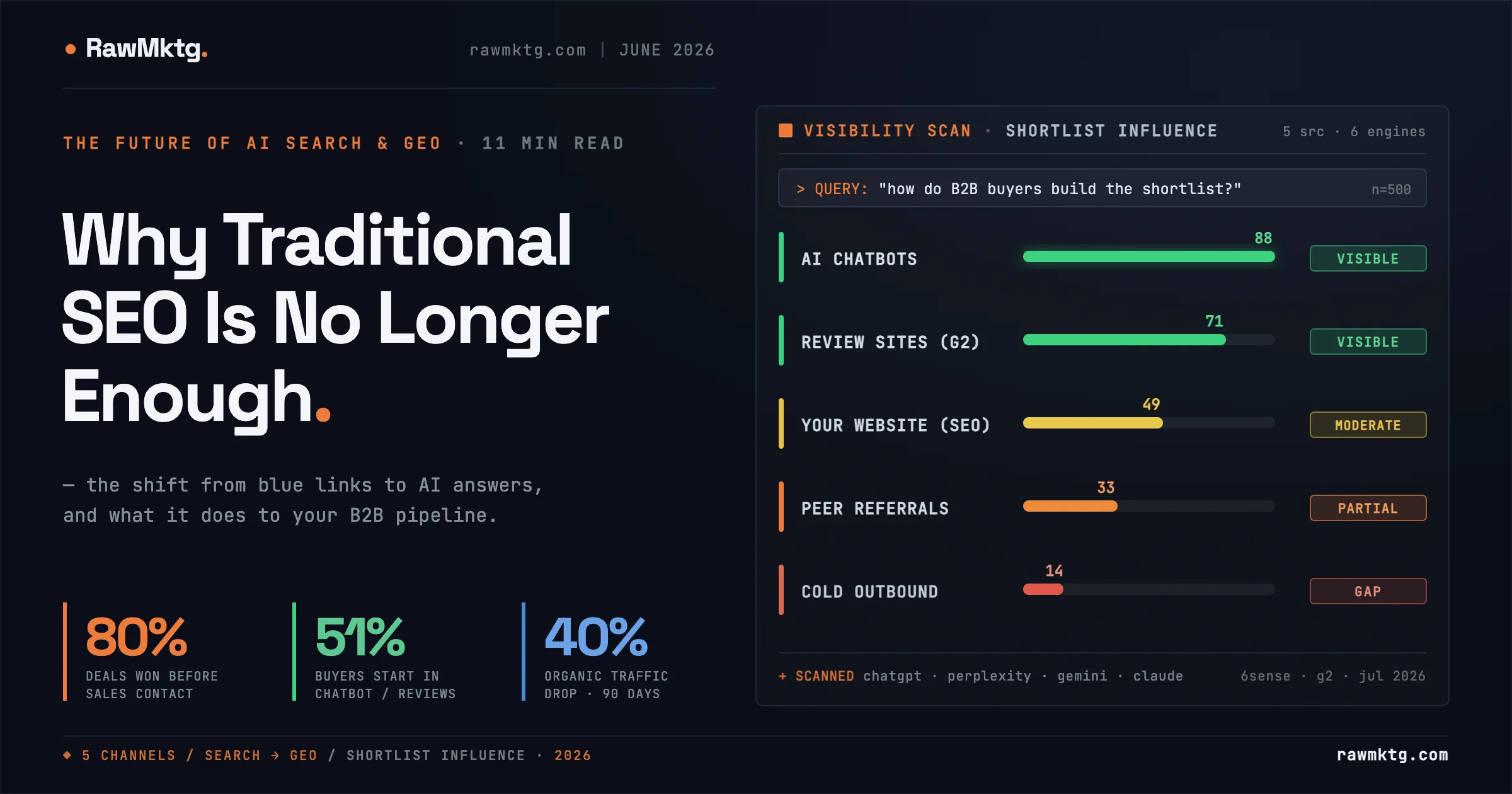
AI chatbots are now the single most influential source shaping vendor shortlists, named by 17.1% of buyers, ahead of vendor websites (12.8%) and peer recommendations (8.9%). For software buyers, 51% now start their research in a chatbot instead of Google. The habit speeds things up (sales cycles shrank from 11.3 to 10.1 months) but the buying group is bigger: a typical enterprise deal now involves 13 people inside the company and 9 outside. Millennials and Gen Z make up 71% of business buyers, and 44% of them prefer to buy with no sales rep at all.
Self-service rules the early stage, but people still want a human before they sign. Gartner found 67% of buyers prefer a rep-free experience, yet 69% still ask a sales rep to check what the AI told them. Why? Trust: about half of buyers say they have hit misleading claims from AI, and about half say the same about sales reps. Buyers now use both, and cross-check each one.
The lesson is simple. If AI shapes the shortlist, and the shortlist decides the deal, then getting recommended by AI is not a nice-to-have, it is a pipeline input, as the carbon and ESG teardown shows in one category.
02How does AI search really work?
Retrieval pulls specific text blocks, not whole pages, and each engine reaches into a different index. That is the executive summary; the full pipeline, chunking, vector retrieval, re-ranking, and the GraphRAG upgrade that beat standard RAG 96% of the time, is decoded in How RAG Actually Works. The one takeaway for now: clear structure and clear links between your facts help the engine trust and use them.
03Why does each AI cite sources differently?
| Platform | How it picks | What it rewards | What it means for you |
|---|---|---|---|
| ChatGPT Search | Queries Bing, pulls 8-12 pages, cites 3-6 | Domain authority; 87% of citations match Bing's top 10 | Build real authority; sites over 32K referring domains are 3.5x more likely to be cited |
| Perplexity | Live search each time, pulls 10-20, cites 2-4 | Niche, specialist sites; 24% of citations are vertical | Deep expert content can win without a huge domain, and it passes real referral traffic |
| Google AI Overviews | Google's index, powered by Gemini | Structured, multi-format; YouTube most-cited outside source | Only 4.5% of cited URLs match page-one results, so deeper pages matter |
Treat the table as the summary; the per-engine deep dive, with a 60-day multi-engine rollout, lives in Why Engines Recommend Different Vendors, and Google's two surfaces get their own breakdown in AI Mode vs AI Overviews. One quiet but critical point first: AI crawlers can only cite what they can reach. An old or strict robots.txt can block bots like OAI-SearchBot or PerplexityBot without you knowing. If they cannot crawl you, you are out before the game starts.
04What does the research say actually works?
| Content change | Effect on AI visibility |
|---|---|
| Add real statistics and data | Strong lift |
| Add expert quotations | Strong lift |
| Write in clear, fluent language | Lift |
| Keyword stuffing | Down about 8% |
Old-school keyword stuffing does not just fail, it backfires: AI reads for meaning, so repeated keywords look like low quality and the model picks a cleaner source. What works is the opposite, expert quotes, exact numbers, and clear, simple writing. The full nine-tactic study and the page-level patterns that win are pulled apart in Anatomy of a High-Citation Page; the three moves that matter most are below.
Lead with the answer
Put a direct 40 to 60 word answer in the first third of the page or section, engines grab these opening blocks. Pages with these answer capsules get cited 40% more often than ones that open with a slow, vague intro. Turn your H2 and H3 headings into real questions, worded the way buyers ask them, the anatomy of a high-citation page.
An enterprise security page ranked well on Google but got zero AI citations, it opened with a long history of security systems. The team rewrote the intro to lead with a dense fact (which three protocols matter, and the exact share each holds). That one change drove a 280% jump in AI citations in 60 days.
Rebuild your proof
Old case studies lean on feelings and story; AI cannot use that. To be citable, a case study needs a simple proof formula: a clear claim, a specific number, and the context to repeat it. Also write public pages that answer late-stage worries head on, like switching costs and setup risk. Buying groups look these up when a deal stalls, and AI cites them.
Fix your name confusion
Say your homepage calls you a "workflow platform," your G2 page says "project management tool," and your LinkedIn says "team collaboration solution." To an AI that looks like three fuzzy identities, so its confidence drops and it picks a rival with one clear, matching label everywhere. Use the same category words across your site, review profiles and press, and back them with consistent entity schema.
05What is the citation flywheel?
This is not theory. In one documented case, a SaaS team published 66 targeted AEO articles in month one, then seeded genuinely helpful answers on high-intent Reddit threads that already ranked on Google, driving a 600% jump in citations and a six-fold rise in trials. The GEO Compounding Flywheel models the full loop, the Share-of-Citation math, and why it gets harder to dislodge over time.
06How do you measure GEO?
| Metric | What it tells you |
|---|---|
| AI Visibility Score | How often your brand shows up across a set of industry prompts |
| Share of Voice | How often you are cited versus your top 3-5 rivals |
| Citation Rate | How often the engine links to your page, not just names you |
| Prompt-Level Performance | How you do on specific money prompts like "best CRM for startups" |
| Citation Quality | Whether you appear up top or buried at the end |
| Sentiment | Whether AI calls you a "market leader" or a "budget option" |
| AI Referral Traffic | Real clicks from perplexity.ai, chatgpt.com and Google AI Mode in GA4 |
As a benchmark: Ahrefs found about 26% of brands have zero citations in Google AI Overviews. Most SaaS firms start at an 8% to 15% citation rate; good on-page and schema work pushes that to 20% to 30%; category leaders reach 40% to 50% or more. This is the scorecard in brief, Prompt-to-Citation Tracking builds the full measurement stack: prompt portfolios, GA4 AI attribution, and revenue per citation as the ROI metric.
07What results are real companies seeing?
| Company | What they did | Result |
|---|---|---|
| B2B tech (Optimist) | Clean Q&A + schema to fix name confusion | 49x more AI-referred revenue, 26x more AI referral traffic in 14 months |
| Financing platform (Concurate) | Real author names, expert bios, valid FAQ schema | +315% Google AI Overview citations, 100% lift in AI referrals in 4 months |
| Series C HR tech | Released anonymized platform data as fact-dense assets | Brand mentions rose 12 to 48/month, displacing two rivals in 90 days |
| Mature SaaS (Discovered) | Fixed schema, 66 targeted articles, seeded Reddit | AI-referred trials grew 575 to 3,500+/month in seven weeks |
| SaaS platform (GreenBanana) | Rebuilt pricing/feature pages for conversational prompts | $4.8M new AUM in 120 days, a 415% return |
| CloudEagle (Quattr) | Optimized 33 product pages, AI-native SEO + internal linking | 3x AI citation share, 77% of new traffic bottom-funnel |
The gap between winners and laggards is already wide. In one review of legal software, Clio scored 89 out of 100 for AI visibility while a rival scored 2. That gap decides who lands on the shortlist. The buyers never see the score, they just see who the AI recommends.
08What's the 90-day roadmap?
| Track | Window | The work |
|---|---|---|
| Technical | Days 1-30 | Audit robots.txt so no rule blocks AI bots; deploy valid JSON-LD on product, solutions and pricing pages; set up GA4 filters for AI referral sessions. |
| Content | Days 31-60 | Add a 40-60 word answer capsule atop key pages; turn headings into buyer questions; rebuild case studies into claim + metric + context; publish honest objection pages. |
| Authority | Days 61-90 | Align category words across your site, G2, LinkedIn and press; build partner citation networks; earn genuine mentions on Reddit and Quora. |
Two free tools cover the first two tracks: the GEO Readiness Scorecard flags the technical and content gaps capping your citations, and the Off-Site Authority Stack Scorecard scores the authority track, review sites, analysts, community and entity schema.
09Why is the window closing?
The real risk: leaders who do not build their brand's authority and citation footprint in the next 6 to 12 months may find their product quietly left out of the AI answers that now guide the B2B buying journey. Not ranked lower. Left out. Traditional SEO is not dead, it is the foundation, but on its own it is no longer enough. The brands that win from here pair clean technical SEO with citation-first GEO content and tight, honest conversion pages. Do that, and you land on the Day One shortlist at the exact moment the buyer decides.
AI now writes the answer instead of listing links, and click-through can fall up to 40% on core terms. 80% of B2B deals go to the vendor already favored before sales contact, and chatbots shape that shortlist more than websites or peers.
AI picks sources by clarity and proof, not keyword rank, keyword stuffing actually hurts you by about 8%. Lead with a 40-60 word answer, rebuild proof into claim + metric + context, and use one category label everywhere.
Track citation rate, not pageviews. Move in the next 6 to 12 months, before the trusted-source list locks in.
How do you transition from traditional SEO to GEO?
Keep the technical SEO foundation, crawlability, structured data and clean information architecture, then shift the content brief from keyword-matching to answer-first passages a model can lift. Add FAQ and comparison content that names competitors honestly, publish structured facts in server-side HTML, and measure AI citations and Share of Model alongside rankings. The transition is additive, not a teardown.
What is GEO (Generative Engine Optimization)?
GEO is the practice of getting your brand cited, mentioned and recommended inside AI-generated answers across ChatGPT, Perplexity, Gemini, Google AI Overviews and Claude. Where traditional SEO optimizes to rank a page in a list of links, GEO optimizes to become the source an AI engine lifts and credits when it synthesizes an answer. It combines technical hygiene (crawlability, schema), citation-first content (answer capsules, statistics, expert quotes), and off-site authority (reviews, mentions, partner citations).
Is traditional SEO dead?
No. Traditional SEO is the foundation GEO builds on, Google itself says you win AI search with solid SEO basics: valuable content, verified schema, and clean site structure. But on its own SEO is no longer enough, because a top ranking no longer guarantees a click or a citation. Between 25% and 39% of AI citations come from pages that are not ranked in the top organic results, so you have to optimize for how AI reads and cites, not just how Google ranks.
Why is my organic traffic dropping even though my rankings are stable?
Because AI answers are intercepting the click. When a generative answer sits above the links, click-through falls about 28% on average, and some B2B SaaS firms see organic traffic drop up to 40% within 90 days of AI features going live on their main commercial keywords. Your page can still rank at the top of Search Console while the AI answers the question without sending anyone to your site, so rank and session counts no longer tell you the truth.
How do you get cited by AI search engines?
Lead with a direct 40-60 word answer in the first third of each page or section (these get cited ~40% more often), add real statistics and expert quotes (the Princeton study found these give the strongest lift, while keyword stuffing cuts visibility ~8%), phrase headings as buyer questions, deploy valid schema, make sure your robots.txt admits AI crawlers, and use one consistent category label across your site, G2 and press. Then build off-site corroboration through reviews and genuine community mentions.
- Princeton, Georgia Tech, Allen Institute, IIT Delhi, GEO: Generative Engine Optimization (ACM SIGKDD 2024)
- 6sense / Omnibound, B2B Buying Statistics 2026
- Gartner, 67% of B2B buyers prefer a rep-free experience
- Gartner, 69% of buyers turn to sales reps to validate AI-generated insights
- Frase, The complete GEO playbook (Conductor 100M-citation benchmark)
- Pixis, ChatGPT vs Perplexity vs Gemini: platform-specific GEO
- cheers.tech, AI search engine source differences
- Quattr, GEO metrics: measuring visibility in AI search
- Discovered Labs, GEO metrics: what KPIs matter (2026)
- Elementera, What the Princeton GEO paper shows your business
- HubSpot, Answer Engine Optimization case studies (2026)
- Optimist, Real-world AEO & GEO case studies for B2B
- AI Thinker Lab, GEO 2026: Princeton-backed
rawmktg. publishes data-driven playbooks and teardowns on how AI search decides what to recommend, pulling citation and SEO data to show exactly where the visibility gaps are. Contact: vinayak@rawmktg.com