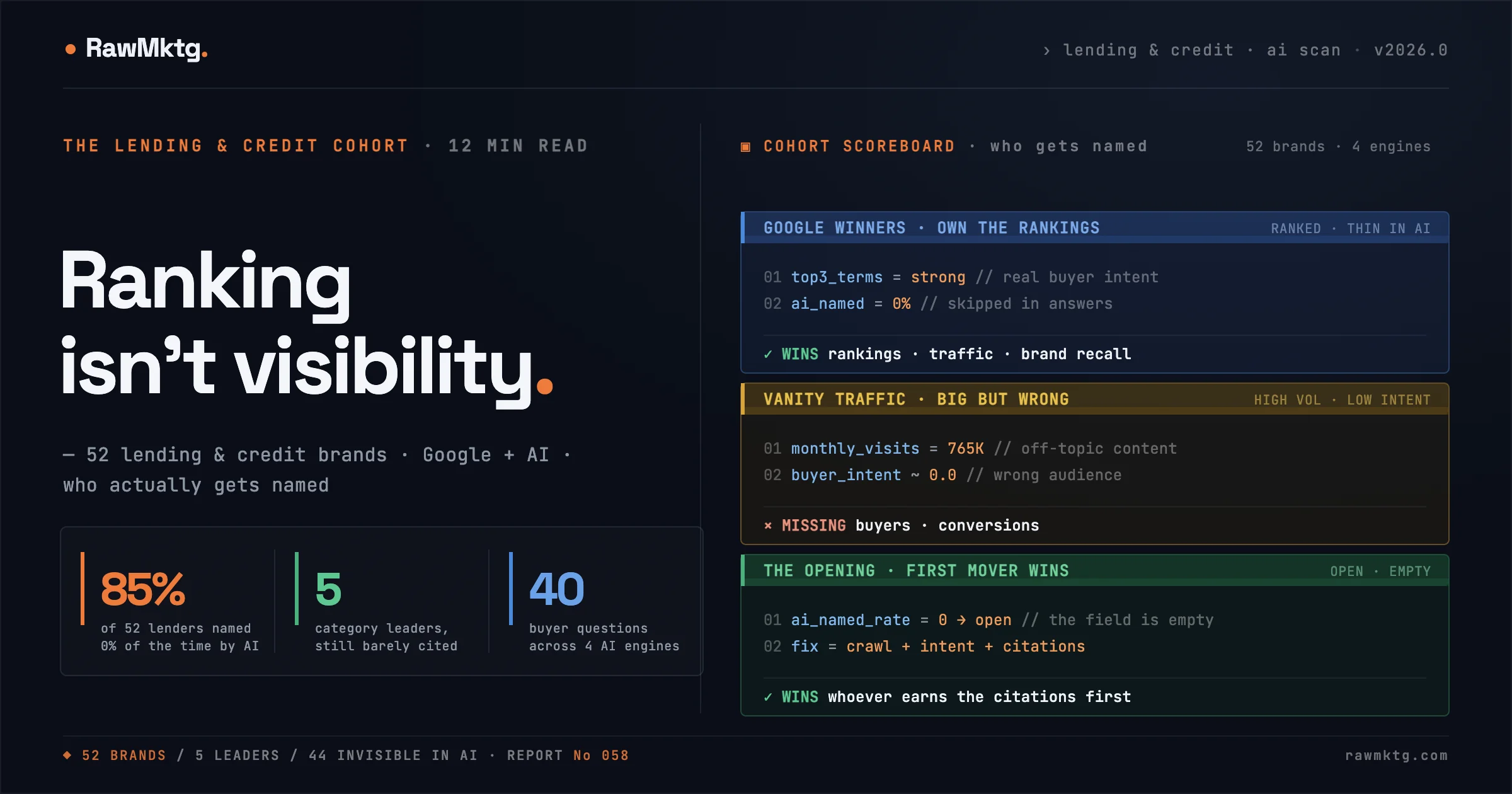
For most of the last decade, a lending or credit brand could grow on a simple formula: rank on Google for the terms buyers search, buy the paid clicks you could not earn, and pour the rest into performance channels. That formula still matters. But it is no longer the whole game, and treating it as though it is has quietly become the most expensive mistake in the category.
To see how far the ground has shifted, we audited 52 lending and credit companies across the US, India, Africa and Latin America, and measured each the way a modern buyer actually finds a lender: website health, presence on Google for real buyer terms, and whether ChatGPT, Google AI, Claude and Gemini name the brand when asked the questions customers ask. The headline finding is stark: across the same 40 buyer questions, 44 of the 52 companies were named 0% of the time by the major AI assistants. Even the five clear category leaders were cited only on narrow "best-of" lists. A brand can win the Google page and be completely absent from the answer a customer now reads first, exactly why traditional SEO is no longer enough.
The visibility gap is the most urgent finding, but it is a symptom of a deeper issue: many lenders optimise one channel in isolation and lose customers at the handoffs between stages. This guide walks the entire funnel, awareness, consideration, application, funding, onboarding and retention, and shows where the audit says the real leaks are. Brands are named only to illustrate patterns.
01How do you get found on Google and AI now?
The AI-answer cliff
When we scored all 52 companies on how often the assistants named them across 40 buyer questions, the distribution was not a gentle curve. It was a cliff. Scoring a field like this properly, with enough runs and honest weights, is its own discipline, laid out in Share of Model, measured properly.
The lesson is not that AI visibility is hard for everyone equally, it is that almost no one in lending has done the specific work that earns it, which means the field is wide open. The same inversion shows up in investing and wealth, where the cleanest sites earned zero AI citations and the messiest got quoted.
Where AI answers actually come from
To fix AI visibility you have to know what answers are built from, and it is not your homepage, only about 2.9% of AI citations point to your own site. Assistants assemble answers primarily from what credible third-party sources say about a category, review sites, trade media, comparison publishers, forums, then cite the brands those sources mention. Owned and paid content plays a much smaller role.
You cannot write or buy your way into AI answers from your own domain alone, and as the carbon and ESG teardown shows, domain authority barely helps. You earn your way in by becoming a brand the sources AI trusts already talk about: get listed and reviewed on the category's review sites, pitch data and commentary to trade publishers, and make sure comparison round-ups include you. For a lender that means G2/Capterra-type listings for B2B software, credible personal-finance and SMB publishers for consumer products, and original data others want to cite. Those answers are assembled by fanning one prompt out into many hidden searches and fusing the results, so inclusion is about covering the sub-queries, not holding the number-one spot for a term.
Three fixable failure modes
| Failure mode | What it looks like in the data | The fix |
|---|---|---|
| The site cannot be read | JavaScript-only pages or aggressive bot-blocking meant crawlers, and AI readers, reached only a fraction of the site; several returned almost nothing. | Server-render or pre-render key pages; confirm Google and AI crawlers can fetch them; fix broken responses and robots rules. |
| Traffic is the wrong traffic | Large visit counts came from off-topic utility content, GST/HSN lookups, gold-rate pages, money-game searches, not buyer-intent terms. | Rebuild content around the terms buyers actually search at each stage; stop measuring vanity volume. |
| Nobody else mentions the brand | Near-total absence from the review sites, comparison publishers and trade media assistants cite; many had zero review-site links. | Earn category coverage: listings, reviews, data-led PR, and inclusion in best-of round-ups. |
Give every channel one job
None of this means abandoning paid media, it is the fastest way to capture existing demand. The mistake is relying on it so completely that the brand never builds the earned, organic and AI-visible presence that captures demand before a competitor's ad does, and keeps working when the budget pauses.
| Channel | Job it's good at | Job it's bad at |
|---|---|---|
| Paid search / social | Capturing in-market demand fast; testing messages | Building durable trust; working after budget stops |
| Organic search | Capturing intent cheaply at scale; compounding over time | Delivering volume this week; instant results |
| AI / generative search | Being the recommended default at the moment of decision | Direct-response attribution today; precise volume control |
| Earned media & reviews | Building trust; feeding AI citations; lowering CAC everywhere | Being switched on quickly or fully controlled |
02Why does traffic quality beat traffic volume?
Ask: would the person who searched this term ever take out a loan or buy this product? If the honest answer is no, the page may still have a role in brand or SEO plumbing, but it should never be counted as marketing performance, and never the thing you celebrate. A page that earns 500 visits from people ready to apply beats 50,000 from people playing a game.
03How do you build trust before the application?
Notice how tightly these link back to awareness. The review sites and comparison publishers AI assistants cite are the same ones a cautious borrower reads, so investing in third-party proof is not a separate PR line item, it is consideration-stage conversion and AI visibility bought with the same dollar. That comparison page can be a vendor-owned asset rather than a directory listing, which is exactly what the best-X-for-Y comparison-page playbook is for.
| Trust signal | Question it answers | Where it pays off |
|---|---|---|
| Ratings & reviews | "Have people like me been treated well?" | Consideration conversion; AI citations; lower paid CAC |
| Transparent pricing | "Will I be surprised by the real cost?" | Application completion; compliance; reduced churn |
| Named case studies | "Does this work for someone like me?" | B2B consideration; sales enablement; PR |
| Security & data proof | "Is my data and identity safe here?" | Application starts; brand trust; regulatory posture |
| Credible press & data | "Do serious outsiders take this brand seriously?" | Awareness; AI citations; link and mention growth |
A single well-made trust asset usually pays off in more than one stage: a transparent pricing page reassures the human, satisfies the regulator, and gives an AI assistant a clean fact to quote. That multiplier is why consideration-stage investment is chronically undervalued.
04How do you convert applications without leaking?
| Funnel step | Typical benchmark | The lever that moves it |
|---|---|---|
| Landing page to lead | ~4.6% conversion | Message match to the ad/term; single clear action; social proof above the fold |
| App install to registration | ~24% | Fast first-run; delay data requests until value is shown |
| Registration to funded | ~18% | Soft-pull pre-qualification; transparent terms; progress indicators |
| Email open (lifecycle) | ~23% (48% transactional) | Segmented, behaviour-triggered sends; plain, human subject lines |
The single highest-leverage move here is the soft-pull pre-qualification: letting a prospect see likely terms without a hard credit inquiry. It reduces the fear that stops applications, filters out prospects who would be declined anyway, and dramatically improves the registration-to-funded rate. Treat the offer experience as part of marketing's remit, not something underwriting owns.
05Why is compliance a marketing discipline, not a constraint?
Practically, a few habits become non-negotiable: present APR, fees and total cost together (not the headline rate alone); avoid absolute claims like "guaranteed" or "instant approval for everyone" unless literally always true; build a lightweight review step into the content workflow so campaigns and AI-generated copy are checked before they ship; and keep data-use and consent language honest and prominent. Transparent, compliant marketing is not just risk reduction, honesty compounds across the whole funnel.
06How do you grow retention and lifetime value?
The response is not more acquisition to refill a leaky bucket, it is lifecycle work: activation that drives first successful use (retention is won in the first week), a well-timed cross-sell or renewal to an existing repaying customer (the cheapest high-quality volume a lender can get), and referral-and-review asks at the moment of relief, when the loan solved the problem. That last point closes the loop: reviews and referrals from happy customers become the third-party proof that persuades the next prospect and the earned mentions that get you named in AI answers. A retention programme is quietly also an awareness programme.
07What's the workflow for winning AI visibility?
08What should you measure to prove each stage works?
| Stage | Primary metric | Vanity metric to demote |
|---|---|---|
| Awareness | AI named-rate; buyer-intent impressions | Total pageviews |
| Consideration | Assisted conversions; branded search lift | Time on site |
| Application | Start-to-finish rate; cost per funded loan | Raw lead count |
| Funding | Approval and fund rate; LTV:CAC | Cost per click |
| Onboarding | Activation rate; day-30 retention | App installs |
| Retention | Repeat rate; referral rate; LTV | Email list size |
The named-rate deserves special mention: it is simply the share of your buyer questions on which the assistants name you, measured on a fixed set of prompts and re-run on a schedule. Today, for almost every lender, that number is near zero. The brands that start measuring and moving it now will define the default answers their whole market reads for years.
09What's the first-90-day sequence?
| Window | Focus | Concrete moves |
|---|---|---|
| Weeks 1-4 | Open the doors | Fix crawlability and broken responses; audit traffic for intent; baseline the AI named-rate on 40 buyer questions. |
| Weeks 3-8 | Fix the pages | Rebuild key pages around buyer-intent terms; add direct top-of-page answers and schema; ship soft-pull pre-qualification. |
| Weeks 6-12 | Earn the citations | Get listed and reviewed on category sites; publish one data-led report worth citing; pitch it to trade media and comparison publishers. |
| Day 90 | Re-measure | Re-run the buyer questions; report named-rate, buyer-intent traffic and cost per funded loan against the week-1 baseline. |
Read one way, the audit is a catalogue of problems. Read the way an ambitious marketer should, it is a map of open ground. The formula is not secret and the tools are not exotic; the scarce thing is the discipline to make the site readable, chase intent instead of volume, the same trap that strands payments and fintech brands, earn the proof that persuades both humans and machines, convert honestly, and keep the customers acquisition worked so hard to win. The brands that internalise this will not just rank. They will be the answer.
Why can a lender rank on Google but be invisible in AI answers?
Because ranking and AI citation are different games. Google ranks your page in a list; an AI assistant synthesises one answer and names a few brands, drawing mostly from what third-party sources (review sites, comparison publishers, trade media) say about the category, not from your own pages. In our audit of 52 lenders, 44 were named 0% of the time across 40 buyer questions despite many ranking well, a brand can win the page and be absent from the answer a customer reads first.
Where do AI assistants get the brands they recommend?
Primarily from earned media. Analyses of AI citations find roughly four-fifths trace back to third-party sources, review sites, comparison round-ups, trade publishers and forums, rather than a brand's own or paid pages. The strongest correlate of AI visibility is how often a brand is mentioned across the web, which correlates far more strongly than backlinks. You earn your way in by becoming a brand the sources AI trusts already talk about.
What is the AI 'named-rate' and how do you measure it?
The named-rate is the share of your buyer questions on which AI assistants name your brand, measured on a fixed set of prompts (say 40 real buyer questions) run across ChatGPT, Google AI, Claude and Gemini, and re-run on a schedule. It is the clearest single measure of AI visibility. For almost every lender today it is near zero, so the brands that start tracking and moving it now can define the category's default answers.
What should a lending marketer fix first?
Crawlability. Confirm Google and AI crawlers can actually read your key pages without executing JavaScript and that nothing in robots rules or bot-blocking shuts them out, it is the most common point of failure and it is cheap to fix. Then point those readable pages at buyer-intent terms (not vanity traffic), make them answer-first and schema-marked, and only then invest in the earned coverage that wins citations. Effort spent downstream is wasted while an upstream gate is closed.
rawmktg. publishes data-driven teardowns of B2B verticals and brands, pulling AI-citation and SEO data to show exactly where the visibility gaps are. Method: same data, same lens, every time. Contact: vinayak@rawmktg.com
Data source: a same-day audit of 52 lending and credit companies (website crawl, Google search and a 40-prompt AI-visibility scan across ChatGPT, Google AI, Claude and Gemini). Industry benchmarks are from published 2025-26 research and are illustrative; brands illustrate patterns, not judgements.