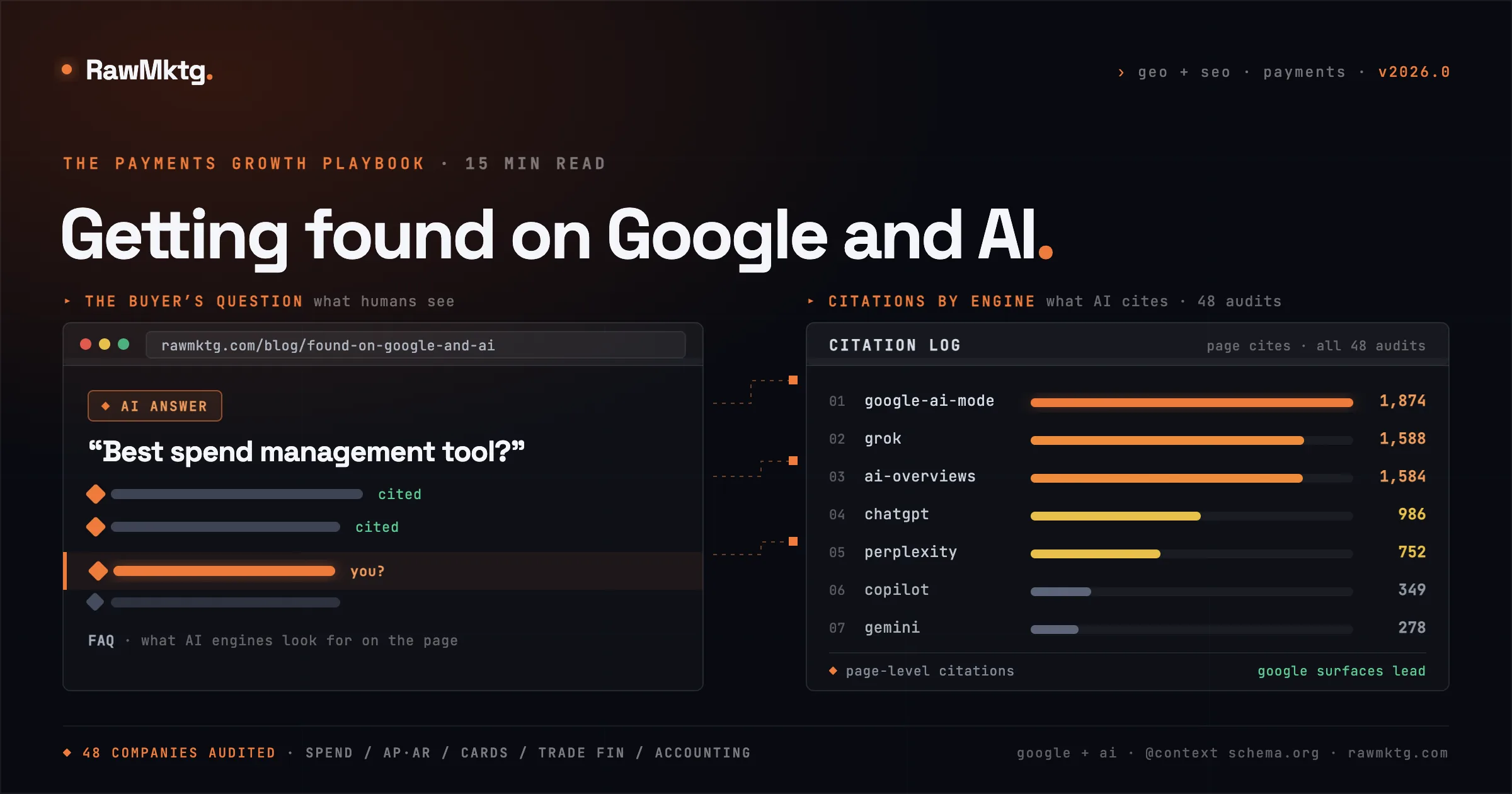
For a decade, getting found in payments meant one job: rank on Google for the terms buyers search. That job has not gone away, but a second one has appeared beside it, and most brands in the category are still only playing the first. A third shift is already forming behind it, as the buyer itself becomes an autonomous agent that checks out through payment protocols like AP2.
The finance leader evaluating a spend-management tool, the controller comparing AP-automation vendors, the founder shopping for a corporate card, they now run the same question through two systems at once. They still open Google, but they also ask ChatGPT, Perplexity, Gemini, Copilot or Grok to shortlist the options. Both systems return an answer. Your brand is either inside that answer or it is invisible.
01How has discovery changed for payments buyers?
02What's in the 48-company dataset?
| Sub-sector | What these companies do | Representative buyer terms |
|---|---|---|
| Spend & expense management | Corporate cards, expense control and bill pay in one platform | "spend management", "expense management software" |
| AP / AR automation | Automating invoices, collections and payables | "accounts receivable automation", "AP automation" |
| Corporate & fleet cards | Issuing and managing payment cards | "corporate card", "fleet fuel cards" |
| Supply-chain & trade finance | Early payments, invoice discounting, working capital | "invoice discounting", "supply chain finance" |
| Accounting automation | Bookkeeping, close and reconciliation software | "bookkeeping software", "accounting automation" |
The shape of the field
Three benchmark numbers give a feel for the typical competitor you are up against, and explain why the opportunity is so evenly distributed: almost everyone sits in the same middle band, so small, deliberate moves change the standings.
03Are you ranking for the wrong traffic?
Would the person who searched this term ever buy what you sell? If the honest answer is no, the page may still have a role in brand or SEO plumbing, but it should never be counted as marketing performance. A page that earns 500 visits from people ready to buy beats 50,000 from people looking up a definition, and our zero-click traffic risk tool helps you size how much of that informational traffic AI now answers away.
Audit your top 20 traffic pages and label each "learner" or "buyer". If more than half are learner pages, you have a routing problem, not a traffic problem, add a clear, contextual path from every high-traffic guide to the relevant product or category page.
04The Page-2 Trap: are you winning your name but losing the category?
| Term type | Typical rank in the data | Buyer intent | Priority |
|---|---|---|---|
| Your brand / product name | #1-2 | Already yours | Defend |
| Niche "owned" term | #1-3 | High, but small volume | Protect & expand |
| Core category term | #20-25 (page 2-3) | High, this is the prize | Attack first |
| Adjacent category term | #25-35 | Medium | Attack second |
| Broad head term | Not ranking | Mixed, giants own it | Later / selective |
Why the leaders win these terms
Look at who occupies the top of "corporate card", "spend management" or "AP automation" and you see the same discipline: Ramp, Brex, Bill.com and a few peers run deep, purpose-built hubs for each category term, a strong landing page, a cluster of supporting articles, comparison pages, and dense internal linking that concentrates authority on the money page. They are not necessarily higher-authority domains overall; they are simply more deliberate about aiming that authority at the category.
05Is technical health quietly taxing your visibility?
If a busy human skimming on a phone can find the answer to a buyer question in five seconds, an AI engine can lift it. Put a short, direct answer near the top of every buyer page, keep the markup clean and schema-marked, describe every image, and you have simultaneously served Google, the AI engines and the reader, the same shape as any high-citation page.
06Which pages do AI engines actually cite?
| AI engine | Citations (all 48 audits) | Read |
|---|---|---|
| Google AI Mode | 1,874 | The new front door to Google, highest citer in the set. |
| Grok | 1,588 | Surprisingly active; rewards fresh, clear content. |
| Google AI Overviews | 1,584 | Confirms: winning Google and winning AI are the same job. |
| ChatGPT | 986 | The assistant buyers name most in conversation. |
| Perplexity | 752 | Research-heavy buyers live here; loves citable sources. |
| Copilot | 349 | Enterprise and Microsoft-shop reach. |
| Gemini | 278 | Growing; tied to Google's wider ecosystem. |
The engine mix matters for where you focus, and each assistant weighs sources a little differently, but Google's AI Mode and AI Overviews dominate this category. Optimising your buyer pages to be cleanly quotable pays off across all of them at once.
The move: redirect the engine you already have
You do not need a new content machine. You need to aim the one that already ranks and already gets cited. Build buyer "hub" pages, for the category term, the key use cases, and head-to-head comparisons, write a short quotable answer at the top of each, and interlink your popular guides into them so both authority and readers flow toward the pages that convert.
07Is your authority gap really a directory-and-data gap?
| Authority lever | Sites with the gap | Effort | Payoff |
|---|---|---|---|
| Claim software directories (G2, Capterra, GetApp) | 90% | Low, self-serve | High: trust + AI citations |
| Get listed on Gartner Peer Insights | 35% | Low-medium | High: the listing buyers trust most |
| Publish one original data report | 98% | Medium-high | Compounding links + citations |
| Add comparison / "vs" pages | 69% | Medium | Captures bottom-of-funnel buyers |
The second lever showed up in 98% of audits: the chance to publish one original data report. Payments companies sit on genuinely unique data, how businesses spend, pay, get paid and manage cash. A single credible annual report ("how mid-market finance teams pay in 2026") earns links from finance media, gives AI engines a fresh source to cite, and lifts Google rankings, all at once. It is the rare marketing task that is both high-impact and self-serve, and it is exactly the kind of earned coverage that the directories and analyst reports AI trusts are built from, the same logic as seeding authority the engines already read.
08What's the 90-day operating system?
| Window | Focus | Concrete moves |
|---|---|---|
| Month 1 | Tidy up + start the buyer hub | Fix broken pages, review noindex tags, resolve canonical mix-ups; add alt text and security headers, compress images, set image dimensions; build strong pages for your core category term and top use cases. |
| Months 1-2 | Move page two to page one | Strengthen category pages with clear answers, proof and internal links; add a short quotable answer near the top of every buyer page; route high-traffic guides to the buyer pages so learner visits become pipeline. |
| Months 2-3 | Build trust + a moat | Claim G2, Capterra and GetApp and get onto Gartner Peer Insights; publish one original data report and pitch it to finance media; add comparison pages, then re-measure at day 90. |
09Where should you spend the quarter?
1. Route your learner traffic to buyer pages, stop the leak.
2. Pick one low-difficulty category term and move it from page two to page one.
3. Add a short, quotable answer to the top of every buyer page.
4. Claim G2, Capterra, GetApp and Gartner Peer Insights.
5. Ship one original data report from your own payments data.
10What should you actually measure?
| Metric | What it really measures | Cadence |
|---|---|---|
| Rank for your core category terms | Progress out of the Page-2 Trap | Monthly |
| Share of buyer vs learner traffic | Whether your traffic can convert | Quarterly |
| AI citations of buyer/product pages | GEO progress, named as the tool, not the guide | Quarterly |
| Directory & analyst listings live | Trust signals buyers and AI weigh most | Quarterly |
| New referring domains from target sites | Authority you are actually earning | Monthly |
| Assisted conversions from content | The bottom line: does discovery drive pipeline? | Monthly |
The AI-citation number deserves special mention: it is simply the share of your buyer questions on which the assistants name you, measured on a fixed set of prompts and re-run on a schedule. Today, for almost every payments brand, that number sits on your guides, not your buyer pages. The brands that start measuring and moving it now will define the default answers their whole market reads.
11Why is the category winnable?
Fix the leaks, build the buyer hub, and earn the trust signals that Google and the AI engines both reward. Do those three things in order and the same work pays off twice, once in classic search, once in the AI answer. The same pattern shows up in every category we audit, from autonomous retail and container tracking to CX platforms, senior living, and allied-health software, ranking is not the same as visibility, and payments is no exception.
How has getting found in payments changed in 2026?
Discovery has doubled. For a decade it meant ranking on Google; now buyers run the same question through Google and an AI assistant (ChatGPT, Perplexity, Gemini, Copilot or Grok) at once. Both return an answer, and your brand is either inside the AI's synthesised answer or invisible, no matter how well you rank underneath. Because both systems reward the same signals, clear content, technical cleanliness and third-party trust, the work compounds: fixing your site for AI usually fixes it for Google too.
What is the Page-2 Trap in payments marketing?
It is the near-universal pattern where a company ranks #1 for its own brand name and one narrow niche term, but sits on page two or three for the broad category terms buyers actually compare on, like "spend management" or "AP automation". 71% of the 48 audited companies showed this signature. It is the good kind of problem: ranking #21 means Google already trusts the page, so moving from page two to page one is far easier than starting from nothing, and every audit had at least one low-difficulty category term within reach.
Why do AI engines cite our guides but not our product pages?
Because your guides are the pages written to answer a question cleanly, and buyer pages usually are not. In 46% of audits, AI engines quoted the company's free definitions and explainers, almost never its product pages, so the brand appears for "what is DPO?" and vanishes for "what's the best AP tool?". The fix is not more content: add a short, quotable answer at the top of each buyer page, keep the markup clean, and interlink your popular guides into the hub pages so both authority and readers flow to the pages that convert.
What should a payments marketer fix first?
Fix the leaks, then aim at buyers. In month one, repair broken pages and canonical or noindex mix-ups, add the missing security headers, compress images and set their dimensions, then start a buyer hub for your core category term. Only after the site is clean and aimed should you invest in the slower earned-media work, claiming G2, Capterra, GetApp and Gartner Peer Insights, and publishing one original data report, that wins durable AI citations.
rawmktg. publishes data-driven teardowns of B2B verticals and brands, pulling AI-citation and SEO data to show exactly where the visibility gaps are. Method: same data, same lens, every time. Contact: vinayak@rawmktg.com
Data source: an aggregate analysis of GEO + SEO audits of 48 digital-payments and transactions companies (website health, Google presence and AI-citation scans across the major engines), August 2026. Brand names are used illustratively and no company is ranked or endorsed.