Your buyers have moved. Not slowly, not incrementally. They have structurally relocated to a new research medium. In 2026, up to 69% of desktop queries and 77% of mobile queries terminate inside a generative AI response, never clicking through to your website.1 Approximately 25% of B2B buyers are already using AI search as their primary research tool for vendor discovery and evaluation.
This is the opening argument for Generative Engine Optimization (GEO), a discipline formalised by a landmark study from Princeton, Georgia Tech, the Allen Institute for AI, and IIT Delhi, presented at ACM SIGKDD 2024.8 That research proved that structured content modifications (adding original statistics, source citations, and expert quotes) lift AI citation rates by 30-40%.
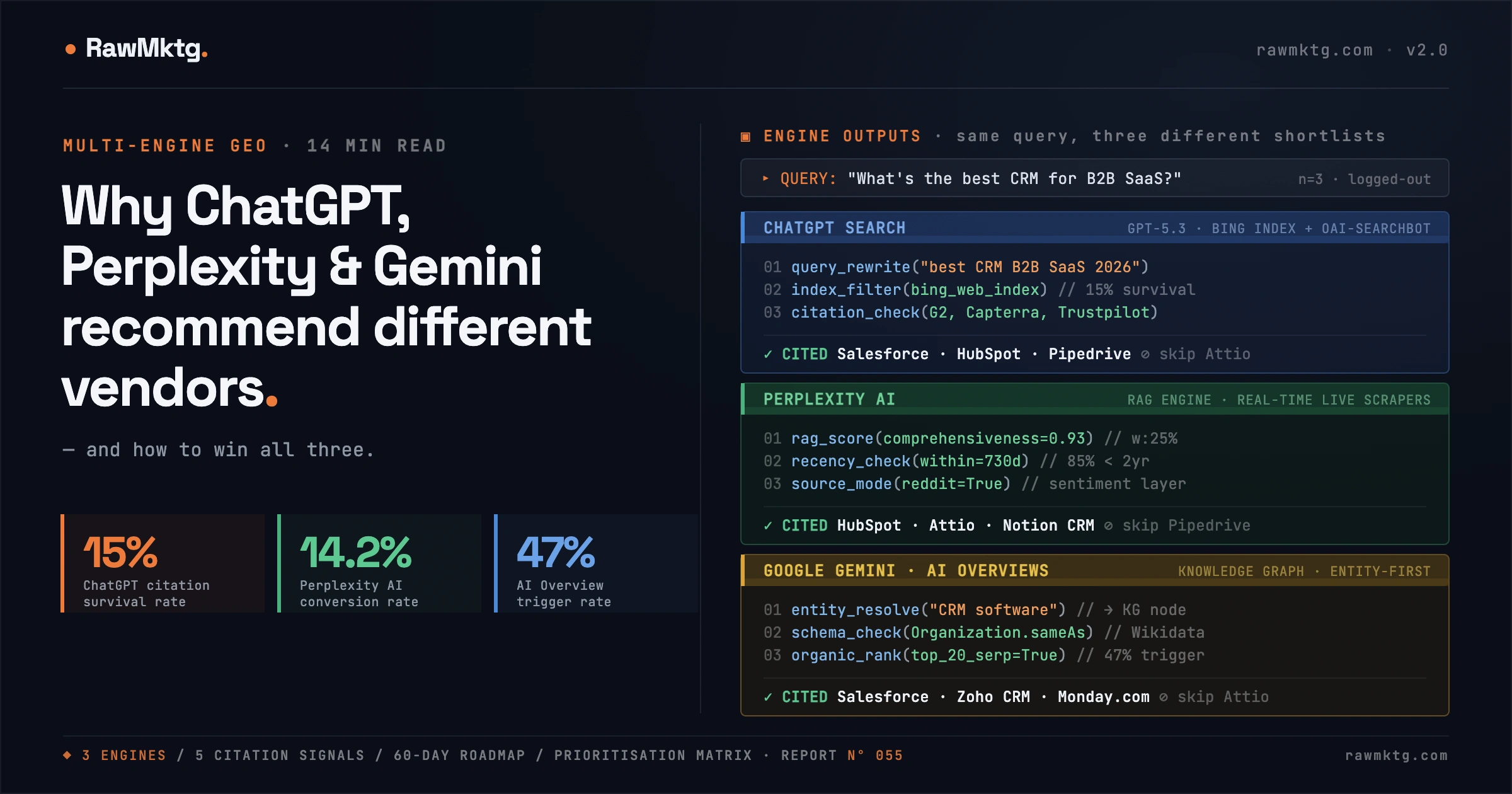
But here is the strategic problem: ChatGPT, Perplexity, and Gemini pull from different data sources, apply different retrieval logic, and weight different credibility signals. A tactic that earns you a citation in Perplexity may be completely invisible to Gemini. Understanding the technical architecture of each engine is no longer optional for B2B growth teams: it is the prerequisite for building a defensible AI visibility strategy. For a worked example of how this plays out in one category, see our teardown of which HR-software vendor AI engines actually recommend.
01: How does each engine actually work?
| Feature | ChatGPT Search | Perplexity AI | Google Gemini |
|---|---|---|---|
| Core Model | GPT-4o / GPT-5.3 Instant | Custom RAG-Optimised LLMs | Google Gemini Enterprise |
| Index Source | Bing Web Index + OAI-Searchbot | Real-time live web scrapers (PerplexityBot) | Google Web Index + Knowledge Graph |
| Citation Filter | Strict context filter (~15% selection rate) | Real-time RAG passage scoring | Entity mapping + organic rank validation |
| Preferred Sources | G2, Capterra, high-authority media, Reddit | Technical blogs, GitHub, Reddit, dev docs | Top 20 organic pages, Wikipedia, Wikidata |
| Update Cycle | Bing updates + real-time API | Programmatic real-time live scrapers | Continuous Googlebot + Knowledge Graph |
| Unique Signal | User Memory profiles, brand mentions | Focus Modes (Academic, Reddit, Writing) | Search Console CTR, Core Web Vitals, E-E-A-T |
02: How does ChatGPT Search choose its sources?
ChatGPT Search (now including GPT-5.3 Instant, launched March 4, 2026) applies five citation pillars to determine which sources survive the filter (a citation, distinct from a mention or a recommendation): Pattern Recognition, Credibility, Relevance, Timeliness, and Diversity.9 In practical execution terms, this translates to four priorities:
What Determines Survival in the 15%?
- Bing indexation first: If your page is not on Bing, ChatGPT cannot see it. Submit URLs via Bing Webmaster Tools and enable the IndexNow protocol for real-time pickup. This is the single highest-ROI action with a 24-hour time-to-value window.
- Review platform presence: A 2025 SE Ranking study of 129,000 domains showed that brands with active profiles on G2, Capterra, and Trustpilot have a 3x higher citation probability. Reddit and Quora brand mentions add a further 4x multiplier.10
- Structured content density: Pages with 120-180 words between headings receive 70% more citations than fragmented layouts. Articles over 2,900 words average 5.1 citations versus 3.2 for shorter assets.8
- Direct-answer capsules: Every H2/H3 should be phrased as a natural language question, with a 1-3 sentence direct answer immediately beneath it (the exact structure ChatGPT's citation filter is optimised to extract).
Configure IndexNow in your CMS (ultra-low cost, 24-hour time-to-value). Then run a Bing Webmaster Tools audit to identify crawl failures on JavaScript-heavy or headless CMS pages. Unrendered content is completely invisible to ChatGPT Search.
// Ping Bing IndexNow API on every publish
fetch('https://api.indexnow.org/indexnow', {
  method: 'POST',
  headers: { 'Content-Type': 'application/json; charset=utf-8' },
  body: JSON.stringify({
    host:        'www.yoursite.com',
    key:         'YOUR_INDEXNOW_KEY',
    keyLocation: 'https://www.yoursite.com/YOUR_INDEXNOW_KEY.txt',
    urlList: [
      'https://www.yoursite.com/blog/new-post',
      'https://www.yoursite.com/product/updated-page'
    ]
  })
})
03: How does Perplexity rank and cite sources?
- Content Comprehensiveness (25%): One URL should address a topic and all related sub-intents. Thin, single-angle pages lose to comprehensive guides. Perplexity rewards depth and breadth on a single URL over a cluster of narrow posts.
- Source Authority (20%): Domain trust and authoritative backlinks remain a prerequisite even in a live-crawl environment. Perplexity's real-time scrapers still apply domain-level credibility signals before scoring individual passages.
- Content Recency (18%): Seer Interactive's 2025 analysis found that 85% of Perplexity citations come from content published within the last two years. A 30-day freshness update loop (refreshing statistics and tool references) directly affects citation eligibility.5
- Structural Clarity (15%): Clean H2/H3 hierarchies, bullet points, and comparison tables are required for Perplexity's chunking algorithms to parse and cite passages accurately. Unstructured prose is scored lower regardless of content quality.
- Factual Verifiable Data (10%): The Princeton GEO study confirmed that embedding specific statistics and named expert quotes boosts citation probability by 30-40%.8 Assertions without proof are systematically deprioritised.
Perplexity-Specific Tactics
Perplexity's Focus Modes demand targeted content types. Academic Mode prioritises peer-reviewed research and primary data, so publish original benchmark reports or platform telemetry. Reddit and Social Modes crawl community sentiment, which requires that customer reviews on G2, LinkedIn, and Reddit consistently reference your brand's specific capabilities rather than generic praise.
Partner ecosystem content is disproportionately powerful on Perplexity. PartnerStack research found that 43% of AI-generated vendor citations originate from partner ecosystem sources, with 21% driven by active partner activity.2 Every integration partner blog post, co-marketing asset, and ecosystem directory listing is a live Perplexity citation candidate that most growth teams are not tracking.
04: How do Gemini and AI Overviews pick what to cite?
Building the Knowledge Graph Bridge
Winning Gemini requires resolving brand entity ambiguity before any content tactic has an effect. The technical implementation is a unified Organization schema block with comprehensive sameAs properties linking your brand entity to Wikidata, LinkedIn, Crunchbase, and Wikipedia. Without this, Gemini's entity resolution step cannot reliably match your brand to its knowledge base, so your pages drop from the candidate pool before extraction even begins.
Five schema types that Gemini explicitly prioritises for AI Overview extraction:
- Organization Schema with sameAs: Bridges your brand to Wikidata, LinkedIn, and Crunchbase for entity resolution, which is the prerequisite step before any other signal is weighted.
- FAQPage Schema: Directly aligns with the Q&A format used inside AI Overviews. Pages with FAQPage markup are structurally pre-formatted for Gemini's extraction pattern.
- Article Schema with author + dateModified: Satisfies E-E-A-T requirements and signals content freshness, both of which are explicitly weighted in Gemini's citation scoring.
- SpeakableSpecification Schema: Directs Gemini to passages optimised for voice and mobile assistant queries, which are a growing share of AI Overview triggers.
- BreadcrumbList Schema: Maps topical depth for systematic crawler navigation, signalling that your site has structured expertise rather than a single orphaned page.
<script type="application/ld+json">
{
  "@context": "https://schema.org",
  "@type":    "Organization",
  "@id":      "https://www.yoursite.com/#organization",
  "name":     "Your SaaS Brand",
  "url":      "https://www.yoursite.com",
  "sameAs": [
    "https://www.wikidata.org/wiki/Q_YOUR_ENTITY_ID",
    "https://www.linkedin.com/company/your-brand",
    "https://twitter.com/yourbrand",
    "https://en.wikipedia.org/wiki/Your_Brand",
    "https://www.crunchbase.com/organization/your-brand"
  ]
}
</script>
AI Overviews in Google Search are tightly coupled to traditional SEO signals. The standalone Gemini App applies broader weight to third-party reviews, comparison articles, and authoritative publications. On a limited budget, both tracks require attention, as they share entity signals but diverge significantly on content source preferences.
05: How should you prioritise GEO across the three engines?
| GEO Tactic | Cost | Time-to-Value | ChatGPT | Perplexity | Gemini |
|---|---|---|---|---|---|
| Bing Webmaster & IndexNow | Ultra-Low | 24 Hours | Critical | None | None |
| Organization Schema + sameAs Nodes | Low | 7 Days | Low | Low | Critical |
| FAQ & Micro-Answer Formatting | Low-Moderate | 14 Days | High | High | High |
| G2 / Capterra Profile Optimisation | Moderate | 30 Days | 3× Boost | Moderate | Low |
| 30-Day Freshness Update Loop | Moderate | 30 Days | 3.2× Boost | High | High |
| Off-Site Forum Sentiment (Reddit, GitHub) | Moderate | 45 Days | 4× Boost | High | Low |
| Proprietary Data & Benchmark Reports | High | 60 Days | Moderate | 40% Boost | High |
| Topical Authority Content Clusters | High | 90 Days | High | High | High |
06: What does a 60-day multi-engine GEO rollout look like?
07: What comes after GEO citations?
In an agentic commerce model, an AI agent will not present three CRM vendor options for a human to review. It will programmatically evaluate technical specs, pricing matrices, and sentiment profiles, then execute the SaaS subscription autonomously. The brands that have structured their schema, off-site consensus, and content architecture for machine retrieval will be selected. Those that have not will be invisible at the moment of transaction.
The citation infrastructure you build today (structured data, entity disambiguation, review ecosystem presence, and answer-lead content) is the same infrastructure that will make your brand selectable by autonomous purchasing agents. The investment compounds across both time horizons.
GEO is not a content experiment. It is the infrastructure for your next acquisition channel. Brands that establish technical alignment with ChatGPT, Perplexity, and Gemini now will own the citation inventory when agentic purchasing becomes the default buyer behaviour. The window for first-mover advantage is measured in months, not years. Because each engine retrieves differently, measure them separately and weight into one headline number, the method in Share of Model, measured properly.
Why do ChatGPT, Perplexity, and Gemini cite different vendors for the same query?
Each engine uses a structurally different retrieval architecture. ChatGPT Search uses Microsoft's Bing Web Index and applies a strict context filter that selects only 15% of initially retrieved pages. Perplexity operates as a real-time RAG engine that scores passages dynamically based on comprehensiveness, recency, and structural clarity. Google Gemini resolves queries against the Knowledge Graph to map entities before fetching source documents, weighting E-E-A-T signals and Search Console CTR data. A tactic that earns a citation in one engine can be completely invisible to another.
What is the highest-ROI GEO tactic for B2B SaaS brands with a limited content budget?
For resource-constrained teams, the highest-ROI first move is configuring Bing Webmaster Tools and enabling the IndexNow protocol (ultra-low cost, 24-hour time-to-value window). This directly improves ChatGPT citation eligibility since ChatGPT Search is powered by the Bing index. Second priority is FAQ and micro-answer formatting (low-to-moderate cost, 14-day impact) which produces High impact across all three engines simultaneously. Organisation Schema with sameAs nodes is Critical for Gemini but Low impact on ChatGPT and Perplexity, so it should follow those two foundational steps.
How do you optimise B2B SaaS content specifically for Perplexity AI citations?
Perplexity uses a five-factor citation probability formula: Content Comprehensiveness (25%), Source Authority (20%), Content Recency (18%), Structural Clarity (15%), and Factual Verifiable Data (10%). Practically, this means: publish comprehensive guides that address a topic and all related sub-intents on one URL; build authoritative backlinks; update content within a 30-day freshness cycle; use clean H2/H3 hierarchies with comparison tables; and embed specific statistics and named expert quotes. Partner ecosystem content is disproportionately powerful: PartnerStack research found that 43% of AI-generated vendor citations originate from partner ecosystem sources.
What is ChatGPT SEO, and is it different from Perplexity SEO?
ChatGPT SEO and Perplexity SEO are informal names for optimising to be cited by each engine, and they are not the same job. ChatGPT leans on its index plus corroboration and weights brand mentions and entity consistency heavily; Perplexity is more link- and freshness-driven and exposes its sub-queries and sources directly. Optimising for one does not guarantee the other, which is why a single-engine 'AI visibility' number is misleading. Prioritise the engine your buyers use, then generalise.
- 1. Generative Engine Optimization (GEO): How to Win AI Mentions, Search Engine Land. searchengineland.com/what-is-generative-engine-optimization-geo
- 2. AI Platform Citation Patterns, Profound. tryprofound.com/blog/ai-platform-citation-patterns
- 3. ChatGPT vs Perplexity vs Google vs Bing: AI Search Comparison Research, SE Ranking. seranking.com/blog/chatgpt-vs-perplexity-vs-google-vs-bing
- 4. How Perplexity AI Answers Work: Retrieval, Ranking and Citation Pipeline, ZipTie. ziptie.dev/blog/how-perplexity-ai-answers-work
- 5. How to Rank on Perplexity AI: Tips & Strategies for B2B SaaS, Infrasity. infrasity.com/blog/perplexity-ranking
- 6. Generative Engine Optimization (GEO): The Definitive Guide 2026, Geoptie. geoptie.com/blog/generative-engine-optimization
- 7. GEO: Generative Engine Optimization (Aggarwal et al., Princeton / KDD 2024). arxiv.org/abs/2311.09735
- 8. The Princeton GEO Paper in Plain English: 5 Tactics That Boost AI Citation by 40%, Derivatex. derivatex.com/princeton-geo
- 9. How Bing Rankings Drive ChatGPT Visibility, Parse. parse.gl/blog/bing-rankings-chatgpt-visibility
- 10. How to Rank on ChatGPT Search: GEO Guide, Peter Mann / Medium. medium.com/@petermannmarketing
- 11. Knowledge Graph Search API, Google for Developers. developers.google.com/knowledge-graph
- 12. How to Optimize for Google AI Overviews, Search Engine Land. searchengineland.com/guide/how-to-optimize-for-ai-overviews
- 13. How to Rank on Perplexity: The Complete Guide, Onely. onely.com/blog/how-to-rank-on-perplexity
- 14. Gemini AI Visibility: How Google's AI Works, AnswerManiac. answermaniac.ai/blog/gemini-ai-visibility-citations-2026
- 15. ChatGPT vs Perplexity vs Google vs Bing: Ranking Factors Research, SE Ranking. seranking.com/blog/chatgpt-vs-perplexity-vs-google-vs-bing
- 16. ChatGPT Search, OpenAI Help Center. help.openai.com/en/articles/chatgpt-search
- 17. AI Platform Citation Patterns (brand visibility tracking), Profound. tryprofound.com/blog/ai-platform-citation-patterns