There's a specific kind of buyer who is shopping for a senior living community in India right now.
They're 45–60 years old. They're making a decision for a parent, or planning ahead for themselves. They're affluent. They're research-intensive. And increasingly, their first stop isn't Google. It's ChatGPT. Or Perplexity. Or Gemini. Or a Google search that now returns an AI Overview before any organic result.
This is the buyer that India's senior living brands are mostly invisible to. And the data proves it.
Why is India's senior-living demand outpacing its digital presence?
India's senior living market is projected to reach USD 7.7 billion by 2030. The demand drivers are structural, nuclear families, NRI guilt, rising disposable incomes, and a generation of parents that wants independence, not just care. The segment isn't charity housing; the premium end sits alongside luxury residential real estate.
But when you look at the digital footprint of the category's leading players, you find a sector that has built beautiful campuses and almost entirely ignored the channels that now drive first discovery.
How do India's top senior-living brands compare on SEO and AI visibility?
| Metric | Primus | Antara | Ashiana |
|---|---|---|---|
| Domain Rating (DR) | 21 | 48 | 43 |
| Monthly organic traffic | 2,548 | 6,182 | 19,876 |
| Ranking keywords | 330 | 370 | 2,214 |
| Referring domains | 314 | 356 | 1,098 |
| High-DR editorial links (DR70+) | 3 | 9 | 18 |
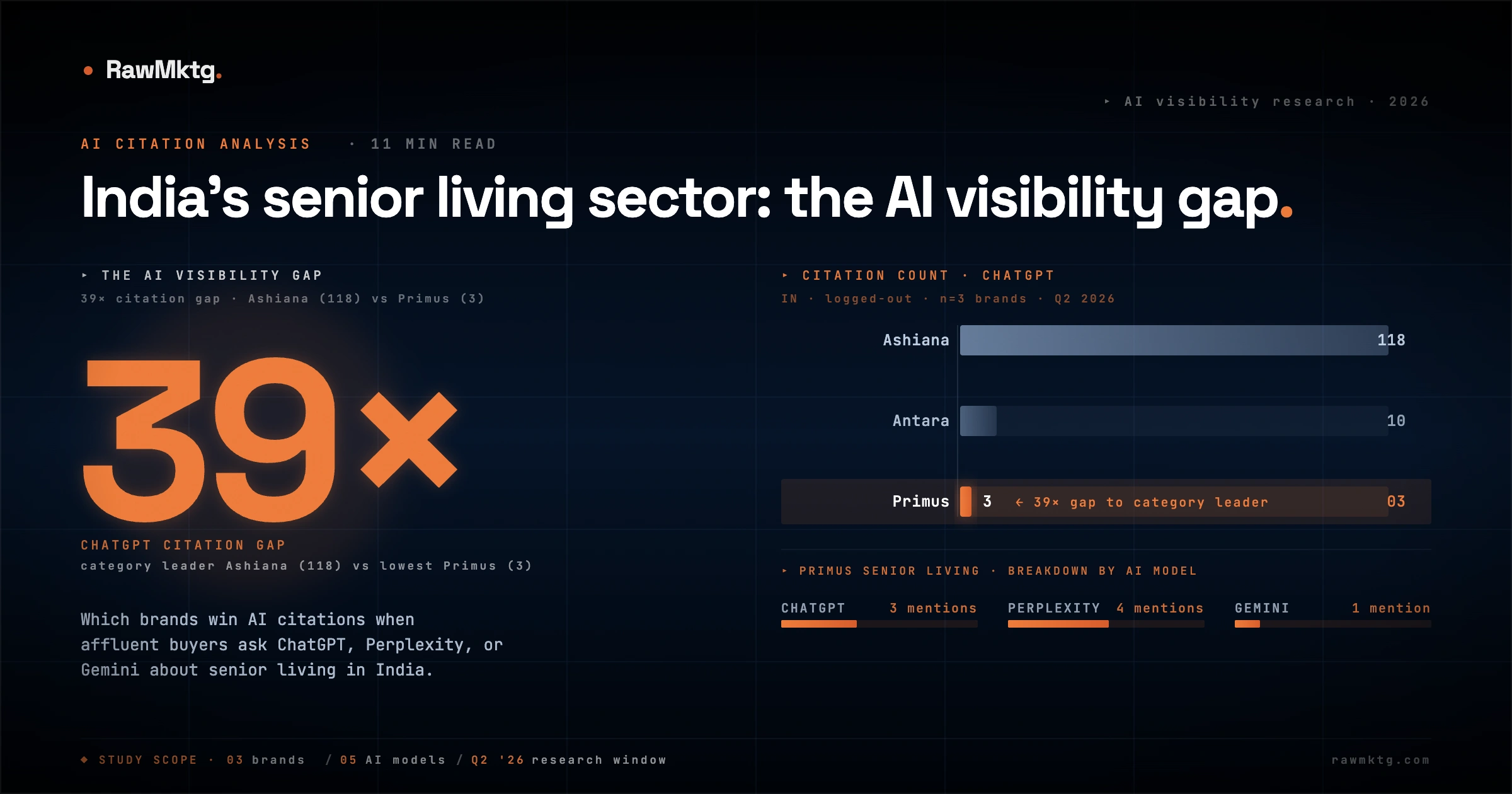
| ChatGPT citations | 3 pages | 10 pages | 118 pages |
| Perplexity citations | 4 pages | 7 pages | 84 pages |
| Gemini citations | 1 page | 4 pages | 49 pages |
| Google AI Overview | 44 pages | 27 pages | 548 pages |
| Copilot citations | 0 pages | 2 pages | 27 pages |
The more interesting story isn't just scale, it's what kind of presence each brand has, and where the LLM-era risk is concentrated.
Why is senior-living visibility two problems, not one?
Most digital marketers in this sector think about this as an SEO problem. Get more traffic. Rank for more keywords. Get more backlinks. That framing is accurate but incomplete.
There are actually two parallel gaps. Gap 1, The SEO gap: keyword footprint, backlink authority, BOFU coverage. This is the traditional search problem. Gap 2, The GEO gap: AI citation presence, LLM brand representation, entity authority. This is the new problem, and most brands don't even know it exists.
Both matter. But they're driven by different inputs and require different fixes.
What is the real SEO gap for India's senior-living brands?
The TOFU Traffic Trap
The instinctive response to an SEO gap is to produce more content. More blogs. More landing pages. More long-form. That's often the wrong move, and the Primus data illustrates why.
Primus's biggest traffic-driving keyword, "senior citizen card benefits", drives 222 visits per month and has zero commercial intent. Nobody searching that query is about to sign a lease for a luxury retirement community.
Meanwhile, the high-intent, transactional queries that actually lead to tours and conversions are being captured by competitors:
- "senior living near me", 1,300 searches/month
- "old age homes near me", 1,400 searches/month
- "assisted living near me", 900 searches/month
- "retirement communities in Bangalore", contested, traffic going to competitors
Antara's keyword split tells the opposite story: growing commercial (+150 traffic) and local intent (+824 traffic), with everything trending up. Ashiana has 81 transactional keywords, more than 13× Primus's 6.
Keyword footprint isn't just about volume. It's about which part of the buyer journey you're capturing. A site with 329 informational keywords and 6 transactional keywords is optimised for awareness, not conversion.
The Backlink Quality Problem
Raw referring domain counts are misleading. What matters is the quality and composition of those links.
Analysis of Primus's 314 referring domains reveals a structural problem:
- 30% spam ratio, approximately 94 domains classified as low-quality or manipulative
- Only 3 genuine editorial dofollow links, Tribune India (DR81) and Silicon India (DR77) are doing the heavy lifting
- PR wire dominance, prsync.com alone accounts for 29 links, all no-follow, all worthless for authority transfer
- Zero links from the major editorial properties that matter: Business Standard, Economic Times, Hindustan Times, The Hindu, Mint
For comparison, Ashiana has 1,098 referring domains, 18 DR70+ editorial links, and a backlink profile that signals genuine editorial coverage at scale. There are 85+ identified domains with DR50+ that currently link to Ashiana and/or Antara but not to Primus, including Medium (DR94), Indiatimes (DR92), Business Standard (DR89), The Print (DR82), and ABP Live (DR82).
This isn't a link-building problem. It's a brand authority problem, and brand authority is exactly what LLMs use to decide whose voice to amplify.
How wide is the GEO gap for these brands?
We ran three real queries through ChatGPT, the kind of queries that NRI families and affluent Indian buyers actually type when they start researching senior living for a parent.
Primus has spent years and significant marketing budget positioning itself as luxury independent senior living, a fundamentally different product than assisted living, with a fundamentally different buyer. Assisted living connotes medical dependency, institutional care, last-resort decisions. When ChatGPT tells an NRI buyer's family that Primus is an "assisted living" provider, it isn't just leaving clicks on the table. It's actively undermining the brand's positioning work at the moment of highest buyer intent.
Why Is AI Getting the Brand Wrong?
LLMs don't form opinions. They synthesise what they've read. When a model has processed thousands of documents that casually use "senior care," "assisted living," and "retirement homes" interchangeably, and very few high-authority sources that specifically, repeatedly, and clearly describe a brand as luxury independent living, the model defaults to the category-level blur.
The fix isn't a press release. It's building the citation infrastructure that gives LLMs clear, consistent, authoritative signals about what the brand actually is. That infrastructure looks like:
- A Wikipedia entity page with precise positioning language
- Consistent brand description in high-DR editorial coverage (not PR wires)
- Q&A platform presence (Quora, Reddit) where the brand's positioning is articulated directly
- Market research reports and industry analyses that use the correct category language
- Review aggregator profiles with accurate, detailed community descriptions
Currently, the GEO signal inventory for most Indian senior living brands includes: Crunchbase (present), PR wires (many), Wikipedia (absent), major news outlets with editorial coverage (minimal), Q&A platforms (absent), review aggregators (thin).
Why are some AI citations worth more than others?
This is why Ashiana, with 548 Google AI Overview citations, 118 ChatGPT citations, and 84 Perplexity citations, has built an essentially unassailable AI presence: it has the referring domain breadth, the editorial backlinks, and the entity authority to sustain consistent LLM recognition across every platform.
How do NRI buyers change the search game?
This issue has a specific amplifier in the senior living context: the NRI buyer.
A significant portion of luxury senior living decisions in India are made or heavily influenced by family members living in the US, UK, UAE, Singapore, and Canada. These buyers don't have informal market knowledge from living locally. They're almost entirely dependent on digital research. And NRI buyers skew heavily toward AI-assisted research, they're comfortable using ChatGPT and Perplexity as primary research tools and they trust AI-curated shortlists.
If a brand isn't showing up, or worse, is showing up with the wrong category description, the NRI buyer simply never considers it. The physical product might be superior. The service model might be excellent. It doesn't matter, because the AI gate kept them out.
What does the traffic trajectory reveal?
Primus's overall organic keyword footprint is declining: -92 informational keywords, -343 traffic over the recent period. The only growing segment is commercial (+92 traffic), which suggests some genuine demand but limited ability to capture it.
Antara's trend is the opposite: everything growing, especially local intent (+824 traffic), which is exactly where high-conversion buyers come from. Ashiana is at scale and experiencing some category-wide correction, but the foundation is so large that any normalisation barely registers.
The divergence in trajectories matters because organic search authority compounds. Every editorial backlink Ashiana earns makes the next one easier to get. Every month that a brand underinvests in SEO foundation work is a month the gap widens.
How do you close both gaps at once?
The brands that will win the LLM-era buyer in Indian senior living need to close two gaps simultaneously.
Closing the SEO Gap
Prioritise "near me" and location+intent queries. These drive actual tours and enquiries. Informational content has its place, but it shouldn't dominate a site's keyword footprint when transactional keywords are converting for competitors.
Disavow spam. Identify and pursue the specific DR50+ editorial properties where category-relevant coverage is achievable: personal finance publications covering retirement planning, real estate desks at Tier-1 newspapers, NRI-focused media.
Google Business Profile optimisation, community-level local landing pages, local citation consistency. Antara's local keyword growth is a direct result of this investment.
Closing the GEO Gap
Wikipedia page. Crunchbase accuracy. Wikidata entry. These are the anchor points LLMs use for entity recognition, without them, the model defaults to category-level generalisation.
Audit every external mention of the brand. Create a precise definition in correct category language ("luxury independent senior living," not "senior care facility") and seed it consistently across all channels, partner content, and PR.
Get into the sources LLMs actually trust: major news outlets with editorial features (not press releases), market research reports, Q&A platforms with genuine positioning, review aggregators with full community profiles.
Run brand-relevant queries across ChatGPT, Perplexity, Gemini, and Google AI Overviews monthly. Track citation count, brand description accuracy, and competitive positioning. This is a new category of brand monitoring that most senior living marketers haven't operationalised yet.
Implement Organization, LocalBusiness, and Review schema on the website. Make it easy for both traditional crawlers and LLM training pipelines to extract precise, structured brand information.
Why is the window closing?
The senior living category in India is still early enough that first-mover advantage in LLM presence is achievable. Ashiana has an 8-year head start in domain authority, but AI citation authority is more recent, even Ashiana's 118 ChatGPT citations reflect a landscape that's only 2–3 years old.
A brand that invests seriously in GEO infrastructure in the next 12 months can establish citation authority while the category is still relatively uncrowded in LLM training data. In 24 months, that window will be materially narrower.
The buyers are already using AI as a research tool. The question is whether India's senior living brands will meet them there, or keep optimising for a search experience that is rapidly becoming secondary.
What's the bottom line?
The data across three of India's leading senior living brands tells a consistent story:
- The SEO gaps are large but fixable with deliberate, quality-focused investment
- The GEO gaps are largely invisible to current marketing teams but represent a compounding brand risk
- The most dangerous scenario isn't invisibility, it's misclassification, where AI actively contradicts the brand's positioning at the moment of maximum buyer intent
- The NRI and affluent domestic buyer skews toward exactly the AI-first research behaviour that most brands are completely unoptimised for
The category is growing. The buyers are there. The AI channels are live and actively shaping consideration sets. The only question is which brands decide to show up. For a different lens on the same India B2B visibility dynamics, our cross-border payments backlink analysis shows how editorial footprint and link quality separate category leaders from followers.
What is the AI visibility gap in India's senior living sector?
Across Primus Senior Living, Antara Senior Care, and Ashiana Housing, the ChatGPT citation gap reaches 39× and the Gemini citation gap reaches 49×. Ashiana, the organic leader with 1,098 referring domains and 81 transactional keywords, earns significantly more AI citations than Primus, which has 314 referring domains and only 6 transactional keywords. The gap reflects structural content and backlink profile differences, not just brand awareness.
What is the most dangerous AI visibility risk for senior living brands?
Misclassification, not invisibility, is the highest-risk scenario. ChatGPT described Primus Senior Living as an 'assisted living' provider across test queries, a fundamental brand error, since Primus positions as luxury independent senior living. Assisted living connotes medical dependency and institutional care. When ChatGPT tells an NRI buyer's family that Primus is assisted living, it actively contradicts years of brand positioning at the moment of highest buyer intent.
Who is the typical buyer for premium senior living in India?
The primary buyer is a 45 to 60-year-old NRI or affluent urban professional researching senior living for a parent, or planning ahead for themselves. This demographic is research-intensive, high-intent, and increasingly begins research on ChatGPT, Perplexity, or Gemini before visiting any brand website. AI-generated shortlists heavily influence which 2 to 3 communities receive physical site visits, making AI visibility a direct driver of qualified footfall.
What is the TOFU traffic trap for senior living SEO?
The TOFU traffic trap occurs when a brand's top organic keywords drive high traffic volume but zero commercial intent. Primus's largest traffic-driving keyword, 'senior citizen card benefits,' drives 222 visits per month from people researching government benefit schemes, not luxury retirement communities. This inflates traffic metrics while the brand remains invisible for queries like 'best luxury senior living India', the queries that actually drive bookings.
How does the backlink profile gap affect AI citation visibility in senior living?
Ashiana has 1,098 referring domains including 18 DR70+ editorial links and coverage in Business Standard (DR89), The Print (DR82), and ABP Live (DR82). Primus has 314 referring domains with a profile heavily weighted toward low-DR directories. AI engines cross-reference brand mentions against authoritative third-party sources for validation. Without editorial coverage in trusted publications, AI models cannot verify brand authority and default to citing better-documented competitors.
This analysis draws on Ahrefs SEO data, AI citation tracking across ChatGPT, Perplexity, Gemini, Google AI Overviews, and Microsoft Copilot, and direct LLM query testing across representative buyer search terms. Data reflects conditions as of Q2 2026.