At rawmktg., we spend a lot of time inside Ahrefs pulling apart how B2B SaaS companies grow, or fail to grow, their organic and AI-driven search presence. We do this for clients, but we also do it for our own education, because competitive landscapes tend to reveal patterns that are bigger than any single company's situation.
A few weeks ago, we turned our attention to the container tracking and supply chain visibility software space. It is a market that sits at an interesting intersection: technically complex, deeply operational, and increasingly dominated by software-first companies replacing the manual port tracking workflows that importers and logistics managers have been running on spreadsheets for years.
We analysed six companies in this category, ranging from large, VC-backed platforms with enterprise contracts to lean, API-first products targeting smaller importers and freight forwarders. We looked at their organic search performance, AI citation footprint, referring domain profiles, keyword strategy, and traffic trajectories using Ahrefs Site Explorer, Brand Radar, Keywords Explorer, and Link Intersect.
Finding 1: How bad is the AI visibility problem in container tracking?
The single most striking data point from this analysis had nothing to do with Google rankings. It had to do with ChatGPT.
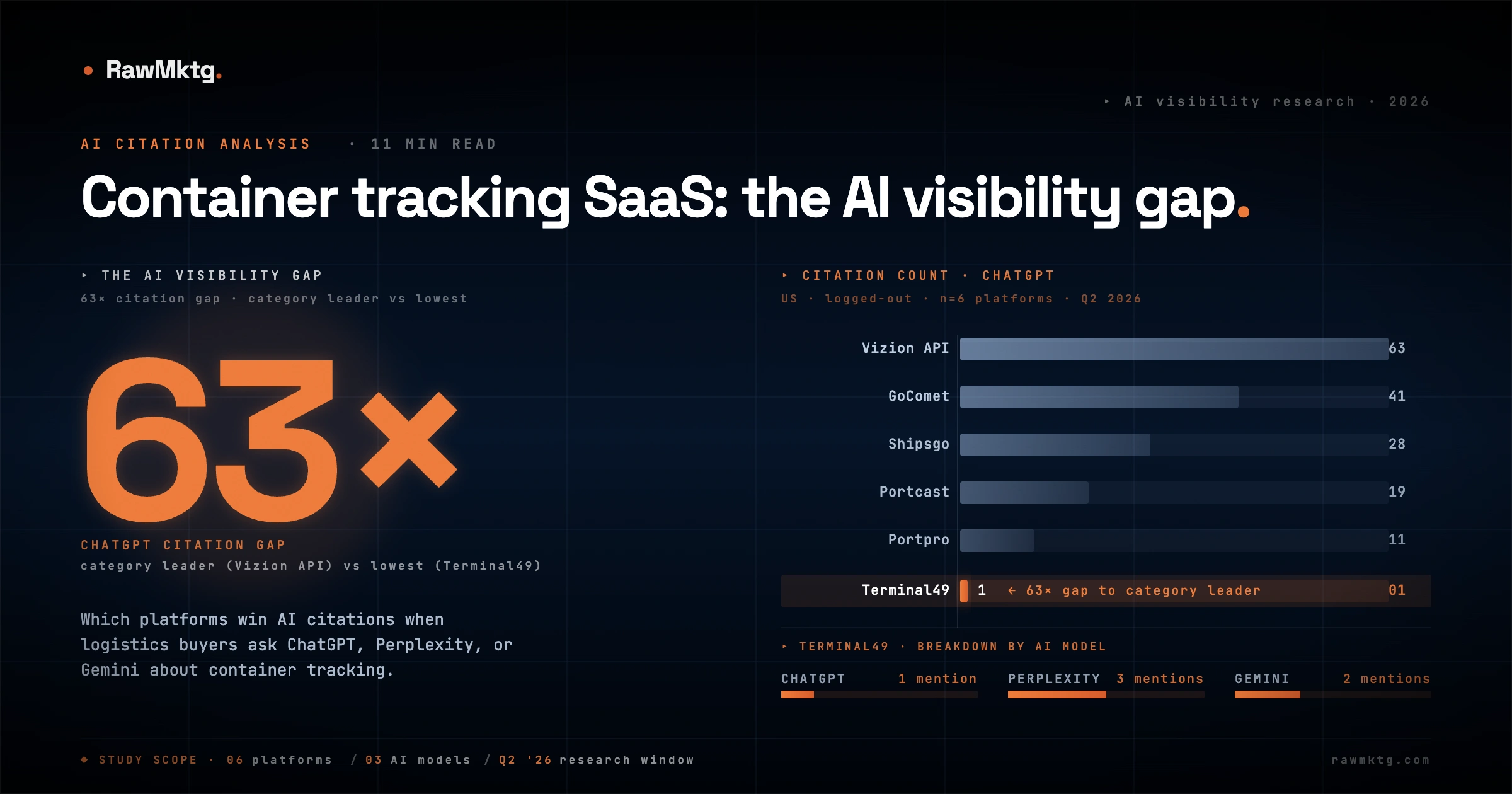
When we measured AI citation counts across the six platforms, tracking how many times each brand appears in responses from ChatGPT, Perplexity, Google AI Overviews, Gemini, and Copilot, the numbers told a story that should alarm every CMO in this space.
Across the peer group, AI citation counts varied by a factor of more than 60× between the leader and the laggard on the ChatGPT dimension. One company in the set had 63 ChatGPT citations. Another had 1.
| Company | ChatGPT Citations | Perplexity Citations | Google AI Overview |
|---|---|---|---|
| Shipsgo | 63 | 121 | 120 |
| Vizion API | 59 | 9 | 37 |
| Project44 | 48 | 9 | 149 |
| Shippeo | 5 | 2 | 137 |
| FourKites | 3 | 1 | 163 |
| Terminal49 | 1 | 2 | 30 |
Table 1. AI citation counts across the six-company peer group, measured across ChatGPT, Perplexity, and Google AI Overview.
When a logistics manager, an importer, or a procurement director types "What is the best container tracking software?" into ChatGPT or Perplexity, and an increasing number of them are doing exactly that, the brands that show up in the answer are being evaluated. The brands that don't show up don't get considered.
The container tracking software market is already a crowded, noisy space where buyers have a lot of options and often struggle to differentiate between them. The companies that are consistently recommended by AI tools are building a compounding awareness advantage that traditional SEO metrics don't capture, and most of their competitors aren't even measuring it.
What Drives AI Citations in This Space?
We looked carefully at which types of content and which types of referring domains correlated with higher AI citation counts. Two things stood out clearly.
First: companies with higher AI citation counts had built structured, use-case-specific content pages that matched the exact questions AI tools are trained to answer. Carrier-specific tracking pages, content covering how to track shipments with individual ocean carriers, appeared to be the single highest-leverage content type in this category.
Second: companies with higher AI citation counts had more referring links from third-party, editorially independent sources. The algorithm that decides what ChatGPT cites is not fundamentally different from the one Google uses to assess authority. It is, at its core, a trust and citation graph. The brands that earn more editorial links from credible sources get cited more by AI, and that pattern held consistently across our peer group.
Finding 2: How concentrated is domain authority in container tracking?
The Domain Rating spread across the peer group we analysed ran from the high 20s to the low 70s. That is not unusual for a B2B SaaS category of this age, but the trajectory data is where things get interesting.
| Company | Domain Rating | Monthly Organic Traffic | Organic Keywords | Ref. Domains | Est. Traffic Value |
|---|---|---|---|---|---|
| Project44 | 72 | 21,940 | 1,729 | 2,988 | $40,300 |
| FourKites | 71 | 16,843 | 747 | 1,962 | $70,100 |
| Shippeo | 56 | 6,577 | 235 | 1,120 | $5,000 |
| Vizion API | 48 | 3,400 | 732 | 2,860 | $2,600 |
| Shipsgo | 41 | 49,772 | 8,263 | 2,305 | $32,800 |
| Terminal49 | 28 | 8,188 | 1,628 | 2,469 | $13,800 |
Table 2. Core organic search metrics across the six-company peer group. Source: Ahrefs Site Explorer, April 2026.
The companies at the top of the DR range have been building their authority profiles consistently for several years. Their referring domain counts are growing. Their high-DR, topically relevant backlinks are compounding. The companies at the lower end of the range are either flat or declining on these same metrics.
What separates a DR 28 company from a DR 72 company in practical terms? In a contested SERP, say, "supply chain visibility software" or "container tracking platform", the higher-DR site does not need to have better content to win. It just needs to be roughly as good. Domain authority is a head start that compounds over time, and it is extremely hard to close quickly.
In a market where the top few search positions capture the majority of buyer attention, this is an existential issue for lower-authority players.
Domain Rating is not fixed. It is a function of the number and quality of unique referring domains, weighted by their own authority and topical relevance. For companies currently sitting with a DR in the 28–50 range, the path to meaningfully improving that number in 12–18 months is clear, it just requires disciplined, sustained execution on topically relevant link acquisition.
Finding 3: Why is every container-tracking site over-indexed on informational traffic?
This was perhaps the most consistent finding across the analysis, and it speaks to a fundamental misunderstanding of how content strategy should work for B2B SaaS.
We categorised the keyword portfolios of each company in our analysis by intent: branded, non-branded, informational, commercial, transactional, navigational. The breakdown was striking across almost every player.
The typical profile looked something like this: 60–70% of organic traffic came from informational keywords. Commercial keywords, terms like "best container tracking software," "supply chain visibility platform," "container tracking solution," or "logistics software comparison", accounted for less than 5% of traffic for most companies in the set, and less than 2% for the worst performers.
| Company | Total Keywords | Branded Traffic % | Commercial / BOFU % | Informational & Other % |
|---|---|---|---|---|
| Shipsgo | 8,263 | 5% | 1% | 94% |
| Project44 | 1,729 | 43% | 6% | 51% |
| FourKites | 747 | 58% | 10% | 32% |
| Shippeo | 235 | 59% | 4% | 37% |
| Vizion API | 732 | 15% | 10% | 75% |
| Terminal49 | 1,628 | 22% | 2% | 76% |
Table 3. Keyword intent distribution across the peer group. Source: Ahrefs Site Explorer, April 2026.
This is a structural problem, not a content quality problem. These companies have invested in building educational content that drives traffic but not in the commercial infrastructure that converts that traffic into pipeline. Their content engines are doing the awareness job. The evaluation job, the content that a buyer reads when they are actually deciding between vendors, is largely absent.
The commercial keyword gaps we identified were substantial. Terms like "supply chain visibility software" (approximately 1,100 US monthly searches), "logistics software" (2,400 US monthly searches), and "freight visibility solution" were either unranked or ranked very low by most companies analysed.
Why Does This Happen?
The pattern we see again and again in B2B SaaS: teams build content for the customers they already have, educational, operational, feature-specific, rather than for the buyers they are trying to acquire: commercial, evaluative, comparison-oriented. Educational content is easier to write, gets more social shares, and feels more like "thought leadership." Commercial content requires more editorial courage and a different production process. Most teams default to the path of least resistance.
Finding 4: What carrier-tracking-page strategy do the winners use?
One of the more specific and actionable patterns we identified was what we are calling the "carrier tracking page strategy."
Several companies in this space, particularly the ones with the highest AI citation counts, have built a library of individual, carrier-specific container tracking pages. Pages targeting searches like "Maersk container tracking," "MSC container tracking," "Evergreen container tracking," "Yang Ming container tracking," and similar queries. These pages are often functional, they actually let users track a container with that carrier directly, and they are SEO-optimised for the specific carrier name plus tracking intent.
The volume on these searches is not trivial. "MSC container tracking" receives approximately 6,100 US searches per month. "Maersk container tracking" receives approximately 3,800. "Evergreen container tracking" receives approximately 3,300. These are not obscure long-tail queries, they are mainstream, high-frequency operational searches from exactly the audience these platforms are selling to.
| Carrier Tracking Keyword | US Monthly Searches | Keyword Difficulty | Approx. CPC |
|---|---|---|---|
| MSC container tracking | 6,100 | 5 | $2.68 |
| Maersk container tracking | 3,800 | 62 | $1.76 |
| Evergreen container tracking | 3,300 | 69 | $2.49 |
| ZIM container tracking | 2,100 | - | $1.73 |
| Yang Ming container tracking | 1,900 | 4 | $6.33 |
| Hapag-Lloyd container tracking | 1,200 | 14 | $2.31 |
| CMA CGM container tracking | 1,000 | - | $1.28 |
| OOCL container tracking | 900 | 1 | $0.15 |
Table 4. Carrier tracking keyword opportunities by US monthly search volume. Source: Ahrefs Keywords Explorer, April 2026.
The companies that have built these pages are capturing traffic at exactly the moment when a buyer is doing the operational work that software like theirs is designed to automate. A shipper manually tracking a container on an MSC vessel is, by definition, a prospect for a container tracking platform.
The companies in this space that have not built these pages are leaving both organic traffic and AI citation footprint on the table, and because their competitors are claiming both, the gap is compounding.
Finding 5: Is container-tracking organic traffic geographically misaligned with the ICP?
This finding was unexpected, and it deserves more attention than it typically gets in B2B SaaS SEO discussions.
Several of the companies we analysed are receiving a meaningful portion of their organic traffic from countries that do not represent their primary commercial market. We saw traffic profiles where 25–35% of visits originated from India, Pakistan, or Southeast Asia, for platforms that primarily sell to North American and European logistics companies and importers.
The reason is relatively straightforward once you look at the keyword data. These companies are ranking for port-specific and terminal-specific tracking queries that are high-volume in those markets, searches related to specific container terminals in Indian ports, Pakistani customs tracking, and regional shipping routes.
The implications for marketing teams are twofold. First, headline organic traffic numbers are misleading in this context. A company reporting 10,000 monthly organic visits may be generating less qualified US commercial traffic than a competitor reporting 6,000 visits, if the second company's traffic is 80% US-based. Second, content that targets these geographically misaligned queries is consuming production budget and link equity that could be directed at US and European commercial keywords with higher pipeline conversion probability.
| Company | United States | India & S. Asia * | Europe | Rest of World |
|---|---|---|---|---|
| FourKites | 87% | 11% | 1% | 1% |
| Project44 | 80% | 4% | 9% | 7% |
| Vizion API | 64% | 19% | - | 17% |
| Terminal49 | 51% | 34% | - | 15% |
| Shippeo | 22% | 8% | 59% | 11% |
| Shipsgo | 10% | 25% | 3% | 62% |
Table 5. Organic traffic distribution by top geography. Source: Ahrefs Site Explorer, April 2026.
Finding 6: Why are container-tracking referring-domain profiles structurally weak?
We pulled the full referring domain profiles for each company in our analysis and categorised the domains by type: logistics and freight media, B2B tech and SaaS research platforms, startup and VC ecosystem sites, job boards, PR wire services, generic tech blogs, and spam. The pattern was consistent: the referring domain profiles in this space are wide but shallow on topical relevance.
Most of the companies we analysed had reasonable total referring domain counts, anywhere from 1,000 to 3,000 unique domains. But when we filtered for domains that a logistics professional would actually recognise and trust, publications like FreightWaves, Supply Chain Dive, Supply Chain Brain, DC Velocity, gCaptain, and Inbound Logistics, the numbers were either very small or zero.
Some companies in the analysis had zero links from every one of those publications. Companies with tens of thousands of dollars a month in marketing spend, selling to an audience that reads those publications daily, with no editorial presence in any of them.
| Publication (DR) | P44 | 4K | Shippeo | Shipsgo | Vizion | Terminal49 |
|---|---|---|---|---|---|---|
| FreightWaves (DR 82) | 21 | 3 | - | - | 5 | - |
| Supply Chain Dive (DR 81) | 9 | 4 | - | - | - | - |
| Supply Chain Brain (DR 79) | 35 | 39 | 3 | - | 7 | - |
| Inbound Logistics (DR 77) | 7 | 20 | - | - | - | - |
| Supply Chain Digital (DR 77) | 21 | 10 | 2 | - | - | - |
| DC Velocity (DR 74) | 1,729 | 209 | 16 | - | - | - |
| gCaptain (DR 74) | 5 | - | - | - | 1 | - |
| Port Technology (DR 70) | 1 | 12 | - | - | - | - |
| Logistics Business (DR 62) | 33 | 136 | 18 | - | 2 | - |
Table 6. Number of linking pages from key logistics and freight media publications. Source: Ahrefs Site Explorer, April 2026.
By contrast, referring domain profiles were often padded with high-DR but zero-relevance links from job listing platforms, generic tech news sites that cover hundreds of software categories, and PR wire services that produce links which Google increasingly discounts.
Why Does This Matter for More Than Just Domain Rating?
Topically relevant referring domains are a qualitatively different type of signal than generic high-DR links. When FreightWaves links to a container tracking platform, it is not just passing link equity, it is signalling to Google's ranking algorithm that this domain is a credible source in the logistics software category. That topical relevance signal affects not just the linked page but the entire domain's authority in that vertical.
The freight and logistics media landscape is also, unlike general tech media, genuinely accessible to B2B companies in this space. FreightWaves, Supply Chain Dive, and their peers actively seek data-led contributions, expert commentary, and product news from companies operating in their coverage area. The companies in our analysis that have earned the most links from these publications have made deliberate, sustained outreach and content contribution a part of their marketing mix.
Finding 7: Is the container-tracking traffic gap accelerating?
The last finding worth highlighting is about direction, not just current position.
When we plotted 12-month traffic trends across the peer group, we saw three distinct trajectories:
- GrowingOne company has added approximately 8,000–10,000 monthly organic visits over the past 12 months, driven by consistent investment in informational content, commercial keyword coverage, and a growing referring domain base. Its authority and traffic curves are both upward.
- VolatileSeveral companies show a traffic profile that peaked around Q4 2025 and has since declined. The December 2025 period saw elevated traffic across multiple players, likely driven by seasonal shipping patterns and tariff-related search activity, but companies without a durable authority base gave back those gains in Q1 2026.
- DecliningAt least one company in the set is in a clear declining trend on organic traffic, despite having a mid-tier Domain Rating. This suggests a content quality or indexation issue that DR alone does not explain.
What are the winners doing differently?
Drawing across all seven findings, the pattern of what separates the highest-performing players from the rest is relatively consistent:
- Content architectureWinners have built content for every stage: educational and definitional content for the top of funnel, use-case and comparison content for the middle, and product-specific and commercial content for the bottom. Laggards have built almost exclusively for the top of funnel.
- Carrier page librariesThe companies that perform best on both organic search and AI citations have invested in building structured, specific pages at scale, carrier tracking pages, port pages, and integration pages, rather than relying on a small number of high-level pillar pages.
- Industry mediaThe top performers have editorial coverage in the publications their buyers read. This is not accidental, it is the result of deliberate, ongoing outreach to freight and logistics journalists and editors.
- GEO strategyThe companies with the highest AI citation counts are producing content that is structured in the way LLMs are trained to cite: clear, factual, specific, well-structured, and supported by credible third-party references.
What This Means for B2B SaaS Companies in Logistics and Supply Chain
Container tracking software is a narrow enough category that the specific findings here are directly applicable. But the broader patterns, the GEO gap, the commercial keyword deficit, the topically misaligned referring domain profile, the carrier-page opportunity, apply to almost every vertical of logistics and supply chain software we have looked at. Our India cross-border payments backlink analysis finds identical adjacent-topic dynamics in a related fintech vertical.
Freight visibility, transportation management, customs brokerage software, warehouse management, procurement automation, freight forwarding platforms, we have looked at several of these spaces and found the same structural patterns. The market is early enough in its SEO maturity that a well-executed 12-month programme can meaningfully change a company's competitive position.
This analysis was conducted by rawmktg. in April 2026 using Ahrefs data, including Site Explorer, Link Intersect, Content Gap analysis, and Brand Radar AI citation tracking. The peer group consisted of six B2B SaaS companies operating in the container tracking and supply chain visibility category. All data reflects Ahrefs estimates as of April 2026.
If you work in logistics technology marketing and want to see how your company's SEO and GEO profile compares to this peer group, get in touch, no pitch, just data.
See where you stand against the peer group
We will pull your Domain Rating, AI citation footprint, keyword intent distribution, and referring domain quality against the benchmarks in this report. Delivered as a clean data brief.
Request the analysis →