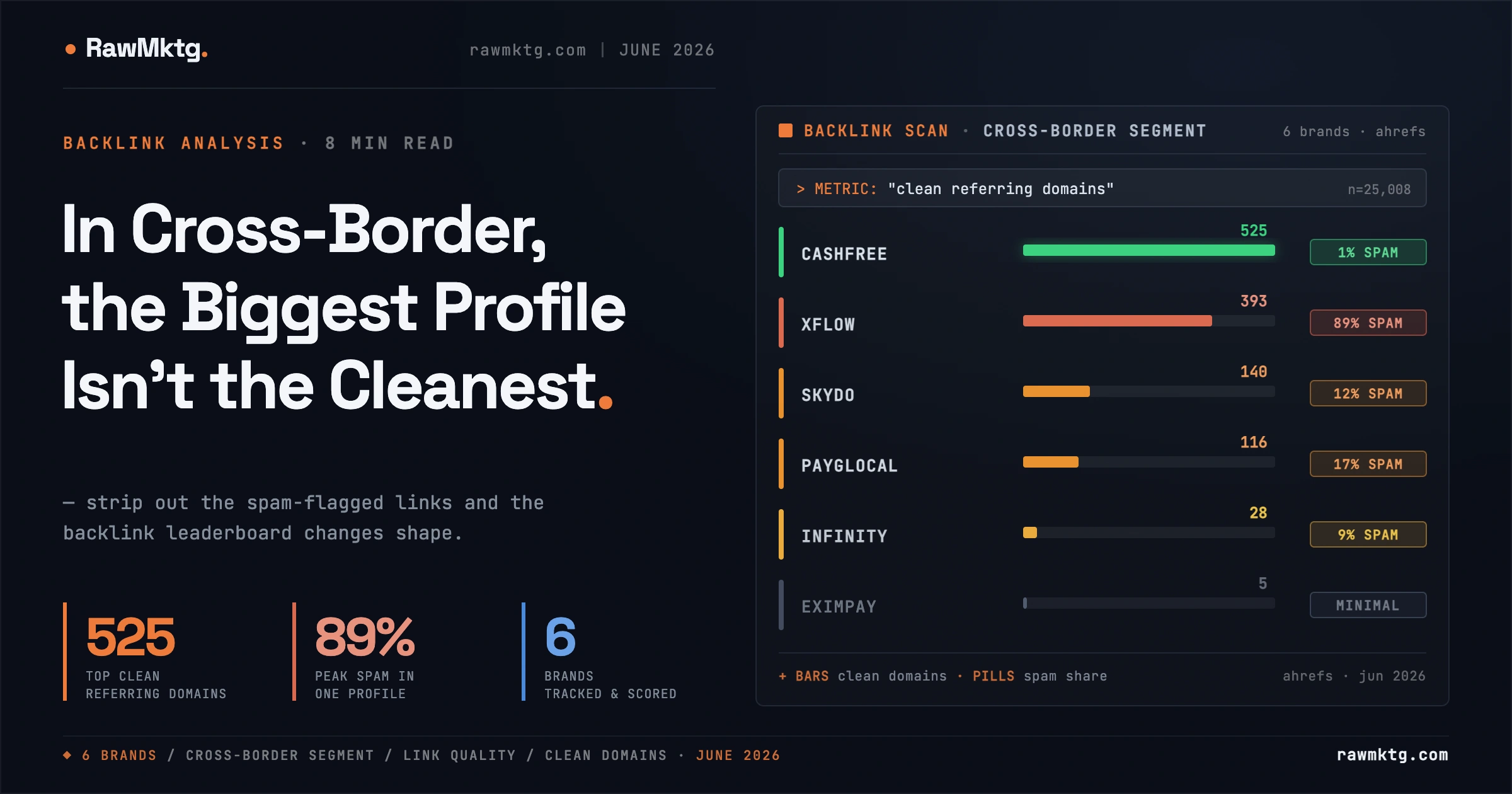
India has quietly become one of the most competitive markets in the world for cross-border payments. A cluster of companies now competes to help Indian exporters, freelancers, startups and platforms move money across borders, and that competition increasingly plays out in content and search visibility as much as in product and pricing. To understand how these brands build authority online, we analysed the full backlink profile of each of six players and classified every link by topic and by quality.
The data comes from six Ahrefs backlink exports captured in June 2026, one per brand, covering every referring page and subdomain Ahrefs has discovered for Cashfree, PayGlocal, Skydo, Infinity, Eximpay and Xflow. Together they span more than 25,000 backlinks. We grouped each link into one of roughly fifteen topics, and separated genuine links from those Ahrefs flags as spam. Two findings stand out: the category earns the majority of its links outside the core cross-border topic, and the quality of those links varies enormously from one brand to the next.
01How should you compare cross-border payments backlink profiles?
| Brand | Backlinks | Clean ref. domains | Spam-flagged | Median DR | Notes |
|---|---|---|---|---|---|
| Cashfree | 14,903 | 525 | 1.5% | 78 | Broad payments and gateway company; largest and highest-authority profile |
| Xflow | 9,179 | 393 | 89.3% | 50 | Large raw footprint dominated by spam-flagged links; clean base is cross-border heavy |
| Skydo | 441 | 140 | 11.8% | 56 | Focused pure-play; links spread across adjacent niches |
| PayGlocal | 280 | 116 | 16.8% | 52 | Cross-border collections; news and fintech leaning |
| Infinity | 79 | 28 | 8.9% | 50 | Small, startup and cross-border leaning |
| Eximpay | 126 | 5 | 9.5% | 7 | Minimal footprint; a handful of low-authority domains |
Fig. 1 · Clean (non-spam) referring domains by brand. Cashfree leads on both volume and authority (median DR 78). Volume is not equity, though: across 41 backlink audits in adjacent segments, only 3.7 percent of the relationships ever formed still pass authority today.
Two things are worth reading carefully here. Cashfree's lead is real and high in quality: 525 clean referring domains at a median Domain Rating of 78, well ahead of the field. Xflow's position is more nuanced. Its raw profile is the second largest by backlinks, but almost nine in ten of those links are flagged as spam, leaving roughly 393 genuine referring domains once the noise is stripped out. The pure-play specialists, Skydo and PayGlocal, run smaller but cleaner profiles in the low hundreds.
02How much do spam links distort cross-border backlink counts?
Fig. 2 · Share of each brand's backlinks flagged as spam by Ahrefs. A high share signals toxic or low-value links that add little genuine authority.
Cashfree sits at the healthy end, with just 1.5% of its links flagged, a profile consistent with steady earned coverage over many years. Skydo, PayGlocal, Infinity and Eximpay cluster in the 9% to 17% range, normal for active link-building. Xflow is the clear outlier at around 89%. The same spam-heavy profile recurs across Indian fintech: in our payment-gateway teardown, about 94% of Airpay's backlinks are flagged as spam.
A spam rate of 89.3% typically points to aggressive low-quality link acquisition or a wave of toxic links arriving from spam networks. For a brand in that position, the practical takeaway is less about earning more links and more about auditing and disavowing the ones already pointing at it, so that its genuine 393 referring domains are not drowned out. The clean links Xflow has earned, concentrated in cross-border payments (164 domains), crypto and Web3 (59) and marketing (38), represent real authority that is currently obscured.
03Which topics actually win links in cross-border payments?
Fig. 3 · Topics ranked by clean referring domains across all six brands. Cross-border (highlighted) leads, but adjacent topics together account for the majority.
Payment-gateway and fintech content (181 clean domains), banking and personal finance (77), e-commerce (74), crypto and Web3 (71), software and developer pages (52), startups (51) and marketing (51) all pull substantial numbers of links. In other words, these companies build authority by showing up across the wider financial-operations conversation, not only in articles with "cross-border" in the title.
This has a practical implication. A brand that publishes only about cross-border payments is optimising for a minority of the available link surface. The category's own link data makes the case for adjacent content more clearly than any content strategy framework could.
04What are the three backlink-profile shapes in cross-border payments?
Cashfree: full-stack breadth
525 clean domains, median DR 78. Strongest clusters: payment-gateway and fintech (135 domains), cross-border (49), e-commerce (43), banking (37) and software (34). Breadth reflects an API-and-integrations business with wide editorial reach.
Specialists: deliberate adjacency
Skydo spreads across cross-border (42), freelancing (20), e-commerce (13) and exports (9). PayGlocal focuses on cross-border (29), payment-gateway (18), banking (13) and news/PR (7). Two brands, two visible strategies, both clean.
Xflow: real authority, hidden by spam
Genuine links tightly concentrated in cross-border (164 clean domains), crypto/Web3 (59), marketing (38) and startups (28). 89.3% spam rate means this authority is largely invisible. Cleanup is a higher priority than new link acquisition.
05Which adjacent topics earn the links?
Freelancing and the gig economy
Independent professionals invoicing overseas clients are a core cross-border audience, and freelancing blogs link readily to payment tools. This is Skydo's second-largest cluster.
| Domain | DR | Links to |
|---|---|---|
| benny.ghost.io | 85 | Skydo |
| docs.xgenious.com | 72 | Cashfree |
| brandignity.com | 71 | Skydo |
| invoiceberry.com | 71 | Skydo |
| kongotech.org | 70 | PayGlocal |
Accounting, tax and compliance
GST, FEMA, FIRC and reconciliation content sits naturally beside cross-border payments, because every inbound payment carries a compliance trail. These pages attract durable, informational links.
Exports, import and trade
Exporters and IT-services firms are central to the category, yet trade and EXIM publications remain comparatively lightly tapped.
| Domain | DR | Links to |
|---|---|---|
| the4.co | 83 | Cashfree |
| cxotoday.com | 76 | Skydo |
| ibsintelligence.com | 74 | Cashfree |
| ecommercefastlane.com | 73 | Skydo |
| 7knetwork.com | 71 | Skydo |
E-commerce and online selling
Direct-to-consumer and marketplace sellers collecting from foreign buyers generate a large pool of links, including marketplace listings and seller-focused pages with very high domain authority.
| Domain | DR | Links to |
|---|---|---|
| apps.shopify.com | 96 | Cashfree |
| commercemarketplace.adobe.com | 96 | Cashfree |
| marketplace.zoho.com | 92 | Cashfree |
| techcrunch.com | 92 | Xflow |
| marketplace.whmcs.com | 91 | Cashfree |
Crypto and Web3
Stablecoin and crypto-remittance adjacency draws links from crypto media. It is a meaningful cluster for some brands, though one to approach carefully given regulatory sensitivity in India.
| Domain | DR | Links to |
|---|---|---|
| hashedem.substack.com | 94 | PayGlocal |
| techcrunch.com | 92 | Xflow |
| cyberpanel.net | 87 | Xflow |
| paybis.com | 76 | Skydo |
| educba.com | 75 | Xflow |
Fintech news and PR
Trade press such as PYMNTS, FF News, The Paypers and IBS Intelligence offers the highest-authority and most repeatable links in the whole dataset, earned through funding announcements and product news rather than written content. The tactical playbook for building this type of off-site authority at scale is covered in Authority Seeding for AI.
| Domain | DR | Links to |
|---|---|---|
| pymnts.com | 88 | Cashfree |
| aramex.com | 79 | Cashfree |
| freepressjournal.in | 79 | Cashfree |
| thepaypers.com | 78 | Cashfree |
| ffnews.com | 76 | Cashfree |
06What This Means for the Category
For marketers and operators in cross-border payments, the data points to two practical conclusions. First, the brands with the most resilient profiles treat compliance, freelancing, exports, e-commerce, startups and trade press as part of one connected story about helping businesses operate globally, the GEO compounding flywheel in action at the content and authority layer. Second, the size of a backlink profile says little on its own. A count of tens of thousands of links can hide a serious quality problem, while a few hundred clean, relevant domains can represent far more genuine authority.
It also suggests where the open ground lies. Several genuinely relevant niches, particularly exports and trade, accounting and compliance, and freelancing, show relatively few referring domains even among the specialists, which means they are far from saturated. The same adjacent-topic pattern appears in our AEC software analysis: brands that restrict content to their core topic consistently rank behind those with broader editorial footprints. And for any brand carrying a heavy spam load, cleaning up the existing profile is likely to do more for visibility than chasing new links.
Which topics generate the most backlinks for cross-border payments companies in India?
Cross-border remittance leads with 266 clean referring domains, but adjacent topics account for three out of every four topical links. Payment-gateway and fintech content (181 domains), banking and personal finance (77), e-commerce (74), crypto and Web3 (71), software and developer pages (52), startups (51) and marketing (51) all generate substantial links. Brands that restrict themselves to cross-border content alone are optimising for a minority of the available link surface.
Why does Xflow have so many backlinks flagged as spam?
Xflow's profile of 9,179 backlinks has approximately 89.3% flagged as spam by Ahrefs, leaving roughly 393 genuine referring domains. This pattern typically points to aggressive low-quality link acquisition or a wave of toxic links from spam networks. For a brand in this position, auditing and disavowing existing spam links is likely to do more for search visibility than earning new links.
How do Skydo and PayGlocal differ in their link strategies?
Skydo (140 clean domains, 11.8% spam) spreads links deliberately across cross-border (42), freelancing (20), e-commerce (13) and exports (9). PayGlocal (116 clean domains, 16.8% spam) concentrates on cross-border (29), payment-gateway content (18), banking (13) and news and PR (7). Both keep profiles clean and reach well beyond the core cross-border topic, but through different adjacent subject choices.
- Source: six Ahrefs backlink exports (referring pages and subdomains), one per brand, captured in June 2026 and together covering more than 25,000 backlinks.
- Spam classification uses Ahrefs' own spam flag. Clean metrics exclude spam-flagged links; spam detection is heuristic and may both over- and under-count.
- Topics were assigned with keyword rules over each link's page title, anchor text, URL and Ahrefs page category, so figures are directional rather than exact; a share of links remain uncategorised.
- Counts use unique referring domains rather than raw backlinks, since one domain can link many times; this is a fairer measure of breadth. A domain active in more than one topic is counted in each.
- Domain Rating (DR) is Ahrefs' 0 to 100 authority score. Backlink data reflects links discovered by Ahrefs and is not a complete census. No brand sponsored or reviewed this analysis.