For technical SEO
Retrieval is the part of AI visibility that is genuinely technical, genuinely measurable, and almost entirely unserved by the tools in this category.
Rendering is the whole problem
Googlebot renders JavaScript. Many AI crawlers do not, or do so inconsistently. A React-driven page that Google indexes perfectly can hand an AI crawler a nav, a footer and nothing else.
We fetch every page twice, raw and rendered, and give you the ratio between them.
Content Visibility Ratio, visible words in a raw fetch divided by visible words in the rendered DOM. Floor for a commercial page is 0.85. This is a number you can take to an engineering team, put in a ticket and re-measure after the fix.
What we check that a general SEO crawler doesn't
AI crawler access specifically
Not just Googlebot. Whether the named AI crawlers are permitted, blocked in robots.txt, or being challenged by your CDN or WAF without anyone noticing.
Section independence
Whether a passage still makes sense lifted out of its page. Retrieval works on chunks, and a chunk full of "as mentioned above" is unusable.
Markup integrity
Heading hierarchy, table framing and structured data as a retrieval system reads them, not as a validator does.
Entity naming consistency
Whether your product is called the same thing across your own site. Inconsistent naming fragments the entity a model is trying to build.
llms.txt, validated properly
Single H1, name-shaped heading, blockquote summary, sectioning, link syntax, whether the descriptions carry facts or adjectives.
Temporal anchors
Whether content states when it is from. Undated pages age badly in a system that weights recency and cannot tell.
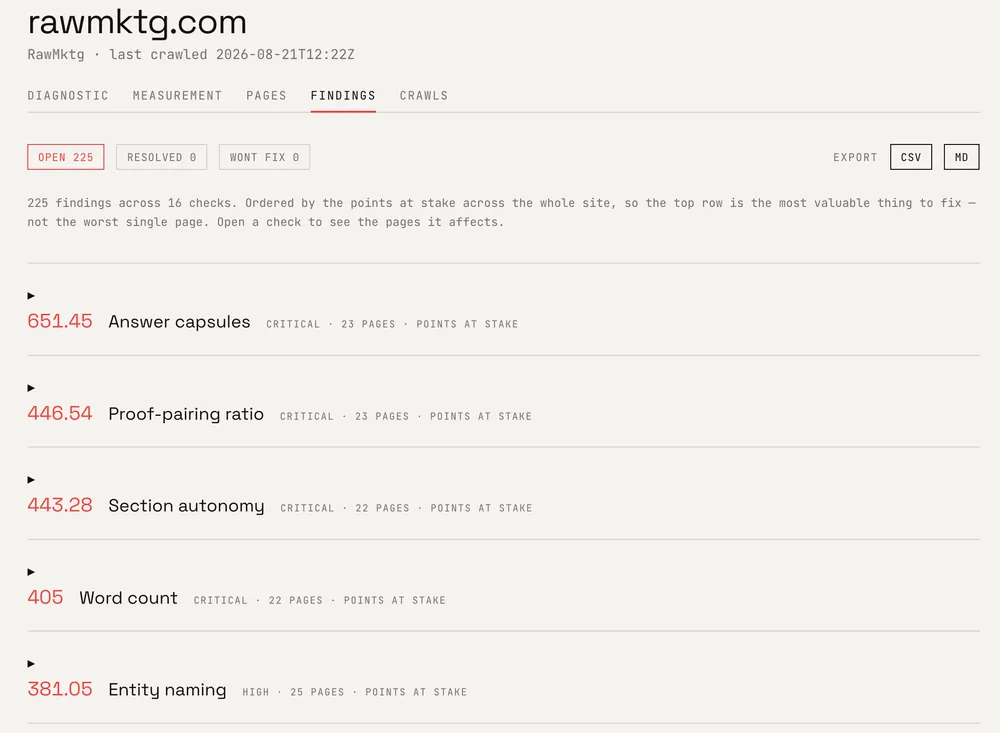
Output that goes straight into a ticket
 Product screenshot
- Every finding names the URL and quotes the evidence, the actual markup or text that failed.
- Generated artefacts: JSON-LD, schema snippets, corrected robots.txt directives, valid llms.txt.
- CSV export with evidence attached, for your tracker or a client report.
- API access on Visibility and Program for findings, pages and rollups.
- Findings persist across crawls, so you can prove a fix landed, and see when one regresses.
Crawling that behaves itself
We respect robots.txt, crawl at a modest rate, and identify our crawler honestly in its user agent. Rendering is used only on the passes that need it, because rendering every page is slow and expensive and mostly unnecessary.
The research: do AI crawlers render JavaScript?, how your page gets retrieved and the broken-sitemap tax.
Measure what a bot can retrieve
Run a free audit and get located, evidence-backed findings you can ticket.